More kids are getting injured on e-scooters

Add Axios as your preferred source to
see more of our stories on Google.
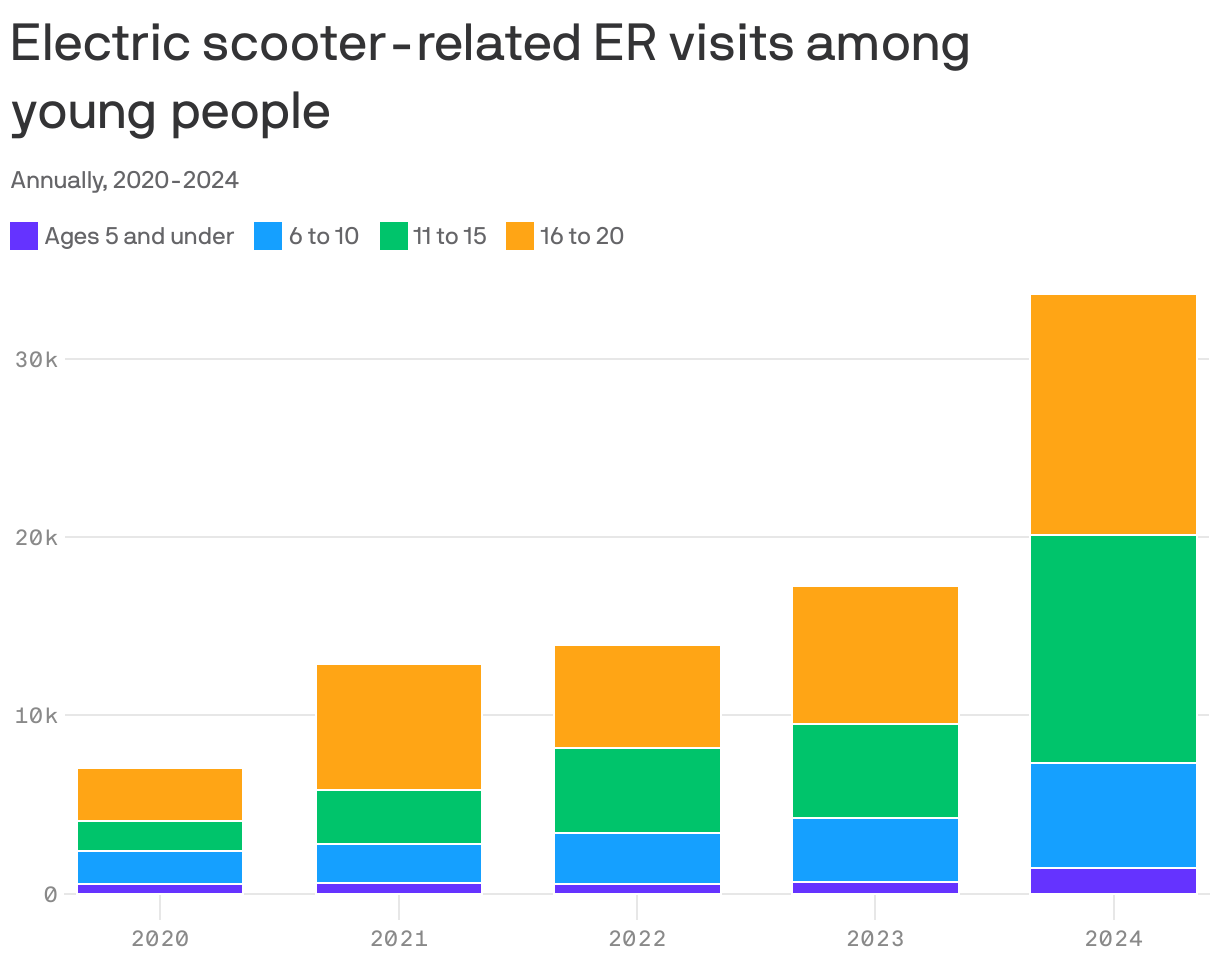
The U.S. is seeing an alarming rise in electric scooter injuries — particularly among children, according to data compiled by ERideHero, a consumer guide to electric micro-mobility.
Why it matters: E-scooters, despite their well-publicized boom and bust history, have become mainstream in many cities, yet lack the safety guardrails that govern other types of transportation.
- People often ride them on sidewalks, for instance, and without helmets.
- Children zip around on adult-sized scooters that go much faster than many parents realize.
The big picture: Some 81 million people took trips on shared e-scooters in the U.S. last year, according to the North American Bikeshare & Scootershare Association.
- Approximately 150,000 shared scooters are deployed across the U.S. on a daily basis.
- Scooters can be a clean, convenient way to travel, but there are also increased risks.
By the numbers: E-scooter injuries in the U.S. rose by 80% to nearly 116,000 in 2024, according to ERideHero's 2025 Electric Scooter Accident Report.
- Accidents among children more than doubled, with nearly 18,000 kids under 15 getting hurt — many suffering head trauma.
- People between 15-24 suffered the most e-scooter injuries, accounting for more than 23%.
- 68% of those injured were male, and over 10,000 injuries involved driving under the influence.
- eRideHero's analysis is based on data sourced from the Consumer Product Safety Commission's NEISS database, which tracks consumer product-related injuries from a sample of over 100 American hospital ER departments.
What they're saying: "The 80% jump in just one year can't be explained by adoption alone," says Rasmus Barslund, founder of ERideHero.
- "I think we're seeing the consequences of treating e-scooters like toys instead of vehicles," he said.
- "We're seeing adult-sized scooters marketed to young kids on Amazon — machines that can reach high speeds being given to children who lack the cognitive development to judge speed and distance safely."
- Plus, he said, there's no safety culture around e-scooters. "We basically put motor vehicles on sidewalks and expected everyone to figure it out for themselves."
The industry is responding with safety tips and other programs.
- Lime, a leading scooter company, for instance, offers an in-person safety course for first-time riders and strongly encourages the use of helmets.
- It also offers a slower-speed "training mode" option to help early riders build confidence.
