Fed's Powell: May be time for another rate cut amid "unusual" job market

Add Axios as your preferred source to
see more of our stories on Google.
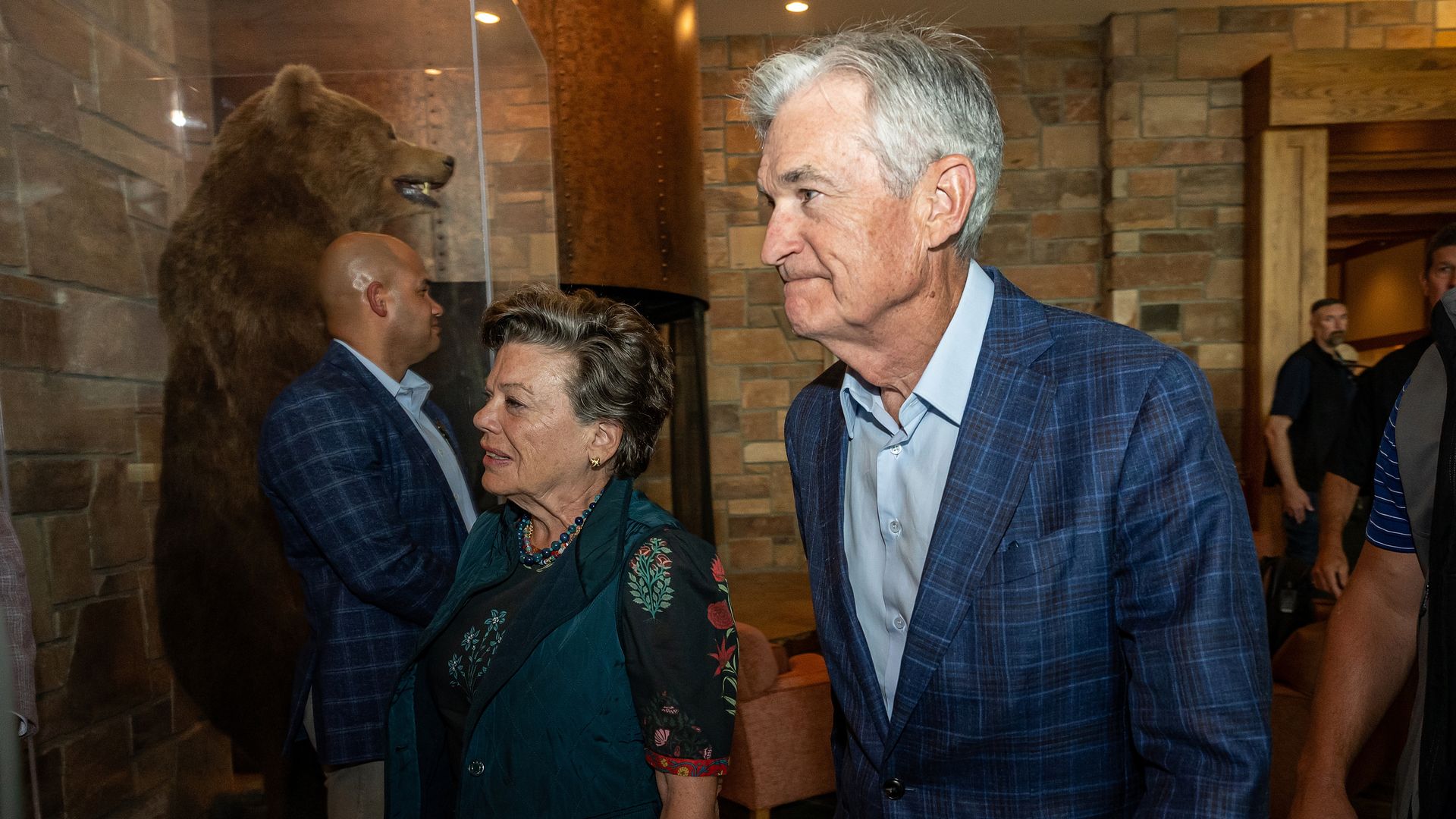
Federal Reserve chair Jerome Powell at the Jackson Hole symposium. Photo: David Paul Morris/Bloomberg via Getty Images
JACKSON HOLE, Wyo. — Federal Reserve chair Jerome Powell opened the door to cutting interest rates in a much-anticipated speech Friday. He didn't fully walk through, though.
The big picture: Powell described a complex mix of forces reshaping the economy, concluding that "the baseline outlook and the shifting balance of risks may warrant adjusting our policy stance," suggesting that a rate cut could arrive as soon as the Fed's mid-September meeting.
- He also said that Fed officials will make their rates decision "based solely on their assessment of the data and its implications for the economic outlook and the balance of risks," which is an implicit rejection of President Trump's calls to lower rates to save the government money.
- "We will never deviate from that approach," Powell said in remarks prepared for delivery at the Kansas City Fed's annual symposium of central bankers in the Grand Teton mountains, often the Fed chief's highest-profile speech of the year.
Driving the news: Powell described the labor market as being in a "curious kind of balance" resulting from both a slowdown in supply and demand for workers.
- "This unusual situation suggests that downside risks to employment are rising. And if those risks materialize, they can do so quickly in the form of sharply higher layoffs and rising unemployment."
- After being introduced in what is likely his final Jackson Hole speech as chairman, the audience — comprised of economists and central bankers from around the world — gave Powell a rare standing ovation.
State of play: Powell also said that the "effects of tariffs on consumer prices are now clearly visible. We expect those effects to accumulate over coming months, with high uncertainty about timing and amounts."
- That is keeping inflation elevated, he said; however, a "reasonable base case is that the effects will be relatively short-lived" as they amount to a one-time adjustment to prices, as opposed to an ongoing inflationary process.
Of note: Powell also unveiled a new longer-term framework through which the Fed will set monetary policy in the years ahead, updating an exercise its leaders last completed five years ago.
- At that time, he noted, worries about the challenges of too-low inflation, and monetary policy being unable to stimulate growth adequately due to the inability to lower interest rates below zero, were paramount.
- The post-pandemic economy, with higher trend inflation and interest rates, created different challenges and hence changes to the Fed's framework.
- In particular, it removed language specifying it would look to mitigate "shortfalls" in employment, changing that to "deviations," to avoid an asymmetric focus on guarding against unemployment relative to inflation.
- Some analysts believe the previous framework contributed to the Fed being late in fighting inflation in 2021 and 2022.
What they're saying: "This year's review considered how economic conditions have evolved over the past five years," Powell said. "During this period, we saw that the inflation situation can change rapidly in the face of large shocks," and interest rates are substantially higher.
The bottom line: In what is very likely his final Jackson Hole speech as chair, and amid stark attacks from the Trump administration, Powell signaled the Fed is open to cutting rates — but only if the data supports it.
Editor's note: This story has been updated with details from the speech.
