What to know about the Home Rule Act and Trump's D.C. takeover

Add Axios as your preferred source to
see more of our stories on Google.
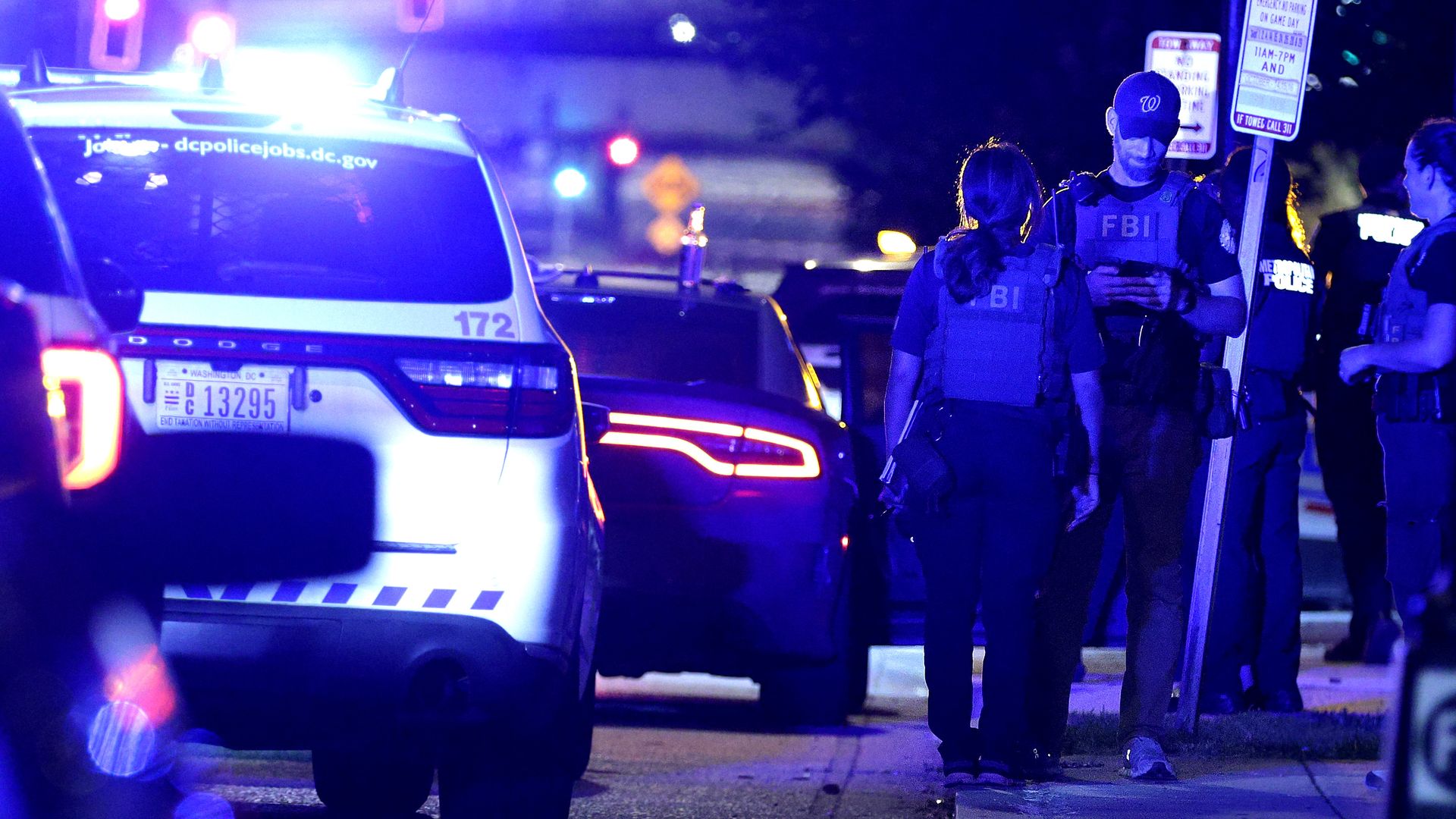
Federal and local law enforcement officers investigate a suspect's vehicle on South Capitol Street on Aug. 11, 2025 in Washington, DC.
President Trump's takeover of the D.C. police began this week, and it's unclear what that control will mean for district residents or how long it will last.
The big picture: Trump's decision to upend the status quo in D.C. isn't without legal merit, as the Home Rule Act gives him the power to do so for roughly a month.
Driving the news: White House Press Secretary Karoline Leavitt said at a press briefing Tuesday that about 850 officers and agents were sent across Washington, D.C., last night and 23 arrests were made during the first night of the federal takeover.
- Photos showed U.S. Drug Enforcement Administration agents patrolling the city and U.S. Border Patrol units are stationed there, too.
- There were also snapshots of the Metropolitan Police Department officers investigating a shooting and federal law enforcement officers gathering at the U.S. Park Police office.
Flashback: Trump first announced plans to federalize the D.C. police force on Monday, saying the city is "totally out of control" (despite a drop in violent crime) and "one of the most dangerous cities anywhere in the world."
- The move prompted protests across the city Monday night and perplexed experts on homelessness and crime.
- Democratic lawmakers from the Washington, D.C., area criticized Trump for the move. Mayor Muriel Bowser called the move "unsettling and unprecedented," but said she wasn't "totally surprised," either.
How the Home Rule Act gives Trump power
The D.C. Home Rule Act allows the district's residents to elect a mayor and some other public officials. The act "is the result of the ongoing push by District residents for control of their own local affairs," according to D.C. Council.
- Section 740 of the act specifically gives the president power to control the D.C. Police in response to "special conditions of an emergency nature" for up to 30 days.
- However, Congress can vote to end the emergency status. It's unlikely this will happen now, since Republicans control both chambers.
- Congress can also vote to extend the emergency powers in a joint resolution.
Worth nothing: This is the first time a president has invoked the provision.
When does Trump's takeover end?
The act points to a 30-day limit. The Executive Order Trump signed said the federal government would maintain control of police "for the maximum period permitted under section 740 of the Home Rule Act."
What they're saying: A White House official told Axios that timeframe is subject to change "consistent with the Task Force's operations."
- Defense Secretary Pete Hegseth said on Fox News Monday that troops could remain in D.C. for weeks or months, but it would ultimately be "the president's call."
- U.S. Attorney for the District of Columbia Jeanine Pirro didn't rule out an extension, either. "I think at the end of 30 days, he will make the right decision as to what he is going to do at that point going forward," Pirro told ABC News Live.
What to expect under Trump's federal takeover of D.C.
Zoom in: Trump's takeover is only two days in, but some of what to expect has already been seen.
- About 800 members of the National Guard will appear on D.C. streets this week. They will work in shifts of 200 for 24/7 coverage, according to The Washington Post, and have "broad latitude," Hegseth told Fox News Monday evening.
- Attorney General Pam Bondi will be in charge of the D.C. police, which has 3,000 sworn members.
The bottom line: Trump has legal authority to takeover the city's police force, but what that ultimately looks like in the coming weeks remains mostly uncertain.
