Lopsided tariffs squeeze U.S. carmakers

Add Axios as your preferred source to
see more of our stories on Google.
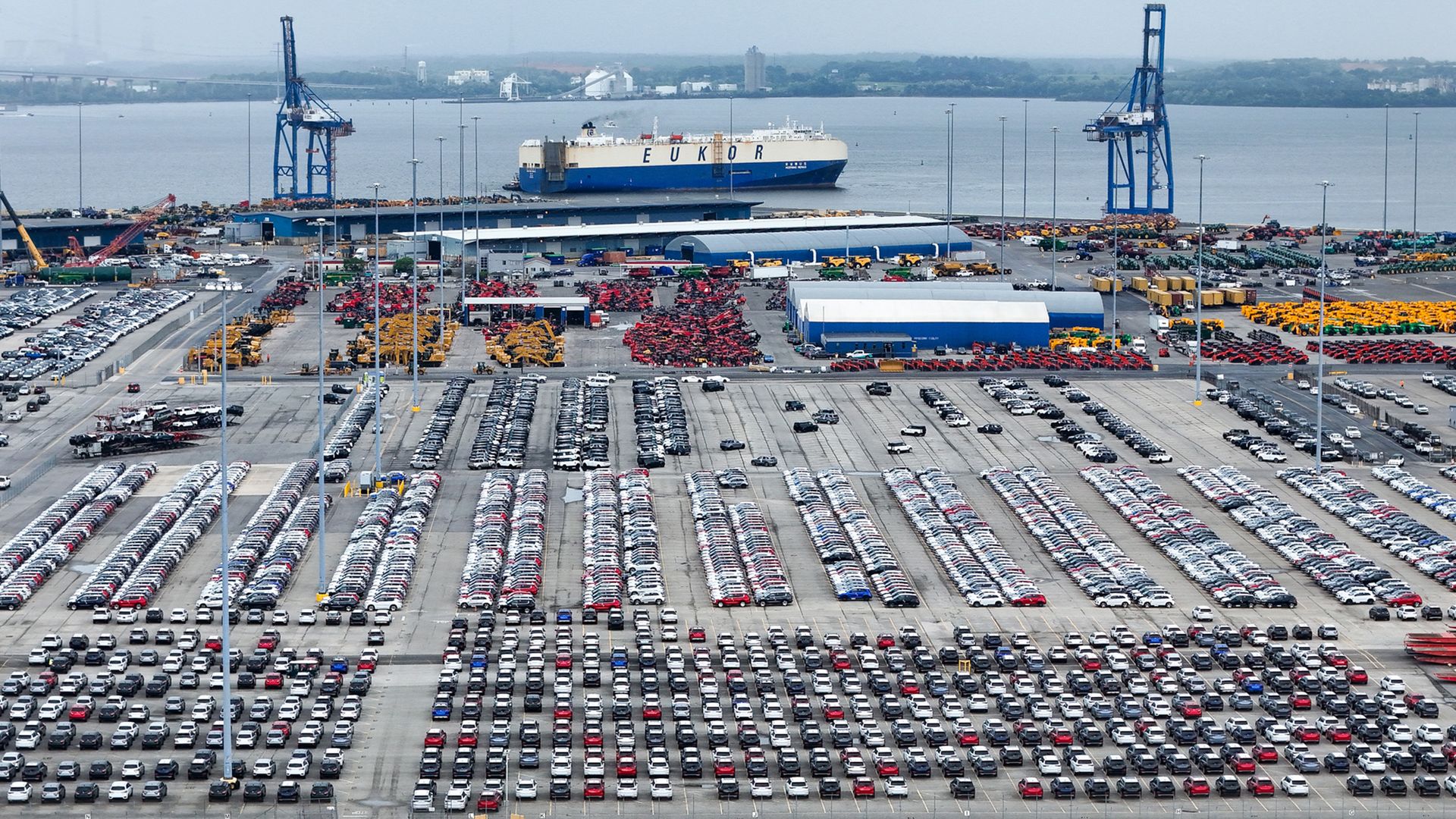
A consequence of President Trump's new trade deals with Japan and the European Union is that they could entice foreign automakers to import even more cars to the U.S. rather than grow their American operations.
Why it matters: Trump's effort to reshape global commerce assumes that punishing tariffs on imports will force foreign manufacturers to set up factories in America, strengthening the U.S. economy.
- But his trade policy conflicts in many ways with those industrial policy goals — for now at least — by making it cheaper to import cars than to build them in North America.
The big picture: That probably won't be the case forever.
- But neither U.S. automakers nor the United Auto Workers is happy about the advantages their competitors have at the moment.
Where it stands: Tariffs on cars imported from Japan or Europe will face a 15% tariff, starting Aug. 1, in lieu of a 25% tax hike the U.S. imposed on all imported vehicles and car parts earlier this year.
- It might seem like a reprieve, but it's still sharply higher than the 2.5% they had been paying before Trump took office.
- U.S.-built cars, by contrast, are taxed 25% on imported parts (except for those that comply with the U.S.-Mexico-Canada trade agreement signed by Trump in his first term). That applies not just to the Detroit 3 carmakers but also to foreign automakers with U.S. plants.
- Plus, they're subject to 50% tariffs on imported steel, aluminum and, soon, copper.
- Cars built in Canada and Mexico, already taxed at 25%, face even higher tariffs beginning Friday. For Canada, the new rate would be 35%; for Mexico, 30%. Many companies build vehicles in Canada or Mexico and ship them to the U.S.
Winners and losers: For now, the winners of Trump's head-spinning trade policies are Japan, the UK and the EU, James Schmidt, vice president-autos for the Oliver Wyman consultancy, tells Axios.
- Losers are the countries still negotiating, like South Korea, Mexico and Canada, as well as U.S. automakers that produce vehicles in those countries. Trump has said tariffs will go up Friday if no deal is reached.
- "It's a big jigsaw puzzle right now," says Schmidt. "The rest of the pieces still have to fall into place."
What they're saying: "U.S. trade policy should push automakers to build in America, with skilled union labor. A flat 15% tariff doesn't accomplish that," the UAW, which previously backed Trump's tough talk on tariffs, said in a statement.
The other side: "No president has taken a greater interest in restoring American auto industry dominance than President Trump, and the Administration is in constant touch with the auto industry to meet this objective," White House spokesperson Kush Desai told Axios.
The bottom line: U.S. trade policy is starting to come into focus, David Steinert, a partner in the automotive and industrial practice at the consulting firm AlixPartners, tells Axios via email.
- "We think there's a good chance that vehicle import tariffs for inside the USMCA will eventually be more favorable than those from the UK, Europe, Japan and Korea (potentially around an average 7.5%)."
