Charging is easier — thanks to Tesla

Add Axios as your preferred source to
see more of our stories on Google.
Two years ago, when we took a cross-country trip in a Kia electric vehicle, finding public charging stations required a lot of advance planning.
- It's a totally different story today now that Tesla Superchargers are open to other EV brands.
Why it matters: Having access to Tesla's nationwide Supercharger network removes much of the charging anxiety associated with long road trips, as my family discovered on our trip.
Flashback: Tesla began opening its proprietary charging network to other brands in 2023, and qualified for lucrative tax breaks in return.
- Initially, non-Teslas needed an adapter, but most brands are now migrating their cars to Tesla's more streamlined plug style.
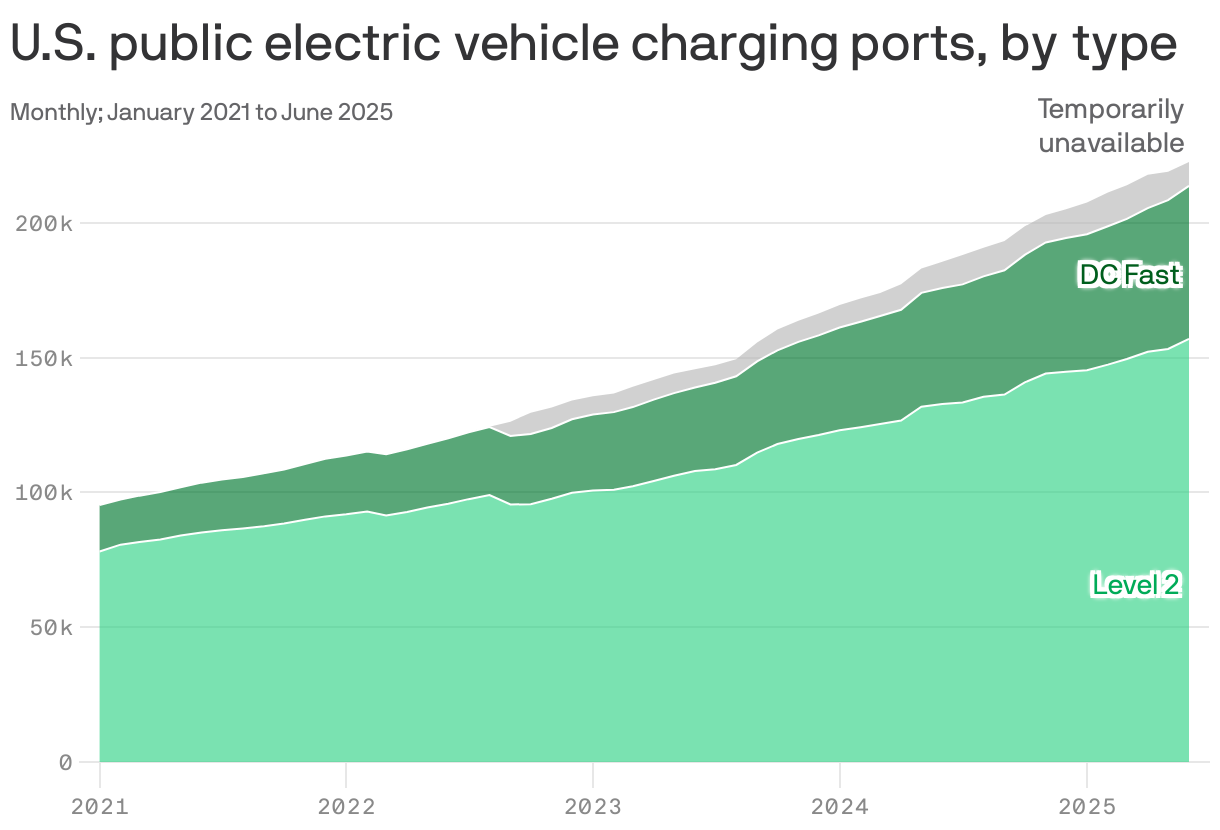
By the numbers: Tesla has roughly 2,700 Supercharger stations in the U.S., with more than 32,000 charging ports, according to a U.S. Department of Energy database.
- Tesla's network alone represents more than half the fast-chargers in the U.S.
- About two-thirds of Tesla locations are currently open to other car brands.
What we found: We had no trouble finding speedy chargers along our 2,200-mile route, which included southern Ontario.
- We stopped to recharge a total of 17 times over two weeks, typically for 20-30 minutes at a time — long enough to use the bathroom or grab a snack.
- We weren't stressed about charging the battery all the way to 100% because we had plenty of range and knew we'd have other opportunities to top off down the road.
Between the lines: We preferred Tesla Superchargers or Rivian Adventure Network locations, when we could.
- Both networks have "plug-and-charge" capability, which streamlines the charging process.
- When you plug the cable into the car, it automatically identifies your vehicle, verifies your account, and starts charging without swiping a credit card or using an app.
- More EVs and charging networks will eventually have this capability.
- Slow-speed Level 2 chargers are pretty useless for a road trip, but at one hotel, we were able to plug in overnight for free, adding 109 miles of battery range over 12 hours at trickle speed.
By the numbers: Charging away from home can be expensive.
- The average price of residential electricity in the U.S. is about 17 cents per kilowatt-hour (kWh), according to the U.S. Energy Information Administration.
- Many public networks charge closer to 56 cents per kWh.
- Some of our sessions cost upwards of $50 — similar to what you'd spend for a fill-up at the gas station.
- In all, we spent $598 on charging.
