U.S. Northeast, Midwest face severe storms, flood threats

Add Axios as your preferred source to
see more of our stories on Google.
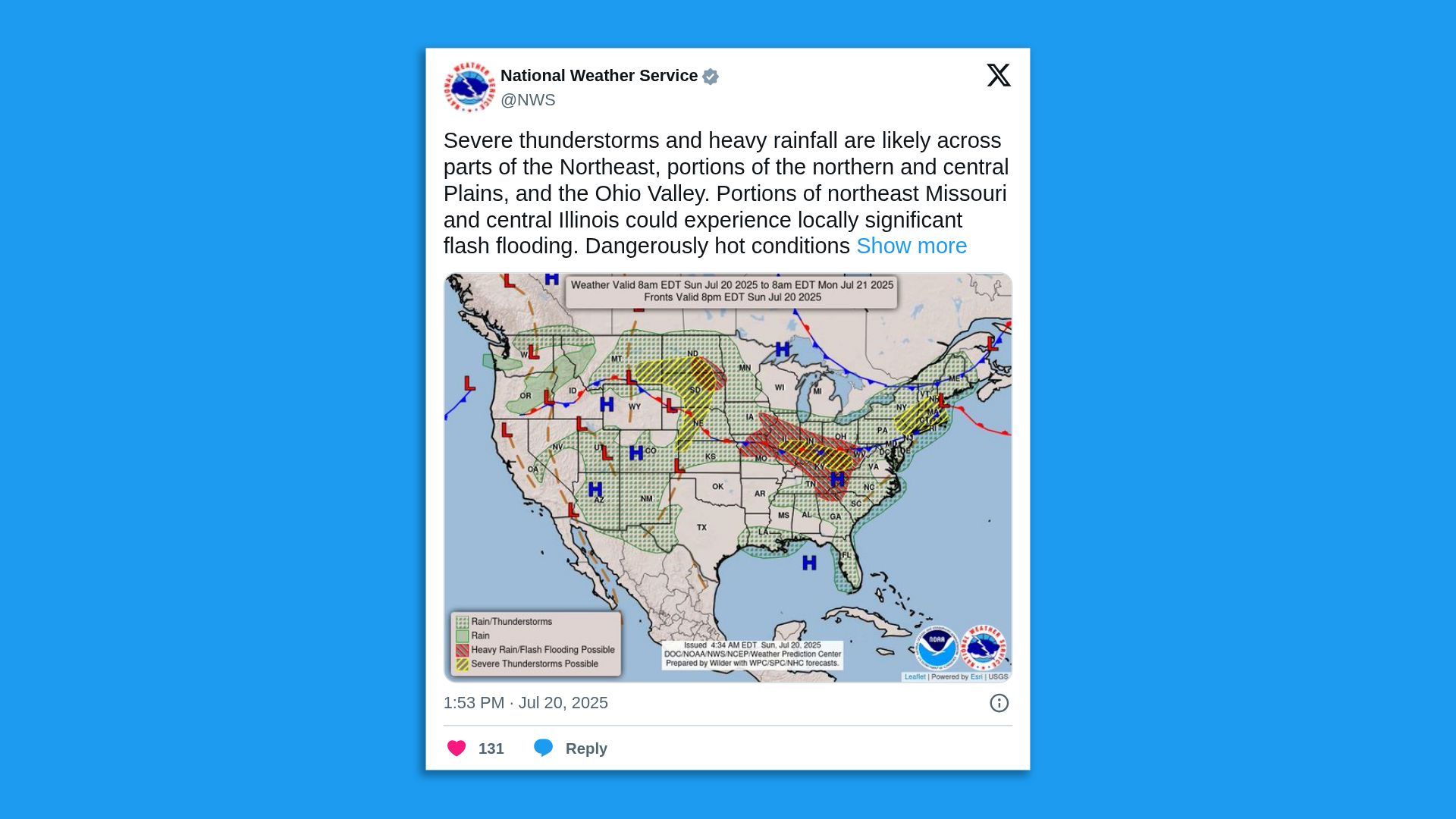
In addition to the flooding threats in the eastern U.S. and Midwest, the National Weather Service warns the Central Plains, Lower and Middle Mississippi Valley, and Southeastern U.S. can expect "dangerously hot conditions." Screenshot: NWS/X
Much of the eastern U.S. and Midwest was facing the threat of severe thunderstorms and heavy rainfall, while heat alerts were issued Sunday for over 50 million people from Kansas to the Carolinas.
The big picture: NOAA's Weather Prediction Center issued a Level 3 out of 4 risk for excessive rainfall over parts of the Ohio Valley through Monday morning, with storms containing 3-4"/hour rainfall rates developing Sunday evening. Forecasters said parts of Missouri and Illinois could see "locally significant" flash flooding.
- "Additional rounds of heavy showers and thunderstorms coupled with locally high rainfall rates and some cell-training concerns will likely promote some additional areas of flash flooding this evening across portions of Kentucky, southern West Virginia and Virginia," the National Weather Service said on X.
Threat level: A severe thunderstorm warning was issued for parts of Iowa, including Des Moines. Severe thunderstorm watches were issued for parts of Connecticut, Maine, Massachusetts, New Hampshire, Rhode Island and Vermont until 9pm Sunday ET and for portions of Montana and North Dakota through midnight local time.
- Per an NWS forecast discussion, there's a slight risk of severe thunderstorms over parts of the Northeast, including New England; the Ohio Valley into the Central Appalachians; and the Northern and Central High Plains on Sunday and parts of the Northern Plains on Monday.
- Tornado warnings were issued Sunday evening for Cincinnati, Ohio; portions of Nebraska; South Dakota and; the Cincinnati-Northern Kentucky International Airport, along with other parts of Kentucky.
- New York, Boston and Indianapolis were among other major cities under threat from the severe weather. The D.C. area could also see isolated thunderstorms, a day after a flash flood emergency was declared in a Maryland region near the city.
Meanwhile, the NWS warned the Central Plains, Lower and Middle Mississippi Valley, and Southeast should expect "dangerously hot conditions."
Driving the news: A cold front over the Northeast to the Ohio Valley was threatening to unleash showers and severe thunderstorms, with the NWS warning potential hazards could include "frequent lightning, severe thunderstorm wind gusts, hail, and a few tornadoes."
- "A quasi-stationary front extending from the Great Basin to the Northern Plains and Middle Mississippi Valley remains quasi-stationary through Tuesday evening," per the NWS.
- "The eastern half of the front, extending from the Mid-Atlantic to the Middle Mississippi Valley on Sunday, will move southward to the Southeast and then extend northwestward to the Middle Mississippi Valley by Tuesday evening," per the agency.
- "Moisture pooling along the front over the Ohio Valley will produce showers and thunderstorms, accompanied by heavy rain."
What we're watching: A building heat dome across central and southeastern parts of the U.S. was expected to impact much of the Midwest by midweek, with peak heat indices of 105 to 115 degrees Fahrenheit expected in cities including Chicago Wednesday and Thursday.
Zoom out: NWS offices have issued a record number of year-to-date flash flood warnings in 2025 — 3,160 flash flood warnings as of last Wednesday, Axios' Alex Fitzpatrick notes.
Between the lines: Research shows climate change is boosting flood risks, as heavy precipitation becomes more frequent and intense, and coastal sea levels are rising.
- Climate change is causing heat waves to become more intense, longer-lasting and more frequent, multiple studies show.
Go deeper: Why flash floods like those in Texas and New York are becoming more common
Editor's note: This article has been updated with new details throughout.
