The data the White House wants you to see


Add Axios as your preferred source to
see more of our stories on Google.
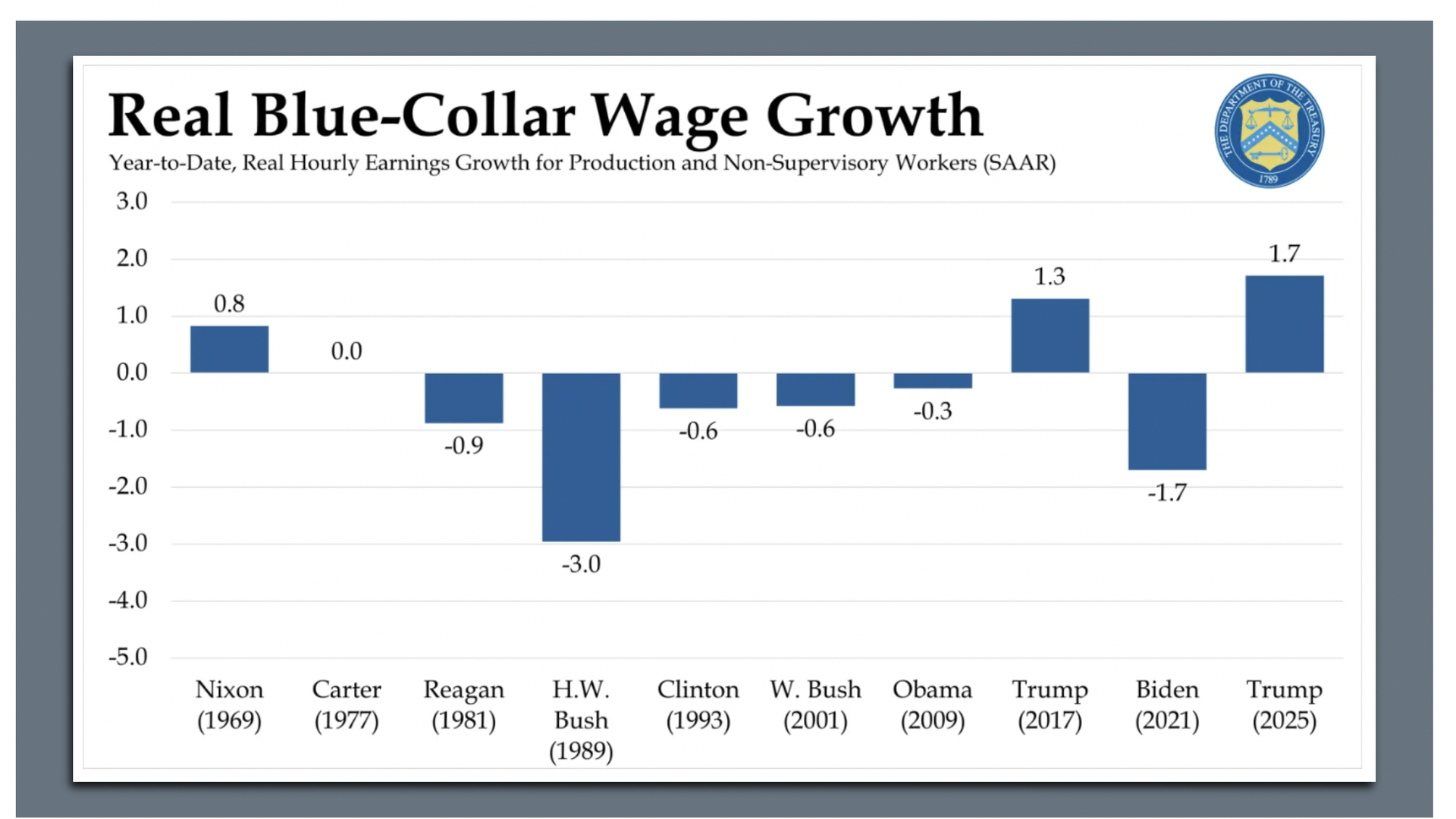
The Trump administration has a new favorite talking point on the economy: That blue-collar wages are rising the most, in inflation-adjusted terms, at the start of a presidential administration in modern history.
The big picture: The data reflect solid wage growth paired with low inflation through the first five months of 2025.
- Fears of a tariff-driven inflation surge cutting into rank-and-file workers paychecks have not materialized thus far.
- But this measure has also shown numerous runs of stronger real wage gains in recent decades, just not at the start of a presidential term. Indeed, there was a stretch of stronger real wage gains by this measure just last year.
Driving the news: The analysis, and chart shown above, was generated by the Treasury Department and has been promoted on the White House website, the president's Truth Social feed, and amplified in certain media.
- "We've seen real wages for hourly workers, non-supervisory workers, rise almost 2% in the first five months," Treasury Secretary Scott Bessent told the New York Post. "No president has done that before."
By the numbers: The data in question is average hourly earnings for production and nonsupervisory workers — a good proxy for private-sector working-class wages — deflated by the Consumer Price Index.
- From December through May, that wage measure rose by 1.7%, comfortably outstripping the 0.9% increase in consumer prices. Treasury converted that improvement in real wages over five months to an annual rate.
- It works out to a 1.7% annual rate of real wage increases, which compares favorably with the first five months of the Biden administration (when inflation significantly outstripped wage hikes), and all other comparable periods in a presidential term dating back at least to Richard Nixon.
What they're saying: "What you've seen is the inflation rate falls significantly and that is what has helped drive this huge increase in real wages," Joseph Lavorgna, a counselor to Bessent, tells Axios.
- He also said the administration's efforts to reduce illegal immigration should lead to higher nominal wage growth for native-born workers.
- "What we should see is faster nominal wage growth because the below-market labor rates that were here before from mass illegal immigration now does not exist," he said.
- "Nominal wages up, inflation down, that makes real wages grow."
Of note: Lavorgna noted that economists who have confidently predicted a surge in tariff-driven inflation have been off base in data released so far.
- "The numbers have just been great, so the forecasting community maybe should have a little bit of humble pie and not act like they know so much," he said.
Yes, but: The 1.7% rate of real wage gain over five months is not particularly extraordinary when you take the presidential politics calendar out of the equation.
- From April through September of last year, for example, this same measure of blue-collar pay rose at a 3.2% annual rate.
- It was also higher for other chunks of Trump's previous term, up at a 3.4% rate in the five months through January 2019, for example.
The bottom line: In the first two years of the Biden administration workers saw nominal pay increases, but high inflation left them worse off.
- In the last couple of years wage growth has outstripped inflation, and the pattern has continued in the first five months of the Trump administration.
