The states where NASA spends the most money on science

Add Axios as your preferred source to
see more of our stories on Google.
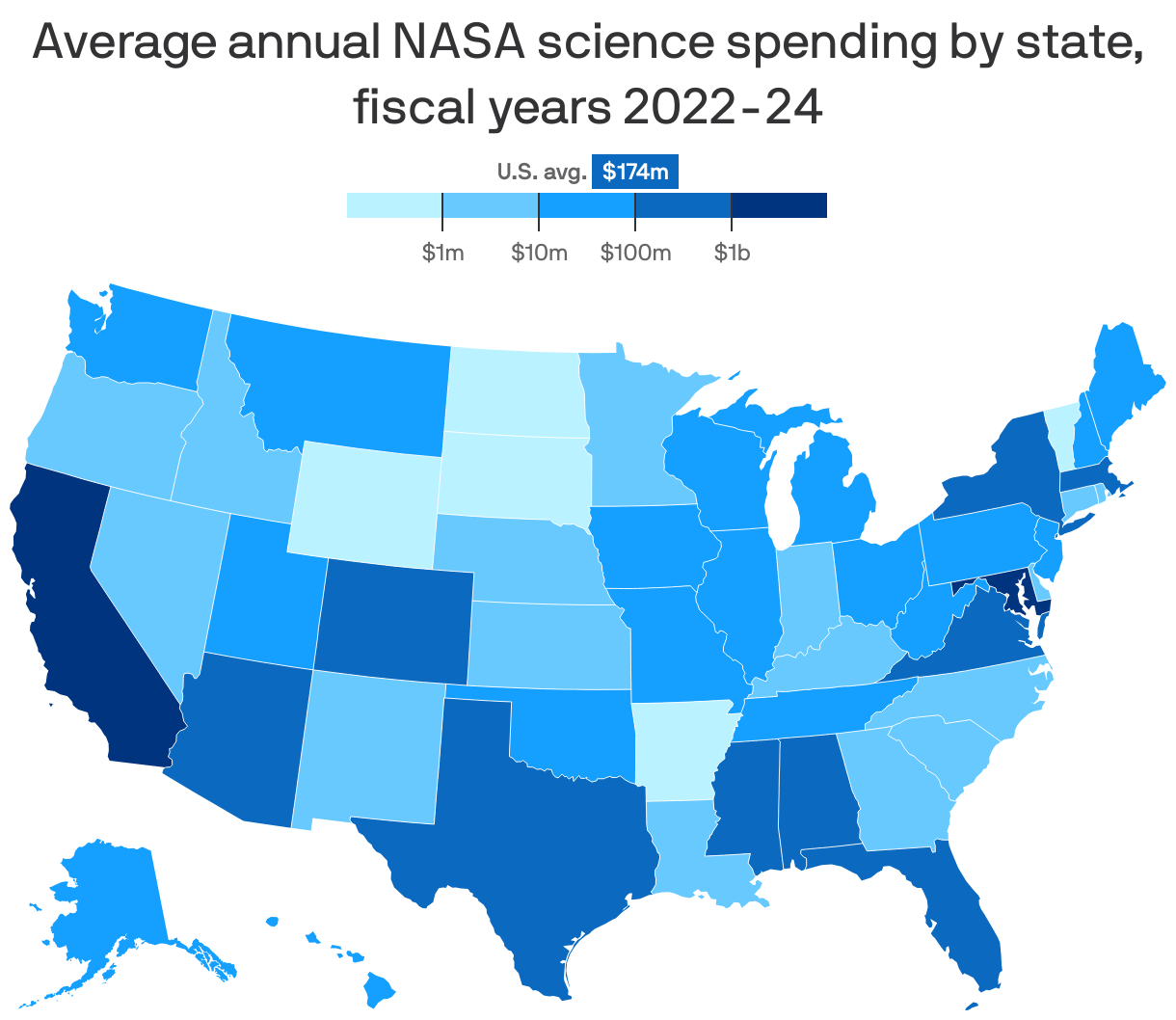
NASA spends hundreds of millions of dollars per state on average annually through its scientific missions, a recent analysis shows.
Why it matters: The space agency's science efforts bear the brunt of the cuts in the Trump administration's proposed budget, down nearly 50% to $3.9 billion.
The big picture: Science represents about 30% of NASA's overall budget and includes missions like space telescopes, robotic probes and satellites that gather data about Earth's changing climate.
- While not always as headline-grabbing as human spaceflight, NASA's science activity has greatly enhanced our scientific understanding of both Earth and our celestial neighborhood.
By the numbers: California (About $3 billion), Maryland ($2 billion), Texas ($614 million), Virginia ($612 million) and Alabama ($586 million) saw the most NASA science spending on average annually across fiscal 2022-2024, per data from The Planetary Society, a pro-space nonprofit.
- Each is home to major NASA facilities, such as California's Ames Research Center and Maryland's Goddard Space Flight Center, which houses the NASA Center for Climate Simulation providing supercomputing resources for climate modeling.
- The numbers represent obligations involving "research grants, contracts and cooperative agreements," the group says.
Zoom in: Missions on the chopping block in Trump's NASA budget include the New Horizons spacecraft (first launched to study Pluto and now in the outer solar system) and Mars Sample Return, an ambitious joint American-European plan to collect Martian soil samples gathered by the Perseverance rover and bring them to Earth for further study.
- Nearly 20 active science missions would be canceled in total, the Planetary Society says, representing more than $12 billion in taxpayer investments.
What they're saying: A chief concern, Planetary Society chief of space policy Casey Dreier tells Axios, is that already paid-for probes and telescopes would be deactivated even though they're still delivering valuable data, wasting taxpayer dollars already spent to launch and run them.
- "This is the part where you get pennies on the dollar return," Dreier says. "They keep returning great science for the very fractional cost to keep the lights on. And a lot of these will just be turned off and left to tumble in space."
Between the lines: Trump's proposed NASA science cuts fit into a broader pattern of pulling resources away from scientific endeavors and data collection, especially involving climate change.
- The White House has also proposed major cuts and culled staff at agencies like NOAA, and is pulling federal funding for climate-related research.
The bottom line: Congress, not the president, sets NASA's budget — but Trump's proposal suggests he believes the agency should be focused on human spaceflight rather than a broader scientific mission.
