Wanted: EV batteries, dead or alive

Add Axios as your preferred source to
see more of our stories on Google.
Battery recycling is one way to secure critical minerals for electric vehicles without getting caught up in geopolitics, but it's not going to break the U.S. of its dependence on China any time soon.
Why it matters: In order to produce new batteries with recycled minerals, you need to collect enough dead batteries to extract those materials.
- Most electric vehicles haven't been around long enough to reach the end of their lives.
- Plus, it turns out that EV batteries last much longer than anyone expected.
- While EV manufacturers typically guarantee the battery for at least eight years or 100,000 miles, evidence shows they'll last as long as 15 or 20 years, according to Recurrent, which tracks EV resale values.
The big picture: A closed-loop supply of recycled battery materials would eliminate the need for additional mining or foreign minerals.
- Redwood Materials is the leader among a handful of companies trying to build that battery ecosystem.
How it works: Redwood takes in batteries from used EVs, as well as phones, electronics and scrap from battery factories.
- Some batteries still have enough life to be remanufactured or reused, such as for backup power at data centers, while others are ready to be recycled.
- Redwood recovers more than 95% of the critical minerals inside — like lithium, cobalt, nickel, and copper — and returns them to the supply chain.
- Last year, it recycled more than 20 GWh of lithium-ion batteries, enough to power 250,000 new EVs.
Yes, but: While Redwood has multi-billion-dollar deals with Toyota and Panasonic to buy its recycled materials, the envisioned market doesn't quite exist yet.
- Most of Redwood's $200 million in revenue last year came from selling intermediate materials, most of which went back into the battery supply chain. Some of these materials were also used in other applications, like graphite for industrial lubricant or gypsum for drywall.
- By early next year, it will begin scaling up production of recycled cathode active material that Toyota, Panasonic and other customers will eventually use to manufacture new batteries.
What they're saying: Already, Redwood is taking in more materials for recycling than it expected, says Dustin Krause, vice president of business development.
- "There's no concern on our side that there's going to be a shortage of material," he tells Axios. "It's going to grow very rapidly."
Here's how Redwood expects things to play out:
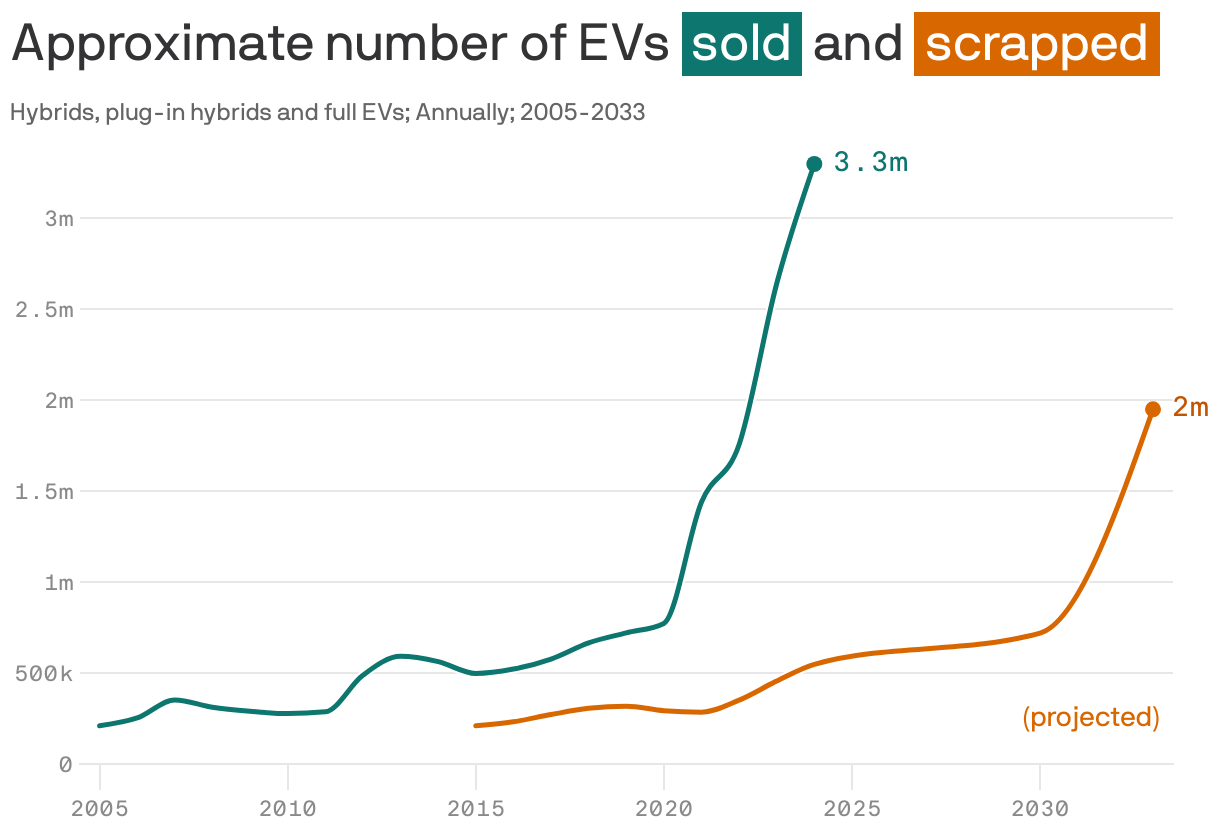
- Vehicles typically last 10-13 years, though some are scrapped early due to crashes.
- Based on EV and hybrid sales trends over the past decade, 700,000 batteries could be coming offline (ready for reuse or recycling) by 2030.
- Nearly 2 million will be ready to scrap by 2033.
The bottom line: It will take years to build enough scale for a circular supply chain, especially if EV sales growth remains muted.
Editor's note: This story has been corrected to show most of Redwood's revenue stemmed from selling various intermediate materials (not from raw minerals).
