Why robots need fences

Add Axios as your preferred source to
see more of our stories on Google.
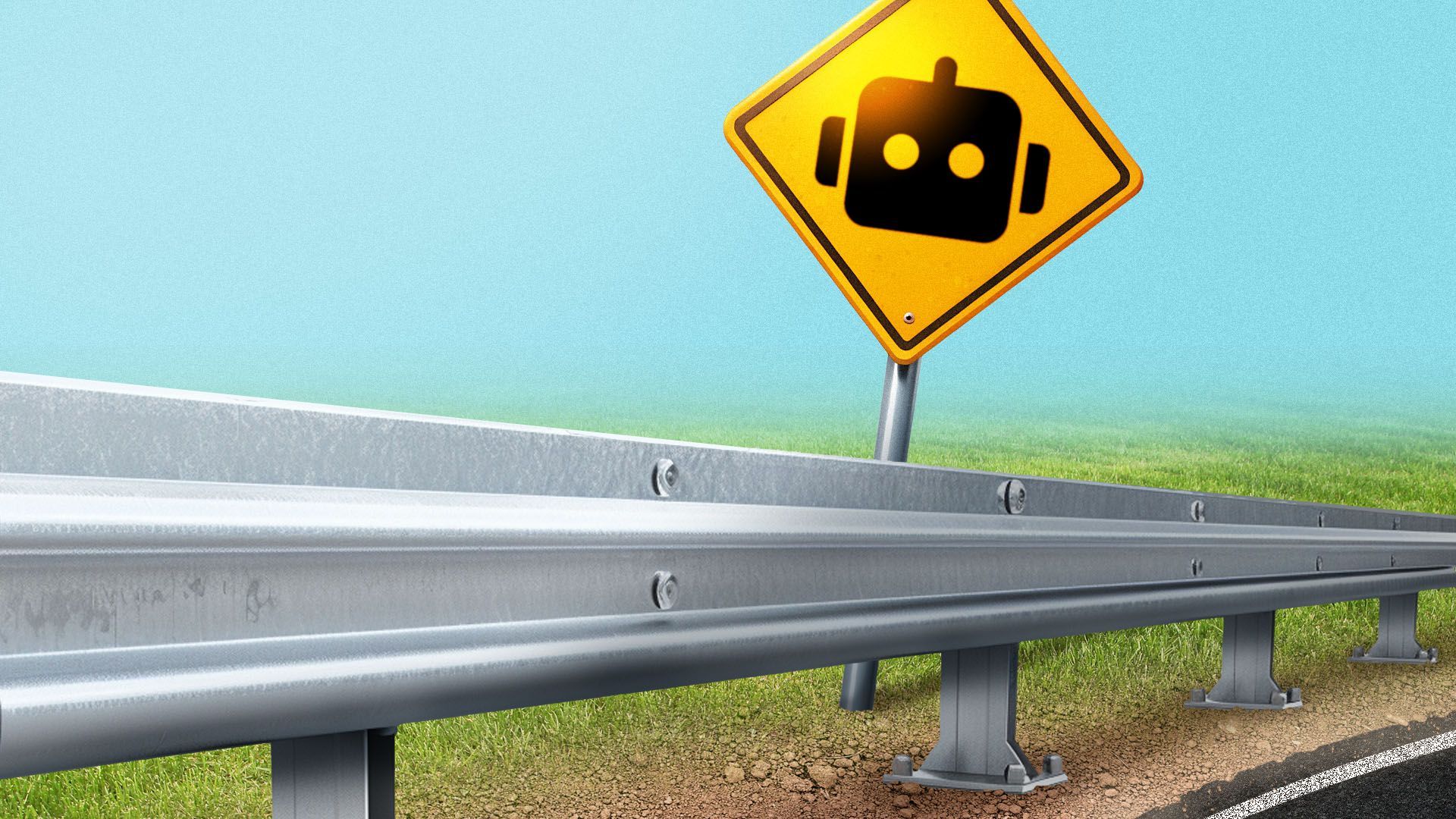
Illustration: Sarah Grillo/Axios
AI-driven creatures — whether they're autonomous vehicles, delivery bots or humanoid robots — aren't ready to be unleashed freely into the wild.
- That's why robotaxis today only operate in certain neighborhoods and humanoids are being tested inside factory cages where they can't hurt anyone.
Why it matters: Unlike chatbots, which can learn to talk simply by scraping information from the internet, AI robots are expected to move fluidly through unstructured environments, communicate with people, manipulate things and make reasoned decisions.
- That's a far bigger challenge that requires tons more training data and real-world experience.
The big picture: Tesla CEO Elon Musk is among the most bullish about how generative AI will reshape autonomy and robotics.
- He envisions 1 million driverless Teslas by the end of 2026 and 1 million Optimus humanoids doing useful work by the end of the decade.
- Tesla is working on a generalized solution for self-driving cars: Instead of coding step-by-step instructions for every street in every city based on high-definition maps, it's using AI to teach cars how to drive virtually anywhere.
- The approach, dubbed AV 2.0, is seen by many as a more efficient — and less expensive — way to develop self-driving vehicles.
Yes, but: It all depends on whether there's sufficient training data available.
- While Musk once scoffed at competitors like Waymo for operating in geofenced areas, he now acknowledges that Tesla's own robotaxi service, coming soon, will need limits.
- "When we deploy the cars in Austin, we are actually going to play not to the entire Austin region, but only the parts of Austin that we consider to be the safest. So we will geofence it," he told CNBC last week.
- "So it's not going to take intersections, unless we are highly confident it's going to do well with that intersection or it'll just take a route around that intersection," he said.
- Eventually, says Musk, Tesla will be smart enough to begin scaling to other cities more rapidly. "These things happen slowly but then all at once," he told CNBC.
The same is true for humanoids.
- Manufacturers are already experimenting with robots that look like humans to sort widgets, lift boxes, or carry parts.
- But until it's safe for them to interact with human workers, those experiments must occur inside cages, explains Melonee Wise, chief product officer at Agility Robotics, maker of a humanoid robot called Digit.
The bottom line: Whether it's a million robotaxis, or a million human bots, they need time — and fences — to learn.
Go deeper: Robot industry split over that humanoid look
