Fed officials called out financial system risks as tariffs stoked sell-off, minutes show

Add Axios as your preferred source to
see more of our stories on Google.
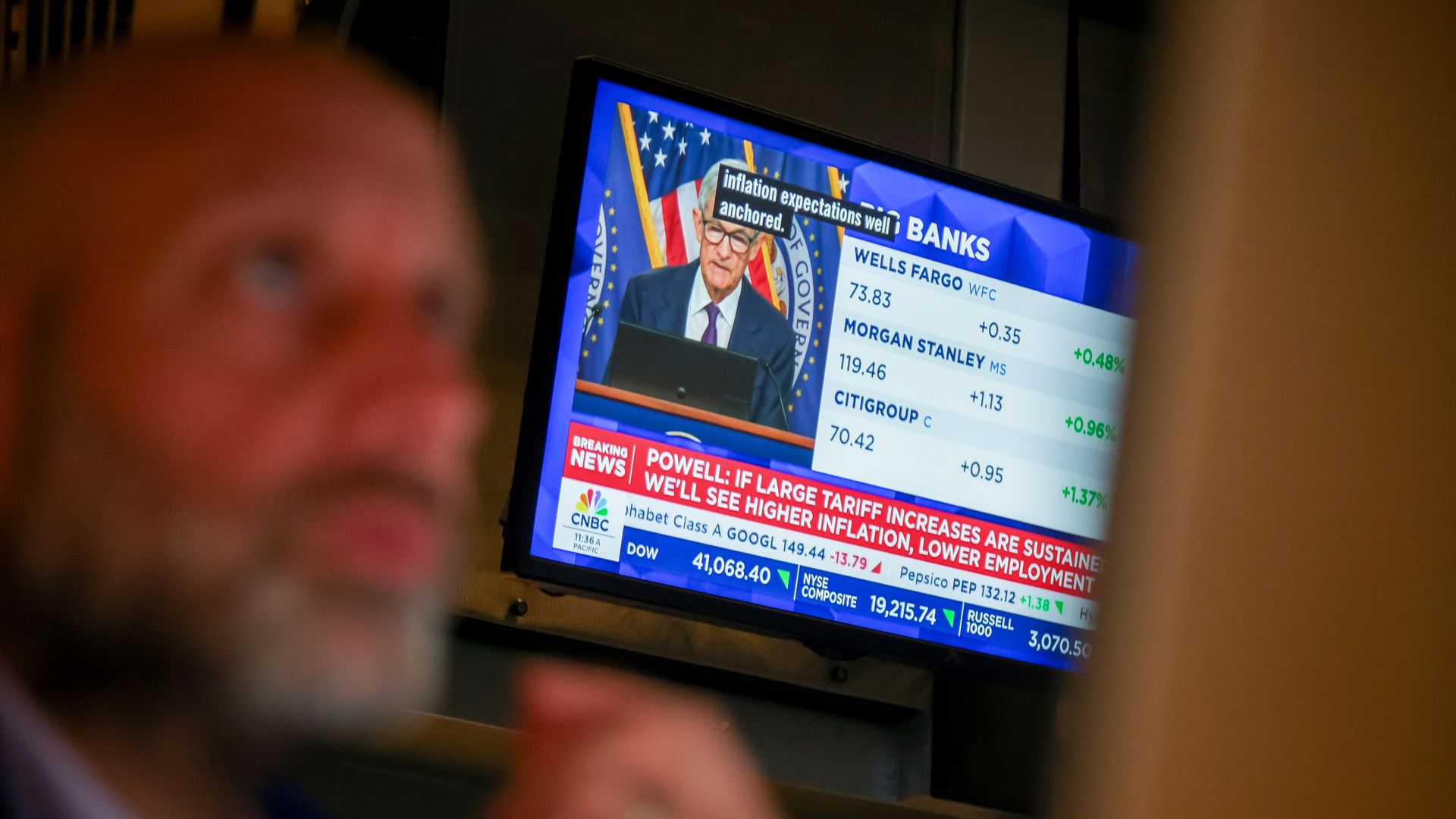
Televisions at the New York Stock exchange show Fed chair Jerome Powell speaking after its interest rate decision earlier this month. Photo: Michael Nagle/Bloomberg via Getty Images
Some officials at the Federal Reserve warned about "vulnerabilities to the financial system" as President Trump's trade war caused sharp swings in stock and bond prices, minutes from the central bank's May 6-7 policy meeting show.
Why it matters: The central bank said the heightened volatility could cause market stress that would expose underlying concerns about the financial system, while noting that a so-called Sell America trade could take a toll on the economy.
What they're saying: "In their discussion of financial stability, participants who commented noted vulnerabilities to the financial system that they assessed warranted monitoring," according to the minutes released on Wednesday.
- The Fed noted "heightened volatility" seen in April, though officials pointed out that markets "had continued to function" despite a surge in trading volumes.
- "Some participants mentioned high levels of leverage at hedge funds or potential concerns about private credit and equity," the minutes say.
The intrigue: Some officials called out last month's unusual mix of financial market conditions, which saw rising borrowing costs and the U.S. dollar depreciating, alongside falling stock prices.
- It's a combination that suggested investors might be losing faith in the U.S. as home to the world's safest assets.
- "These participants noted that a durable shift in such correlations or a diminution of the perceived safe-haven status of U.S. assets could have long-lasting implications for the economy," according to the minutes.
What to watch: The stock market has recovered since officials gathered earlier this month, but at the time some Fed officials questioned the extent of asset price declines as trade tensions appeared to be ratcheting up.
- "While noting that asset prices had declined somewhat, several participants observed that downside risks to the outlook had increased, leading them to question whether asset prices had actually gotten closer to fundamental valuations," the minutes show.
- Several Fed officials noted that while households, banks and other corporations looked to be in solid shape, "an economic downturn or higher interest rates could lead to a deterioration in those conditions," the minutes show.
State of play: The Fed kept interest rates steady for the third consecutive time earlier this month, though it warned about inflation and economic effects from tariffs.
- "Participants observed that there was considerable uncertainty surrounding the evolution of trade policy as well as about the scale, scope, timing, and persistence of associated economic effects," the minutes show.
- The central bank decision came days before the Trump administration said it would reduce tariffs on Chinese imports to 30% from triple-digit levels for 90 days.
- In the days since, top Trump officials have signaled imminent trade deals as the clocks runs out on the 90-day pause on "Liberation Day" reciprocal tariffs, while threatening steep tariffs on Europe.
