Trump administration can't yank foreign students' visas, judge says

Add Axios as your preferred source to
see more of our stories on Google.
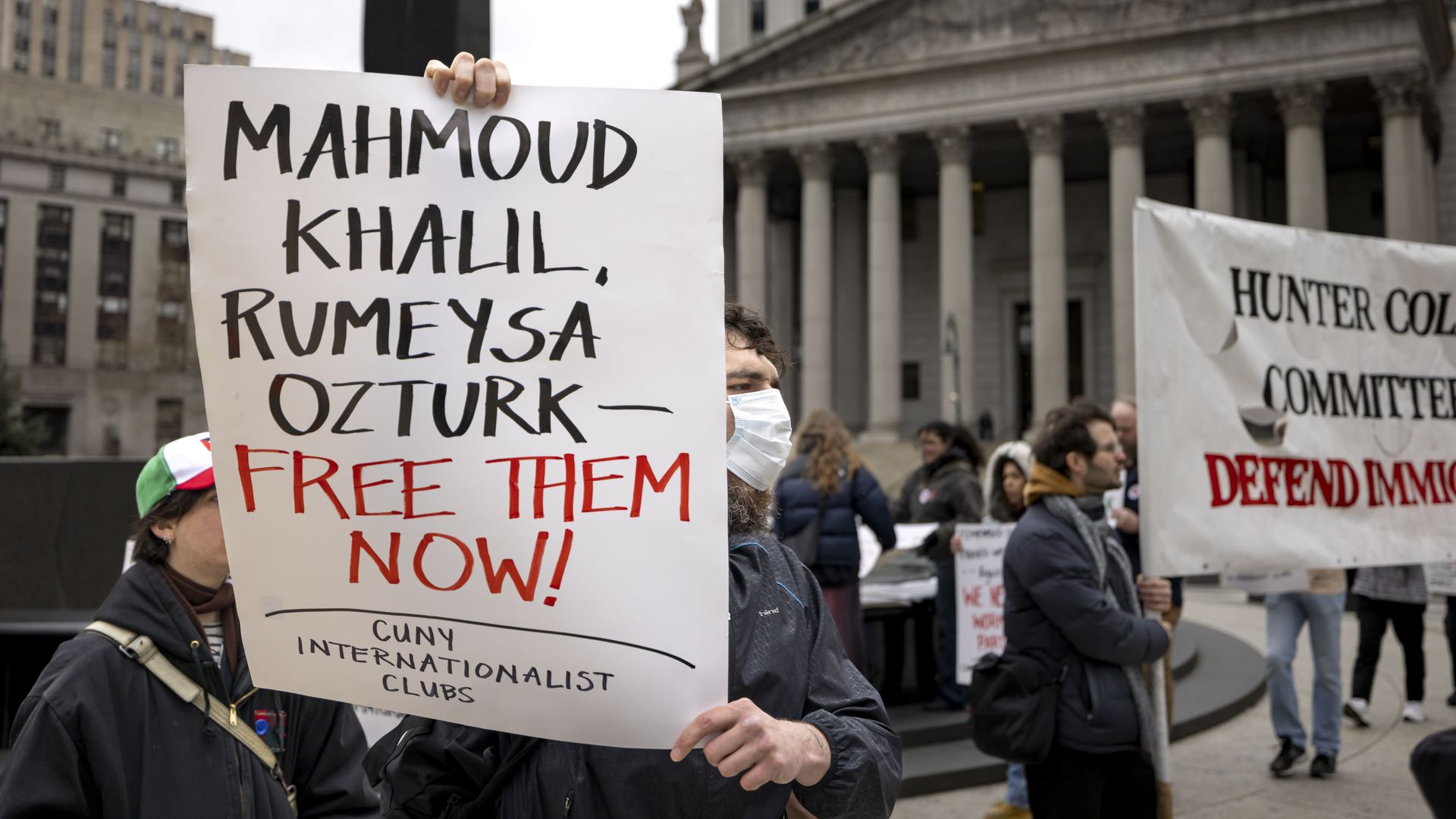
Students and faculty from the City University of New York hold a rally supporting international students who have had their visas revoked by the Trump administration. Photo: Michael Nigro/Pacific Press/LightRocket via Getty Images
Foreign students studying at American universities scored a legal victory Thursday when a federal judge barred the Trump administration from revoking the students' legal status while their lawsuit proceeds.
Why it matters: The temporary injunction bars immigration officials nationwide from arresting or detaining the students while the court resolves lawsuits challenging the administration's efforts to revoke F-1 student visas.
- The injunction comes the same day the Trump administration targeted Harvard's ability to enroll foreign students.
Catch up quick: The administration had claimed that many of the students whose visas were revoked had committed crimes. However, Judge Jeffrey S. White of the Northern District of California said in his order many of the plaintiffs before him had committed no crimes.
- The students' contact with police included incidents such as one with a plaintiff who had "unknowingly enrolled in a university set up by the federal government as a sting operation" and another with a student who had not taken sufficient college credits to maintain their student status.
- "Defendants do not suggest that these individuals pose an immediate safety threat or that they pose a threat to national security," White said.
What they're saying: White said the nationwide injunction is necessary to ensure that the federal government doesn't attempt to revoke the students' status by other means.
- "It is unclear how this game of whack-a-mole will end unless Defendants are enjoined from skirting their own mandatory regulations."
In another veiled shot at the administration, White made clear the right to due process is afforded to everyone, not just American citizens.
- "Plaintiffs allege Defendants violated the Due Process clause of the United States Constitution," he wrote. "Lest any Defendant be unsure, that clause 'applies to all 'persons' within the United States, including aliens, whether their presence here is lawful, unlawful, temporary, or permanent.'"
- Several members of the Trump administration have complained recently about how due process is inhibiting their ability to deport immigrants.
- "To say the administration must observe "due process" is to beg the question: what process is due is a function of our resources, the public interest, the status of the accused, the proposed punishment, and so many other factors," Vice President JD Vance bemoaned recently on X. "To put it in concrete terms, imposing the death penalty on an American citizen requires more legal process than deporting an illegal alien to their country of origin."
The other side: "Today's ruling delays justice and seeks to kneecap the President's constitutionally vested powers under Article II," said Department of Homeland Security assistant secretary Tricia McLaughlin said in an emailed statement Thursday evening.
- "It is a privilege, not a right, for universities to enroll foreign students and benefit from their higher tuition payments to help pad their multibillion-dollar endowments; that fact hasn't changed," she added."
- "The Trump administration is committed to restoring common sense to our student visa system, and we expect a higher court to vindicate us in this. We have the law, the facts, and common sense on our side."
Editor's note: This article has been updated with comment from DHS Assistant Secretary Tricia McLaughlin.
