Tariff math leaves retailers very little choice on prices

Add Axios as your preferred source to
see more of our stories on Google.
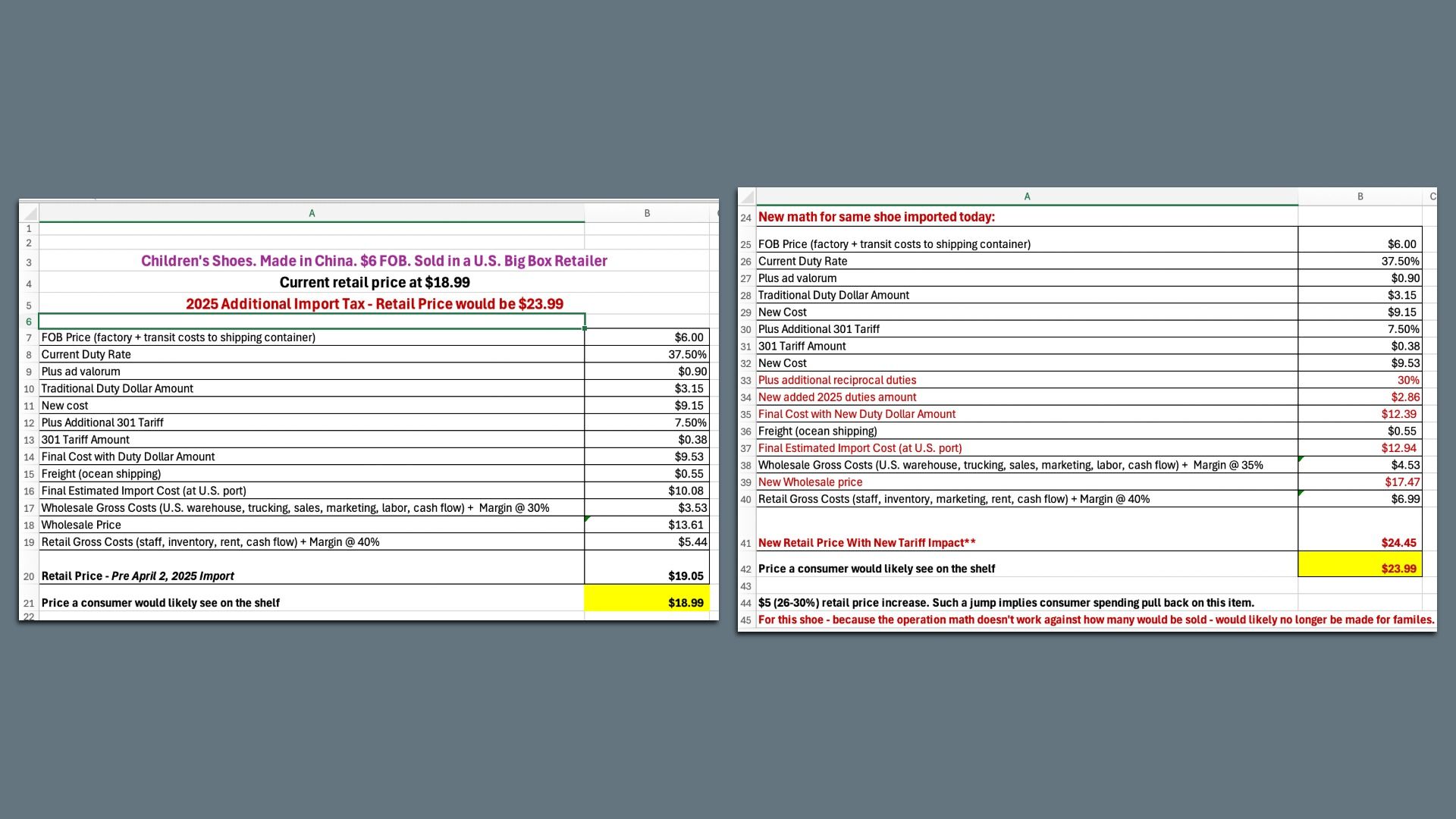
Source: Footwear Distributors and Retailers of America
A spreadsheet making the rounds in Congress illustrates the stark tariff-era math for America's retailers, leaving them with two options: hike consumer prices or risk a cash crunch that threatens their survival.
Why it matters: The numbers, an illustrative example produced by a footwear trade association, show that many importers of consumers goods from China can't make the math work, even after the reduction in tariff rates from 145% to 30%.
- Given typical margins in these industries, importers can only eat so much of the tariff costs before they hit a cash flow crisis that leaves them short on the capital necessary to import the next batch of goods.
The big picture: It's a warning for the economy and consumers in the months ahead if the high tariff rates stick. Many retailers will likely have few choices but to hike prices.
- But there is no guarantee that shoppers will keep buying, resulting in a negative feedback loop: less cash to hold on to staff and bring in goods from overseas. At a large enough scale, it means layoffs and shortages.
State of play: The spreadsheet shows the financials of a hypothetical retailer that sells children's shoes sourced from China, mocked up by the Footwear Distributors and Retailers of America, and updated to reflect the recent trade truce.
- The math — which the trade association said it checked with industry CFOs — was intended to show the dire financials that explain how the price of the shoes sold at a big box retailer would have to jump, even with the slimmest of margins necessary for a small profit, payroll, rent and more.
By the numbers: A pair of $19 children's shoes sold at a big box retailer would rise to $24. In isolation that may be manageable to consumers, but it would coincide with similar hikes on a broad range of imported goods.
- "For most working class families shopping in big box stores, this price is too high," the spreadsheet says, warning that a consumer then "doesn't purchase or delays purchase for kids."
- The group said the math doesn't make sense for how many of those shoes would likely be sold — meaning they ultimately may no longer be sold at all.
Zoom in: The typical retailer faces roughly $3 in higher costs at the border with the additional 30% tariff — an amount that spikes to almost $300,000 in additional capital for an order of 100,000 pairs of shoes.
- If retailers can secure a loan for the additional costs, borrowing costs would be steep. Banks may be reluctant to lend money for a tax that is higher than the value of the actual good.
- The next option: cutting costs — perhaps even payroll — to make up the cost as best they can.
"Retailers are saying, 'We're at the point where there's no more fat to trim. There's nowhere left to eat these costs,'" Andy Polk, FDRA's senior vice president, tells Axios. "The math simply no longer works."
- Polk says the impact will likely hit in the summer months, when retailers roll through pre-tariff inventory — right before back-to-school shopping season.
- "When Congress is on August recess, costs will be increasing, and people might have problems finding their sizes in certain shoes they may want," Polk says.
The other side: The Trump administration has argued that the tariffs will help fuel a rebirth of U.S. domestic manufacturing and that Chinese exporters will shoulder a meaningful share of the burden.
The macroeconomic fallout
Top economic officials are waiting to see whether the tariff fallout results in higher inflation, a labor market slowdown — or a stagflationary combination of both.
- "A lot of the tariff impact today has actually not shown up in the numbers yet," Atlanta Fed president Raphael Bostic told reporters yesterday in Florida.
- "There's been a lot of front-running, building inventories and all those sorts of things," Bostic adds, strategies that have masked the impact of tariffs from consumers.
Between the lines: Many businesses are running down inventories stocked up before tariffs took effect. Now they are in wait-and-see mode, though time is running out, Bostic says.
- "What we are hearing from an increasing number of businesses is that those strategies are starting to run their course — and so the ability to wait and just hold might be declining," Bostic said.
- "If these pre-tariff strategies have run their course, we're about to see some changes in prices — and then we're going to learn how consumers are going to respond to that," Bostic said.
The bottom line: Bostic says that "consumer balance sheets are not as strong as they were collectively three or four years ago," meaning consumers may not be as willing to accept higher costs as they have been in recent years.
