Ionna EV charging network aims to raise the bar on Tesla

Add Axios as your preferred source to
see more of our stories on Google.
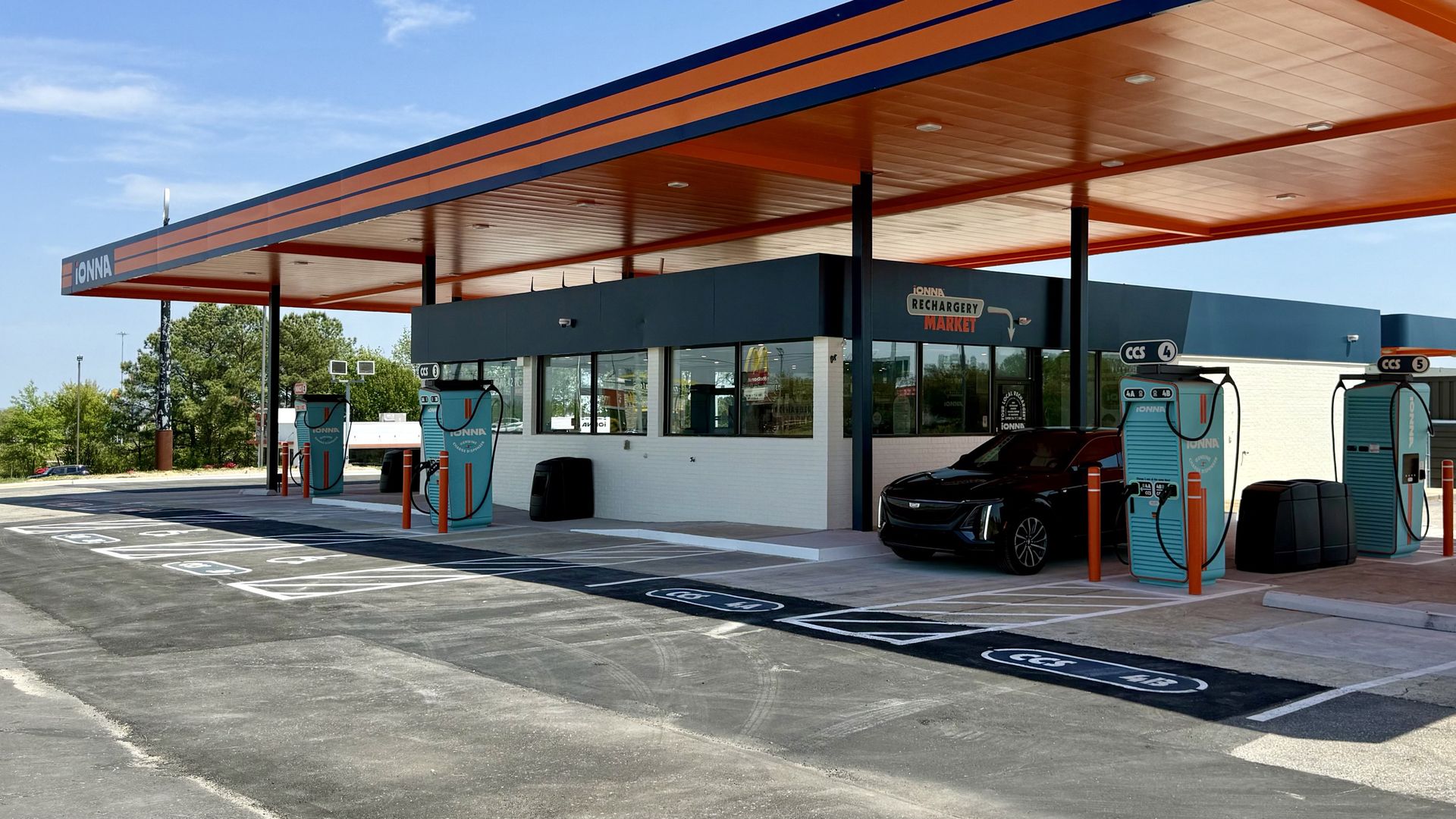
Ionna Rechargery, with a convenience store, in Garner, North Carolina. Photo: Courtesy of Ionna
Tesla's Supercharger network has long been the gold standard for EV charging, but Ionna, a new network backed by eight major automakers, is raising the stakes.
Why it matters: With Ionna, the carmakers' goal is to build a rival charging network that offers faster charging and unique amenities.
- That means reliable, 400 kW charging under lighted canopies, along with coffee, bathrooms, food, and spaces to hang out or take meetings. Think gas station, only better — and electric.
Catch up quick: Less than two years old, Ionna is a joint venture between BMW, General Motors, Honda, Hyundai, Kia, Mercedes-Benz, Stellantis and Toyota.
- It's modeled after a similar pan-European network called Ionity that was created by some of the same players.
- Ionna's goal is to open 30,000 charging bays across the U.S. by 2030 — roughly the same number of plugs Tesla has today, but with faster speeds.
- The fastest Tesla chargers deliver up to 250 kW of power; Ionna chargers provide 400 kW.
Where it stands: The first 12 "Rechargeries" are now open, providing a total of 120 charging bays, with plans for 1,000 by the end of this year.
- For now, 60% of the bays have CCS connectors, the most common type of plug, and 40% have Tesla's NACS connector, which is gradually becoming the industry standard. That ratio will shift as the NACS transition continues.
- Ionna also has a partnership to open Rechargeries at 50 Sheetz convenience store locations by 2026, with incentives and loyalty programs rolling out this year.
Zoom in: The first Rechargery in Apex, North Carolina, is in a former gas station, where the service shop is now a cafe.
- Another, in Garner, North Carolina, features Amazon's "Just Walk Out" technology in the snack shop.
- Other Rechargeries have opened in Texas, Pennsylvania, Ohio, Kansas, Arizona, and Missouri, with California up next.
- "We're experimenting with different business models," CEO Seth Cutler tells Axios. "We want to make sure the driver experience they have is better, bar none, than what they'd have at a gas station today."
