Paul Tudor Jones issues warnings about AI, tariffs

Add Axios as your preferred source to
see more of our stories on Google.
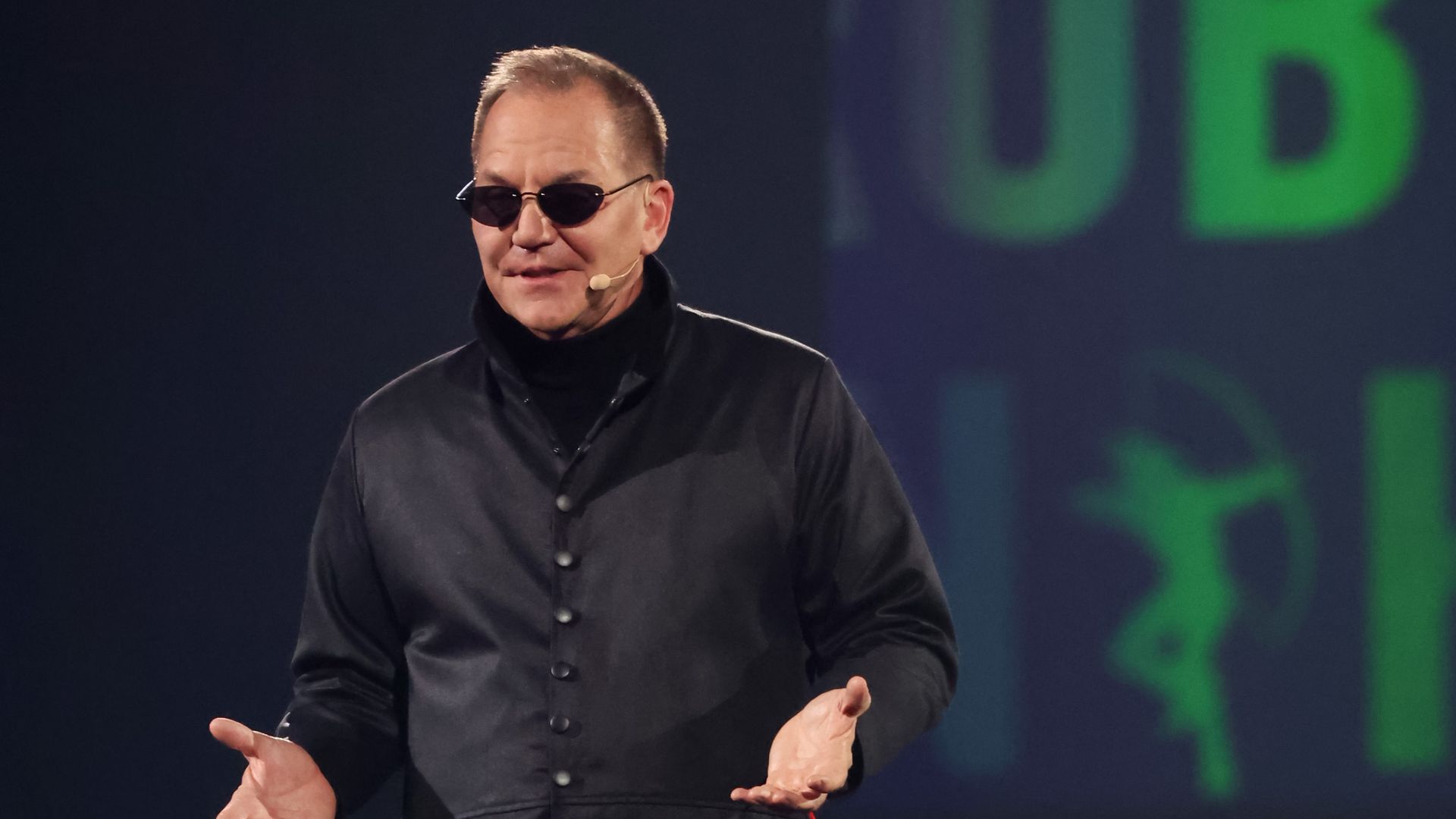
Jones offered dire warnings about AI on CNBC's "Squawk Box." Photo: Kevin Kane/Getty Images for Robin Hood
Billionaire hedge-fund manager Paul Tudor Jones said Tuesday that the U.S. trade war with China was past the point of no return.
Why it matters: Jones' comments come as economists have also suggested that the impact of Trump's tariffs are likely to outlast him.
Driving the news: Jones, the founder of Tudor Investment, predicted that stocks are going to hit new lows even if Trump backtracks from his aggressive tariffs, currently set at 145% on imported Chinese products.
- "It's pretty clear. You have Trump who's locked in on tariffs. You have the Fed who's locked in on not cutting rates. That's not good for the stock market," Jones said on CNBC's "Squawk Box." "We'll probably go down to new lows, even when Trump dials back China to 50%."
State of play: Recent history suggests that at least some levies could stick after Trump's time in office ends.
- "We have never had any trade deescalation with China from Trump's first-term trade war. Politicians don't see a public appetite for it," Joseph Politano, an economist at Apricitas Economics, told Axios this week.
- "I worry future presidential hopefuls see tariffs as a big expansion of executive power — the ability to economically reward and punish businesses at will — and will be loathe to give it up."
Jones also shared a dire warning about artificial intelligence, expressing drastic, longer term fears about how rapidly AI technology is developing.
- Jones, sharing his takeaways from an exclusive technology conference he recently attended, said that although AI can be a "force for good" in health and education, experts at the conference suggested that "AI clearly poses an imminent security threat in our lifetimes to humanity."
- He cited a breakout session following a panel of AI model developers, in which all four, he said, argued in favor of an offered proposition that "there's a 10% chance in the next 20 years that AI will destroy 50% of humanity." Jones was vague on exact details of their argument, but referenced "biohacking" and "weapons."
- Jones did not immediately respond to Axios' request for followup comment.
The other side: Biosecurity experts say AI-driven "biosurveillance" could actually help spot the next pandemic or biological attack.
- Collecting better biological data, and running it through AI, "might be the difference between managing a really small outbreak" and "letting it spread and become a much bigger problem," Stephanie Batalis, a Georgetown Center for Security and Emerging Technology fellow, told Axios last year.
