Here's how the Catholic Church will choose a new pope

Add Axios as your preferred source to
see more of our stories on Google.


White smoke will soon rise again from the Sistine Chapel chimney, signaling a new era of leadership in the Catholic Church — but first, there must be prayers, meetings and a highly secretive conclave.
The big picture: Cardinals from across the globe gathered in the Vatican Wednesday to select the next leader the Roman Catholic Church following the death of Pope Francis.
- The conclave, a storied vote that has been chronicled in film and fiction, typically draws the attention of those in and out of the faith community and marks a new era for the Church.
Driving the news: Francis died April 21 at 88, weeks after he was released from an extended hospital stay following a bout of pneumonia.
- The individual chosen to replace Francis will be the 267th pope.
Here's what happens when a new pope is chosen:
What happens right after a pope dies?
When a pope dies or resigns (a rare occurrence), the College of Cardinals takes over governance in his place, according to the United States Conference of Catholic Bishops.
- Cardinals are bishops and other officials chosen by the pope and wear traditional red vestments.
What's next: A series of meetings, called general congregations, take place in the Vatican. During these gatherings, the cardinals prepare for the papal election, called a conclave.
- Cardinal electors must be under age 80 to vote in the conclave.
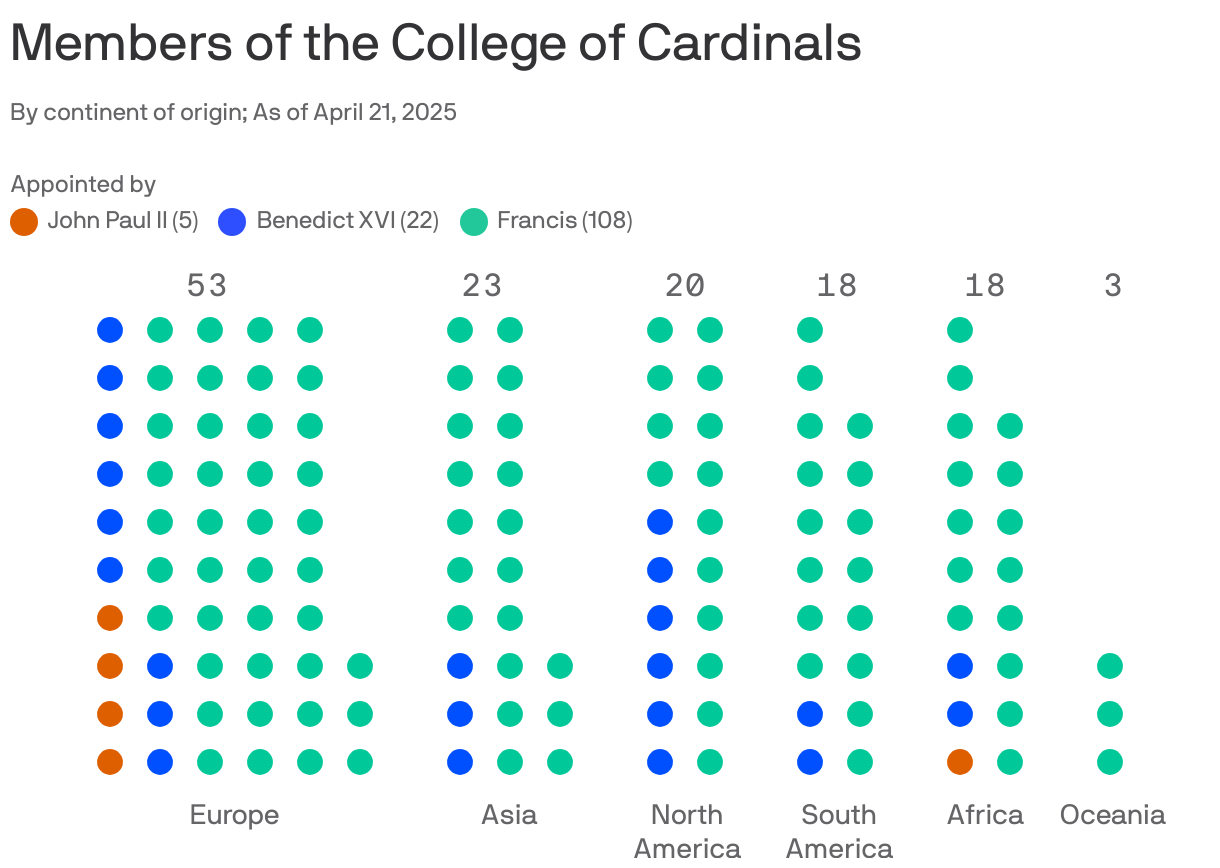
- The number of electors is traditionally capped at 120. But according to the USCCB, thanks to Francis naming a slew of new cardinals under the age of 80, there will be more than 130 eligible electors.
Some 15 to 20 days after the end of a pontificate, they'll gather in St. Peter's Basilica for a mass seeking guidance to elect a new pope.
- Then they go to the Sistine Chapel.
How does the election work?
The electors take an oath of absolute secrecy and seal the chapel's doors, where they'll vote by dropping folded ballots into an urn.
- The secrecy is regarded with the utmost seriousness: if the cardinals discuss with outsiders, they risk being excommunicated.
- The chapel is also checked for hidden microphones and cameras to ensure secrecy, CNN reported.
One round of voting is held on the first day, followed by four rounds of voting every day after until a successor is chosen, though there are pauses if the group is having difficulty reaching a consensus.
- If no one receives the needed threshold of a two-thirds vote, the ballots are burned, sending black smoke into the Vatican City sky.
When will there be a new pope?
In the last 100 years, voting has not exceeded five days.
- Francis was elected pope on the conclave's second day.
When a winner emerges — and accepts the post — the ballots are burned with chemicals that produce a white smoke to signal a new pope has been chosen.
- He'll take a papal name (Francis was born Jorge Mario Bergoglio) and will be introduced to the world.
- The famous "Habemus Papam" ("We have a pope") announcement is set to be delivered by Cardinal Dominique Mamberti.
Who can be pope?
Technically, any baptized Roman Catholic man can be named Pope, according to the College of Cardinals report.
- But a non-cardinal has not been chosen since 1378 — a phenomenon that's only happened six times in the Church's history.
- That's not to say the process still can't end in a twist.
- In fact, Francis — the first from the Jesuit Order and from the Americas — was himself somewhat of a surprise.
More from Axios: Pope Francis dies on Easter Monday at 88
