Recent hospital violence fuels effort to create workplace protections

Add Axios as your preferred source to
see more of our stories on Google.
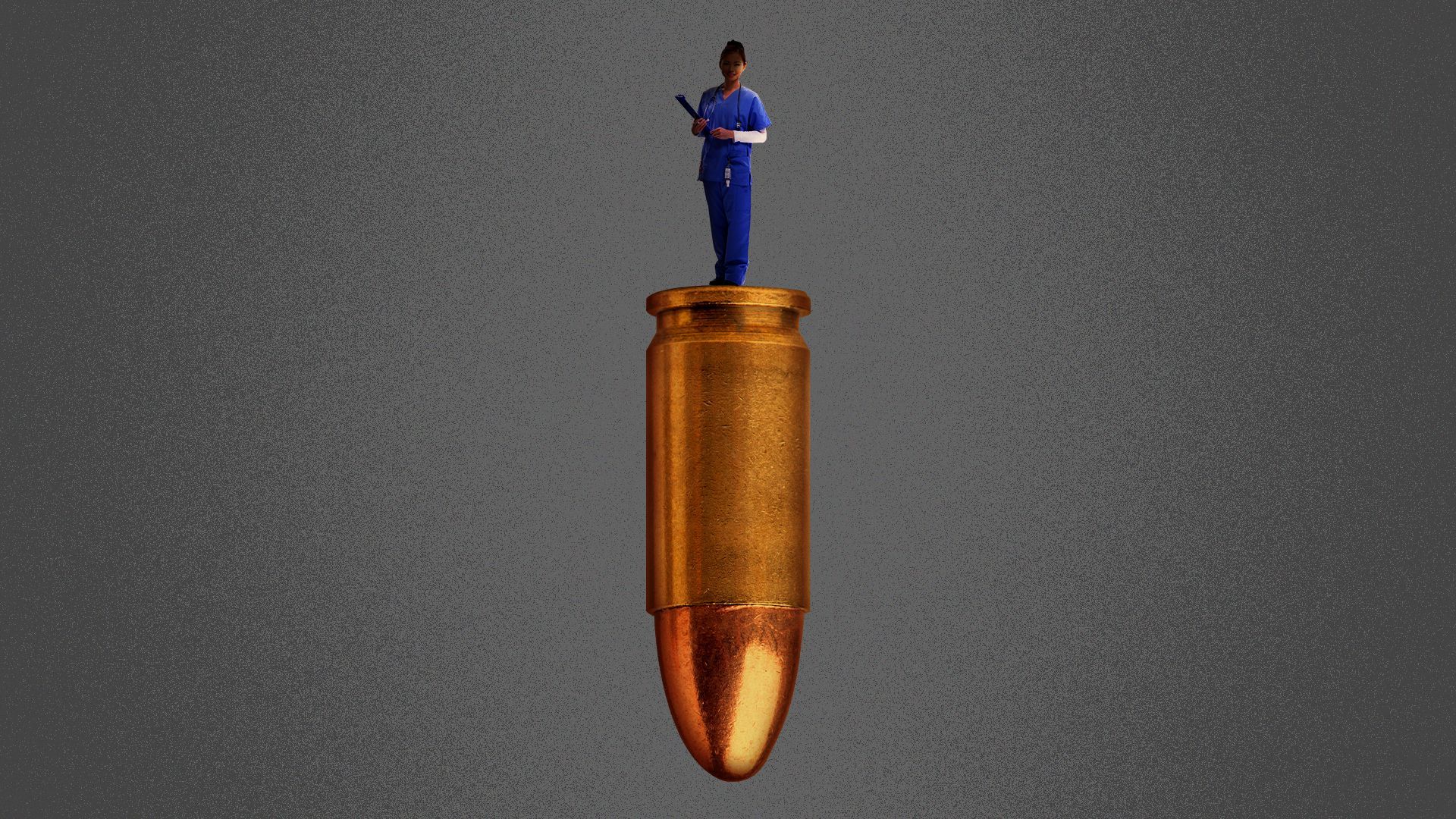
Illustration: Allie Carl/Axios
A new round of workplace violence in hospitals and clinics is lending urgency to efforts to create a first-ever federal standard for protecting nurses, social workers and others in the medical system.
Why it matters: Health care workers routinely rank in government statistics as among the likeliest to experience threats or assault on the job. But there's no nationwide requirement for health systems to perform hazard assessments, train employees about dangers or inform them of their rights.
Driving the news: Sen. Tammy Baldwin (D-Wis.) and Rep. Joe Courtney (D-Conn.) this month introduced legislation that would require health care employers to write and implement a workplace violence prevention plan.
- An effort to make people who assault hospital employees subject to federal charges stalled in the last Congress, with nurses unions saying it could have criminalized patients.
- The Occupational Safety and Health Administration has reviewed workplace violence in health care for nearly a decade, and last year said it would issue a proposed rule. This legislation would mandate that OSHA create that standard, essentially writing the requirements into law.
- National Nurses United backs the bipartisan legislation. "We know that workplace violence is not part of the job, and that it is preventable and that it should be anticipated," Michelle Mahon, director of nursing practice for the union, told Axios.
Yes, but: The cost of establishing a nationwide standard would be signifiant. OSHA estimated complying would total $1.22 billion a year for more than 300,000 affected establishments. The standards would reach beyond hospitals, to home health, EMTs and residential and behavioral care facilities.
The moves in Congress come after a spate of high-profile incidents, including a gunman taking hostages in a York, Pennsylvania hospital's intensive care unit and the lockdown of a Troy, Michigan hospital after one of its employees shot a co-worker in a parking garage.
- NNU says those headline-grabbing examples are only the tip of the iceberg when it comes to violence in the nation's health systems. A 2024 survey by the union found 8 in 10 nurses said they'd experienced violence on the job in the last year.
- "We hear about really catastrophic events of violence like active shooters. But nurses are getting injured at work as a result of workplace violence every day," Mahon told Axios.
- Incidents can result in life-altering harm, as in the case of a Florida nurse who had nearly every bone in her face broken by a patient in February.
Between the lines: Societal violence is increasingly spilling over into hospitals and making it harder to protect facilities that, by their very nature, are always open to the public.
- More patients are entering the system under the influence of drugs or alcohol, contributing to a rise in violent incidents.
- Pent-up frustration with the health care system's long waits and coverage denials is also often directed at frontline workers.
- There are also threats of terrorism: A recent advisory from the American Hospital Association warned health systems of a social media post alleging active planning of a coordinated, multicity attack targeting hospitals. The FBI later said it did not identify any specific credible threat.
Zoom in: CEO Shan Sinha, whose company Canopy sells panic buttons for use in health care, pointed to a recent episode of medical drama "The Pitt" where a frustrated patient punches a nurse in the face.
- "We've gotten to a spot where there's higher levels of mainstream awareness and, I think, it's because it's real," Sinha said. "I think this has been building for a while, and then it's just everything else in the world is exacerbating it."
Hospitals say they are increasingly investing in both physical design that can improve safety. At least 6 in 10 hospitals already have violence prevention plans, per the AHA.
- The AHA has also been working with the FBI to understand the nature of violence in health facilities to find more ways to help prevent it.
- "Most of these acts include, fundamentally, some grievance," said Scott Gee, AHA deputy national adviser for cybersecurity and risk, adding it may be coupled with accelerating contact and agitation with the hospital.
- "Those are steps along the path that all too often leads to violence. And identifying those steps early on is the goal of this of this program, so you can interrupt that path to violence."
