Trump blinked, but the global economy will never be the same


Add Axios as your preferred source to
see more of our stories on Google.
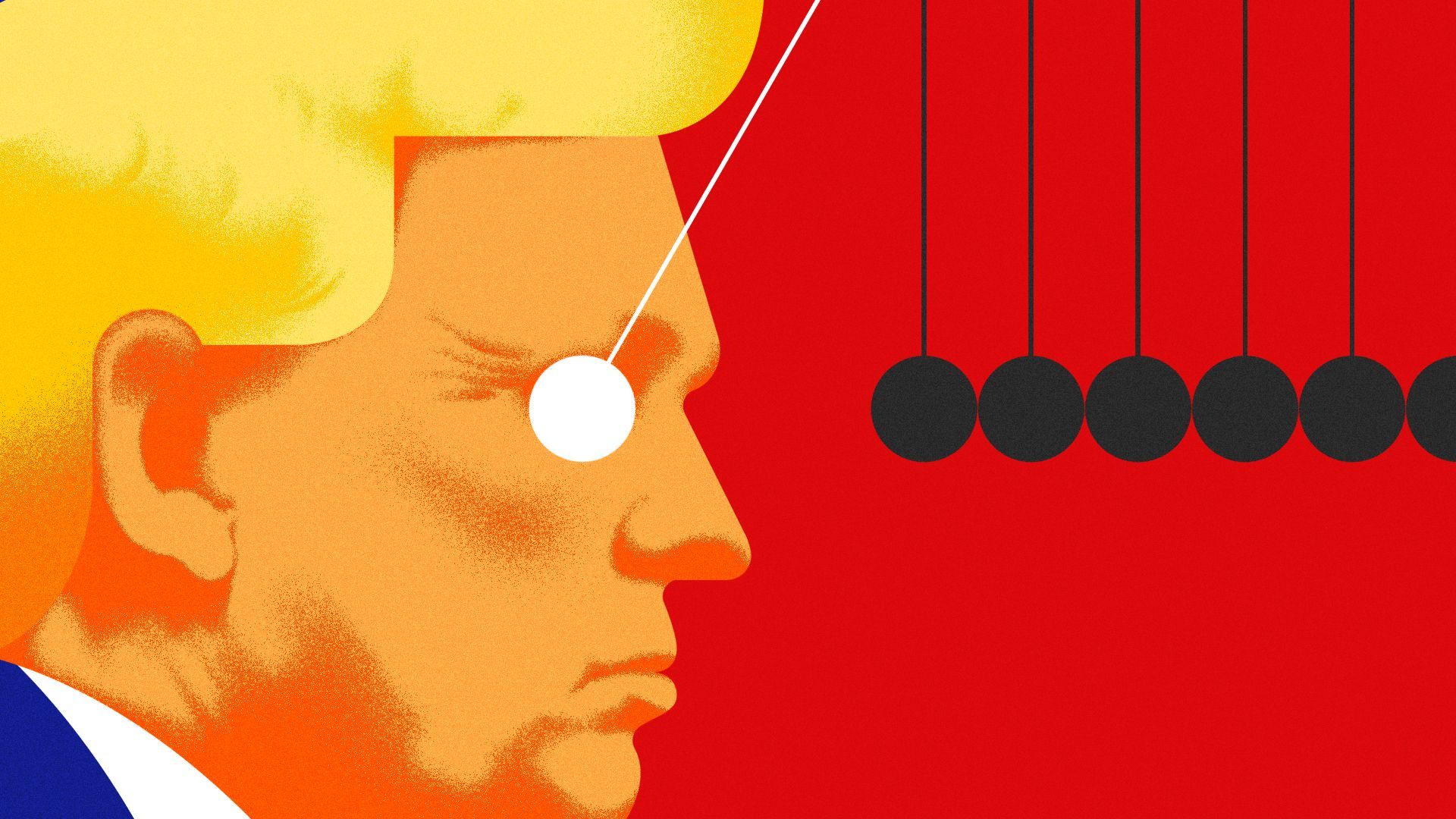
Illustration: Maura Losch/Axios
There is now sand — a lot of it — in the gears of global commerce, and it won't be going away in the foreseeable future.
Why it matters: President Trump may have backed down on some of the most extreme — and hardest to justify — trade barriers he announced a week earlier. But the tariffs that remain in place still make for a more fractured global economy, albeit with slightly different fractures.
- Instead of waging an all-out trade war with practically all U.S. trading partners, all at once, the new policy alignment amounts to an escalated trade war with China amid ongoing skirmishes with the rest of the world.
- The era of frictionless global trade is over.
State of play: It's hard to overstate how much the escalation in U.S. trade policy over the last two months — and especially the last eight days — dwarfs anything in living memory.
- Even after Trump's retreat Wednesday, he is imposing a minimum 10% tariff on pretty much all goods from all countries. The last time the average tariff rate was that high was 1943.
- But a reciprocal 125% tariff on Chinese imports, plus additional tariffs on steel, aluminum and automobiles, brings the average effective tariff rate to 25.3%, per the Yale Budget Lab's calculations, the highest since 1909.
- Even after trade patterns shift toward lower-tariff countries (more Chinese manufacturing activity shifting to 10%-taxed Vietnam, for example), the Yale team estimates it will settle at 18.1%, the highest since 1934.
Between the lines: The big open question over the last eight days has been whether Trump's aggressive "reciprocal" tariffs were meant to be an over-the-top starting point for negotiation or a new standing feature of the global economy.
- Now we know that the answer is "yes."
- On one hand, he backed off the elevated tariffs for most countries for 90 days because, he claimed, 75 countries were clamoring to make a deal. That points to the "let's negotiate" theory.
- But the 10% baseline tariff looks to be the new cost of business for anyone relying on imports.
- It's distortionary and expensive, but low enough that there could be more room for firms to absorb it in the form of lower margins or tougher negotiations with suppliers than, say, the 46% levy originally proposed for Vietnam.
Zoom out: Wednesday's backdown shows that Trump, for all his trade war zeal, does respond to normal incentives. A plunging stock market, countless calls from CEOs and leaders of other countries, and frustrated Republican lawmakers clearly got his attention.
- The bond market's role looms particularly large, as a surge in long-term interest rates since Monday — and a corresponding plunge in Treasury bond prices — raised the prospect of ongoing damage to the U.S. government's ability to borrow.
- U.S. rivals surely took note; the notion of using the global bond markets as a tool of geopolitics is not unknown.
The bottom line: Global trade as most living Americans know it is over, even if the scale of the disruption ahead is lower than it was 24 hours ago.
