Uber and Lyft drivers aren't going away

Add Axios as your preferred source to
see more of our stories on Google.
/2025/04/09/1744206381966.gif?w=3840)
As robotaxi services begin to spread across America, ride-hailing drivers could worry that they'll be pushed aside in favor of robots — or at least that their incomes will shrink.
Why it matters: Like manufacturing, retailing and other industries, transportation is a prime target for automation.
Reality check: Cashiers aren't going away, and neither are factory workers or Uber drivers.
- Instead, they'll work alongside robots for the foreseeable future.
Driving the news: Uber and Lyft are starting to offer robotaxis as a ride option in select cities, joining Waymo, which is already in San Francisco, Los Angeles and Phoenix.
- In the beginning, these robotaxis will be confined to certain neighborhoods and will only operate in optimal conditions.
- But they'll help Uber and Lyft manage their networks more efficiently, such as during peak demand, when prices often surge.
- Longer term, as technology advances and costs come down, robotaxis could also mean cheaper fares for riders.
By the numbers: Uber controls about 75% of the U.S. ride-hailing market; Lyft owns the rest.
- Drivers on both networks earn about $23 per hour, according to Gridwise Analytics, which collects driver data to track the gig economy.
- Uber drivers earn an average of $513 per week, while Lyft drivers gross $318.
Where it stands: So far, the presence of robotaxis in San Francisco, LA and Phoenix hasn't affected ride-hailing drivers much, Gridwise found.
- "Drivers are still working at the same pace, getting the same incentives, and taking as many trips as before," co-founder and CEO Ryan Green tells Axios.
The big picture: The hassles and costs of owning a car in urban areas have fueled the growth of ride-hailing platforms, especially among younger people.
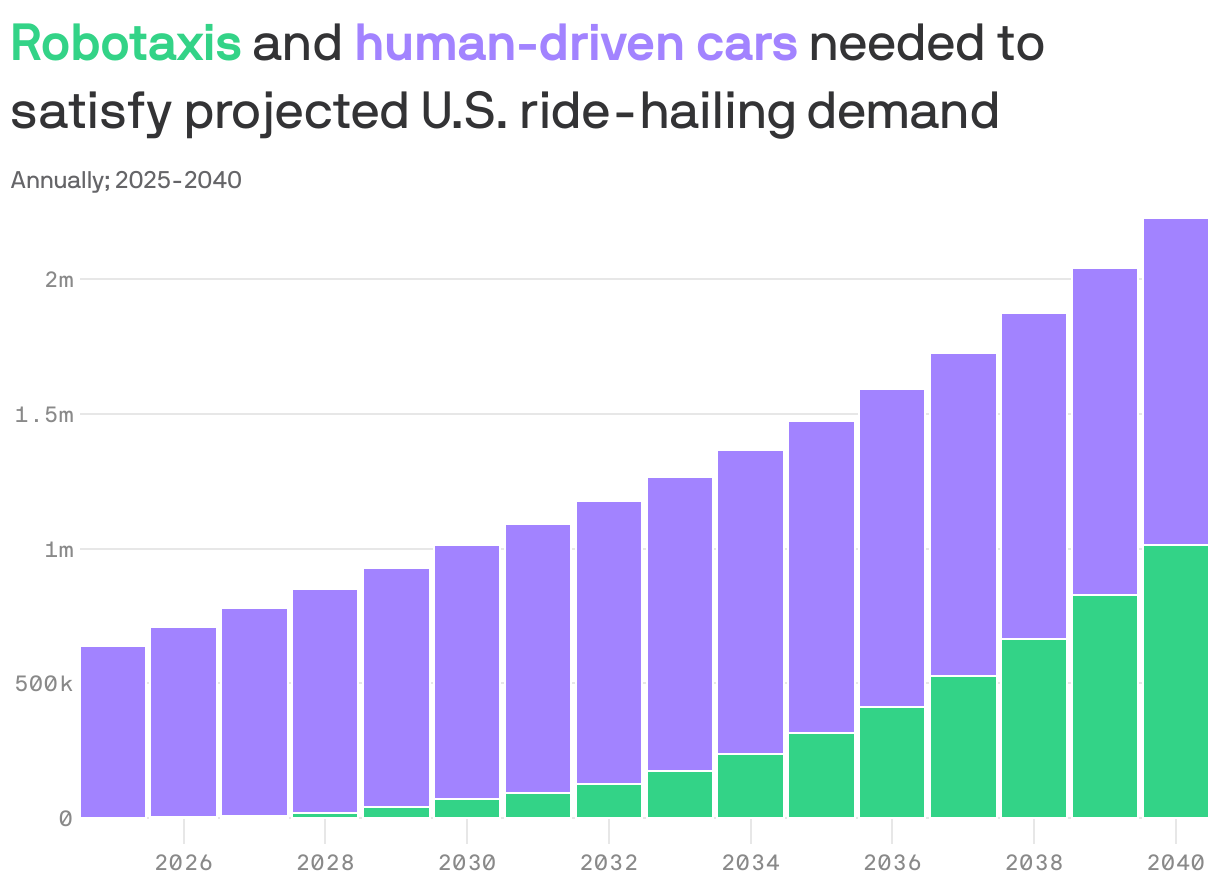
- That growth is expected to accelerate sharply over the next 15 years, as more people turn to ride-hailing for their daily commutes instead of just occasional use, say forecasters at S&P Global Mobility.
- "Gen Z and Gen Alpha have a different mindset when it comes to mobility," Mario Franjicevic, a principal research analyst at the firm, tells Axios.
- "They don't own CDs or vinyl. They don't own DVDs. They subscribe to Netflix and Spotify. They will do the same with mobility. Owning a car is not a status symbol to them."
- By 2040, S&P Global Mobility is projecting 15 billion ride-hailing trips a year in the U.S., up from 3.6 billion in 2024.
The intrigue: About half of those trips will be in robotaxis; the other half will still be driven by humans.
Between the lines: Jeremy Bird, Lyft's executive vice president of driver experience, described three phases of the robotaxi transition in a recent blog post.
- Adoption: Robotaxis are still a novelty. There aren't enough of them to meet a city's transportation needs, and they can't operate in certain weather conditions or on certain roads. (That's where we are today.)
- Hybrid network: Some riders will select robotaxis, but others will still prefer a human driver for extra assistance or premium service.
- Lyft-ready network: Anyone's automated car can be deployed on the ride-hailing network to generate income when they're not using it. Entrepreneurial drivers could run an entire fleet of robotaxis on Lyft.
The bottom line: The ride-hailing pie is still growing, and robotaxis aren't going to eat it all.
