Exclusive: Fed's Barkin says tariff price hikes could start by June

Add Axios as your preferred source to
see more of our stories on Google.
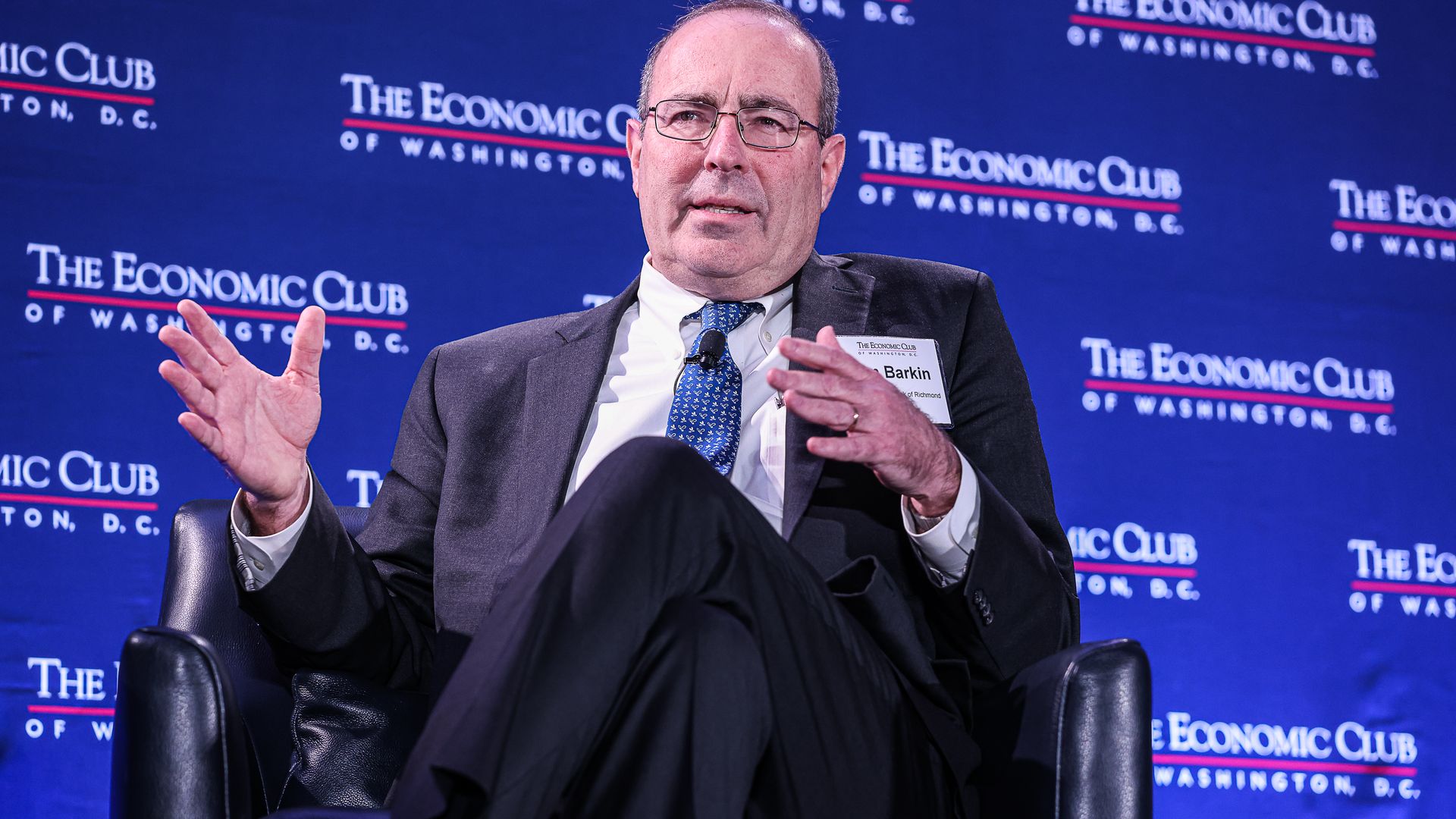
Richmond Fed president Tom Barkin. Photo: Valerie Plesch/Bloomberg via Getty Images
The trade war is likely to cause fewer jobs and higher prices, a top Federal Reserve official tells Axios. But price hikes may not show up until the summer, as companies work through pre-tariff inventories.
Why it matters: Richmond Fed president Tom Barkin, in an exclusive interview, described a deep-seated uncertainty among businesses that is likely to slow activity — along with a surge in prices that requires the Fed to act cautiously in responding.
What they're saying: "As I've talked to business people, they're still struggling to have confidence in where this lands," Barkin said in the first interview with a Federal Reserve official since the tariffs went into effect.
- "The direction is clear ... it's just the destination that people are challenged with," Barkin told Axios Wednesday morning, in advance of a speech to the Economic Club of Washington, D.C.
Zoom in: Barkin, a former strategy consultant who frequently talks to business leaders about the inner details of the economy, describes a push-and-pull over who will absorb the cost of tariffs.
- "For the most part, there is enough inventory that we're talking about June prices more than we're talking about April prices," he said, as companies typically have 30 to 60 days' worth of pre-tariff inventory to work through.
- "I was talking to a home improvement manufacturer who said they're not going to do the Memorial Day promotion that they normally do because you've only got so much inventory at [a] lower cost. So why would you put it on promotion?"
Companies are determined to pass along higher tariff costs by way of higher prices, but they'll face resistance from consumers who are exhausted by the high inflation of the last few years.
- "You've got an emboldened supplier who has a set of tariffs they know they've got to pass on," Barkin says. But as for consumers, "they're tired of higher prices and they don't want to pay them anymore."
- He says that in a "cage match between exhausted consumer and emboldened manufacturer, that might all play out in one big swoop, but it wouldn't stun me at all if it played out over time."
Zoom out: The risks to both sides of the Fed's mandate — for maximum employment and stable prices — set up a dilemma for policymakers.
- What might help on one side (cutting rates to address joblessness) risks making things worse on the other (allowing higher inflation). Barkin was noncommittal on where policy might shake out.
- "Some of the shifts we're seeing run the risk of both being inflationary and negative for unemployment," Barkin says. "And if that's the case, that's a hard box for policymakers."
- "Policy for the Fed is a lot easier to have conviction when you have conviction that one part of your mandate is under control" — such as in 2018, when officials were confident that inflation was under control, or in 2022, when inflation was high but at least the job market was very tight.
State of play: While recession chatter has become overwhelming in recent days with the stock market sell-off, Barkin is more cautious, saying the "core question" is whether consumer spending holds up, even as government spending and business investment fall.
- "The unknown here is consumer spending, and consumer spending has been supported significantly over the last few years by low unemployment, by increasing real wages and by increasing wealth."
- "So what you look at now is a fragile stock market. Will that cause people to pull back? Unclear."
- "You have risks to the job market, though the unemployment rate remains still quite stable. Will that increase? And if we do have inflation coming out of whatever tariff regime is finalized, will that lead to lower real wages?"
- "The data at this point is still perfectly solid, but I think people are wondering whether the consumer spending part of the economy is at risk."
The intrigue: While the plunging stock market may cause Americans to pull back spending, Barkin notes that it doesn't always work that way. "In 1987, when I was just out of business school, the markets crashed, and there wasn't much if any spending reduction then."
Of note: "And by the way, there may well be disinflationary forces, too," Barkin says. "We haven't talked about energy prices, which are down, oil prices are down, and OPEC's producing more, and we haven't talked about the impact of retaliation on some of our export manufacturing."
- "I was talking to some people in the peanut business last week who do a lot of their exporting to China," he says. Retaliatory tariffs by China will reduce their sales, but "they're still producing the same amount of peanuts. So that'll have an implication on peanut prices."
The bottom line: "Having talked [with] all these businesses about the tariffs, you know how the imposition of tariffs at this kind of scale hits inflation versus hits employment. I think it's going to hit both."
