A closer look at the nationwide impact of NIH cuts

Add Axios as your preferred source to
see more of our stories on Google.
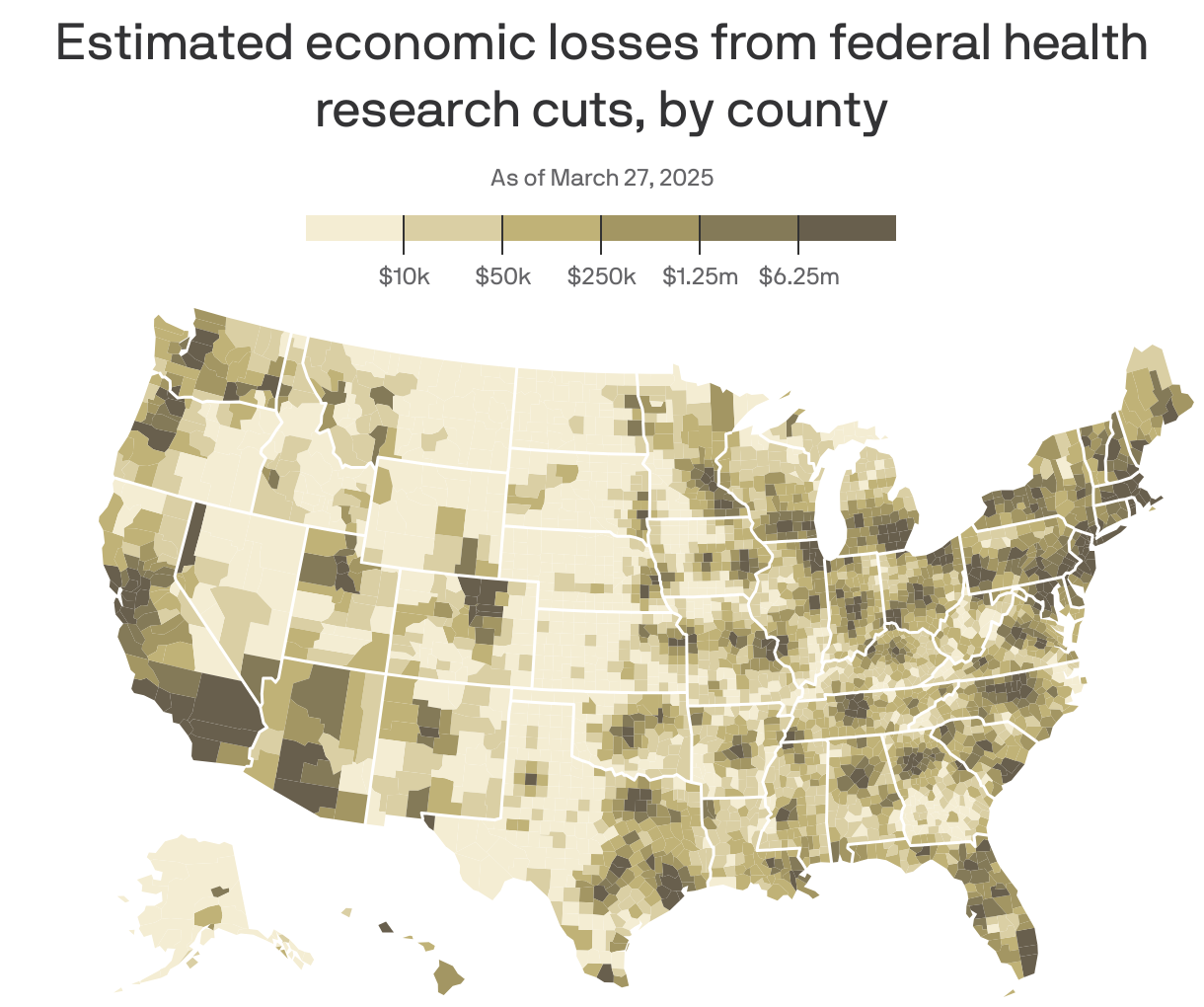
Nearly half of all U.S. counties will experience economic losses of at least $250,000 as a result of the Trump administration's planned cuts to indirect funding by the National Institutes of Health, per the Science & Community Impacts Mapping Project.
Why it matters: Much of the discourse around the cuts has focused on the impact to states or individual universities. But this data compiled from a consortium of universities shows just how widespread the effects of the cuts would be at the local level, researchers tell Axios.
- More than 500 counties will lose more than $6.25 million in funding, their data shows.
Catch up quick: In February, the Trump administration said it would cap the indirect cost rate on all new and current grants at 15% of the total cost.
- Nearly two dozen states sued, earning a temporary freeze on the cuts for the states that participated in the suit. An additional 16 states have since filed their own legal challenge.
Zoom in: The researchers — from the University of Pennsylvania, University of Maryland, University of Utah, Georgia Institute of Technology and University of Oregon — used a variety of data points, including commuter information.
- The goal was to show a more comprehensive picture of the potential economic impacts.
- For instance, Washtenaw County in Michigan — home to the University of Michigan — may sustain $217 million in economic losses. But the map shows its neighboring counties, some which have smaller colleges and universities, may also sustain millions of dollars in losses.
What they're saying: The pain isn't confined to elite institutions on the East and West coasts, the researchers said.
- "I don't think people have a sense of the extent to which the NIH funding is embedded in communities, big cities, regional hubs, small towns all across the U.S.," Joshua Weitz from the University of Maryland told Axios.
Maya Goldman contributed.
