Don't expect a Russian gas revival in Europe

Add Axios as your preferred source to
see more of our stories on Google.
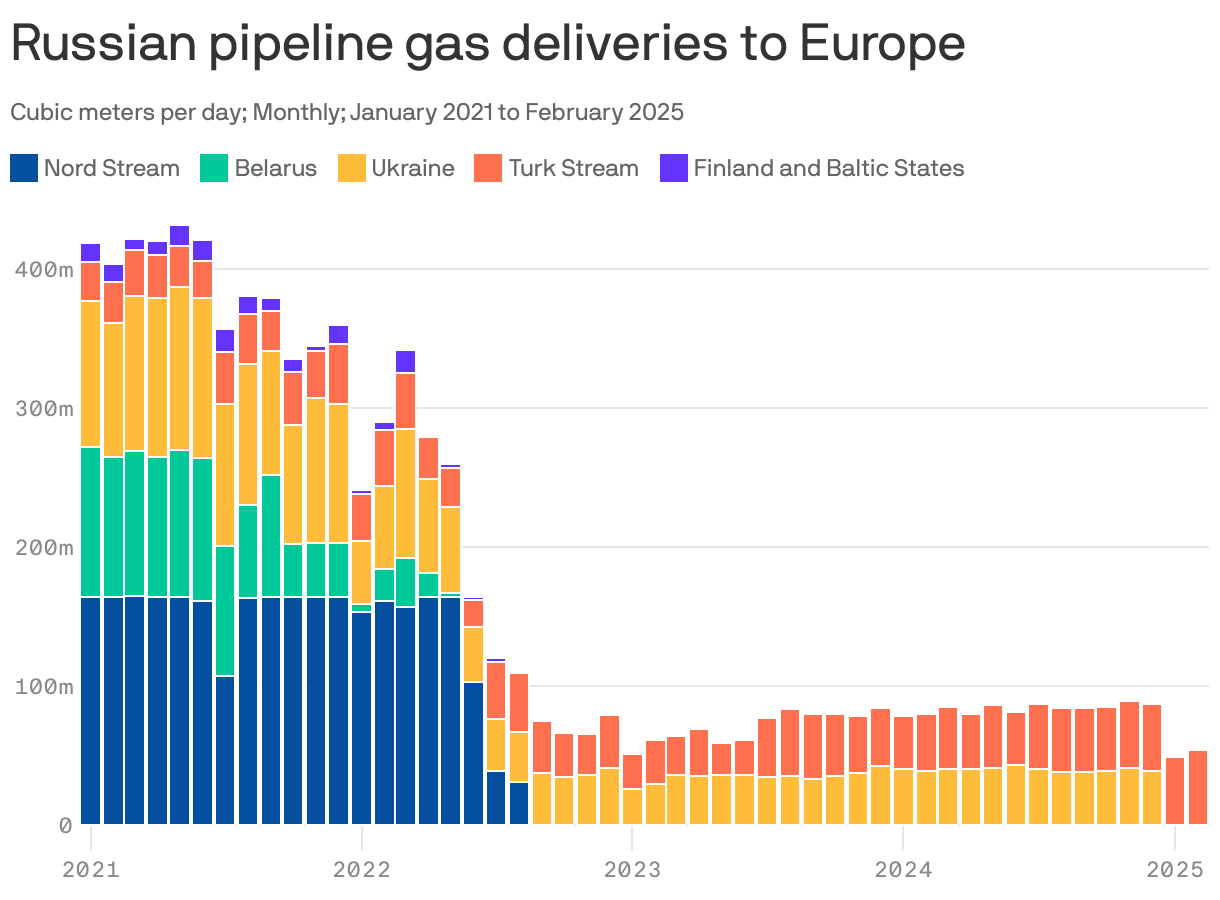
Despite lots of recent chatter, there are strong reasons not to expect a rebound of Russian pipelined gas to Europe, a new analysis argues.
Why it matters: Russia was long Europe's dominant supplier, and the breakup is the starkest example of the war on Ukraine reshaping global energy flows.
- But cease-fire discussions and high European gas prices have prompted discussion of revival.
- Most recently, Russian foreign minister Sergei Lavrov floated the idea this week in an interview with state media.
Yes, but: A near-term rebound is unlikely, writes Jack Sharples, a researcher with the Oxford Institute for Energy Studies. Some reasons include:
- Damage to the Nord Stream pipeline system in 2022 sabotage and Germany's refusal to sign off on Nord Stream 2. TurkStream is the only major pipeline still supplying Europe, and Sharples notes that it's at capacity.
- The more recent end of transit through Ukraine that "will not restart in the absence of a durable and lasting political settlement."
- Expiration of some long-term contracts with Gazprom and disputes over others, and a "wave" of LNG coming to market in 2025-2030.
The big picture: While Russian LNG shipments have risen, overall EU dependence on the Kremlin is a small fraction of prewar levels.
- Russia provided 14% of EU gas use last year, per the climate think tank Ember that's urging more use of renewables and storage.
Catch up quick: Top EU officials vow not to again become dependent on Russia, which once provided roughly half the bloc's gas.
- Higher LNG imports from the U.S. and elsewhere, substitute fuels and more have filled much of the gap, albeit precariously.
- But some European politicians and industries say avoiding Russia must be weighed against high prices sapping industrial competitiveness.
The bottom line: Who knows if pipeline volumes could again grow, but it looks quite unlikely that Europe will ever again be highly Kremlin-reliant.
- "For Gazprom, even if it does achieve a partial rebound, by the time it does so it will face a much more competitive European gas market than the one from which it withdrew in 2022-2024," Sharples writes.
