The economy is a tiring baseball pitcher

Add Axios as your preferred source to
see more of our stories on Google.
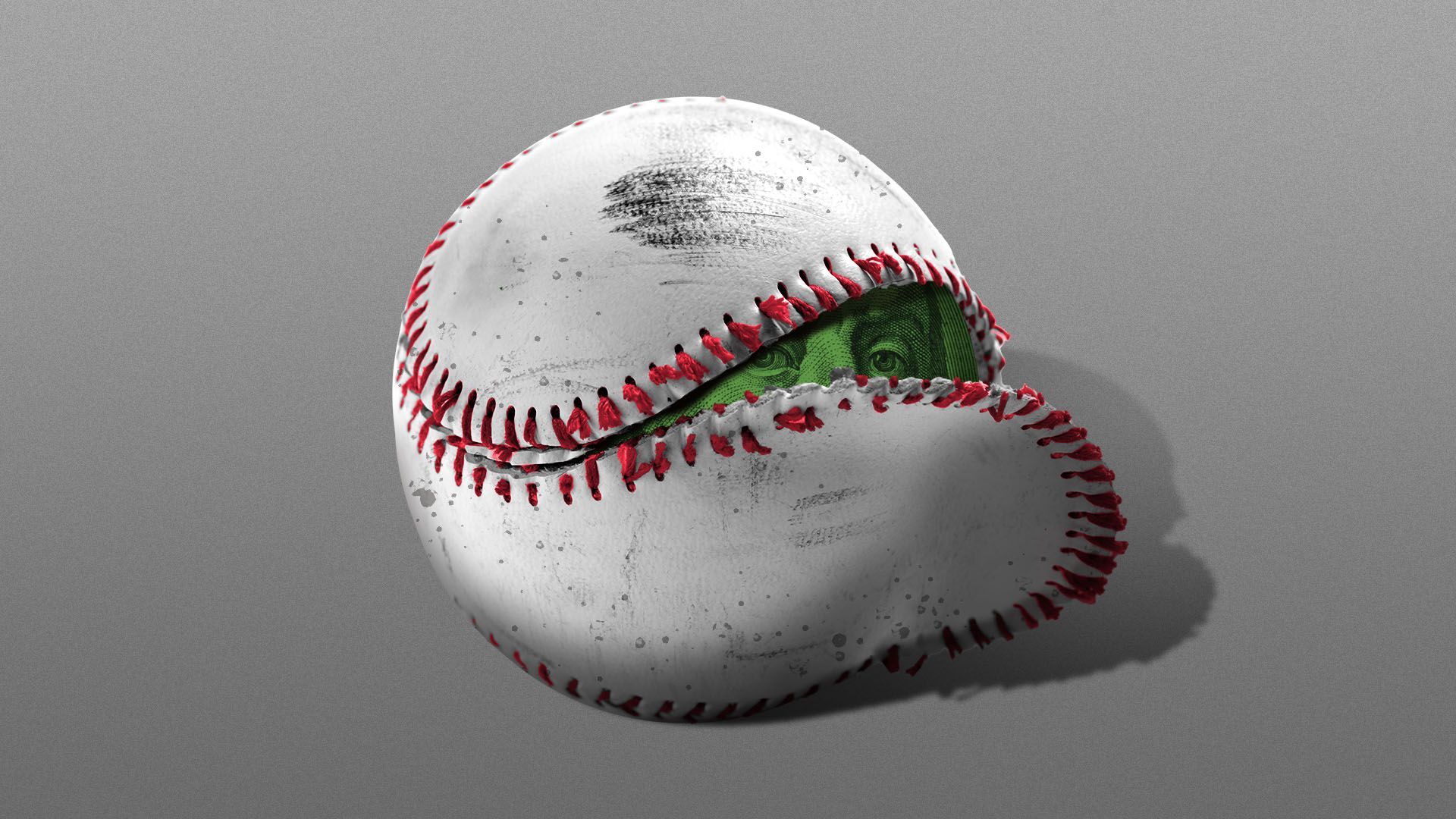
Illustration: Sarah Grillo/Axios
It's the sixth inning of a baseball game. The pitcher, by the measures that matter most — how many hits and runs he's allowed — is having a good night. But the manager sees something subtle and pulls him out of the game anyway.
The big picture: This is, more or less, the state of the U.S. economy at the onset of spring. All is well with headline measures like GDP growth and the unemployment rate. It's the peripheral indicators that hint at trouble ahead.
- Much as a baseball manager can't just look to the scoreboard to tell whether their pitcher is gassed, the signs of concern in the economy right now are found in secondary indicators.
- They could be ignored in isolation but are more worrying when so many of them flash the same warnings, as we noted over the weekend.
State of play: A baseball manager might pull a pitcher whose fastball velocity slips by even 2 or 3 miles per hour, or who is suddenly allowing batters to foul off lots more pitches, or whose arm mechanics look a bit off.
- Similarly, the early warning signs of an economic downturn often turn up in places that are, on their own, not terribly definitive.
On Monday morning, for example, the New York Fed released its Empire State Manufacturing Survey, a readout of conditions facing the factory sector in New York state.
- It fell sharply in March, with the index dropping 26 points to -20 (zero is the line between business conditions improving and worsening).
- It's a volatile survey of one sector in one state — generally not to be made too much of. It actually notched worse readings in both January and May of 2023, a year in which the overall economy did just fine.
Between the lines: It's not the survey in isolation that's worrying; it's that it comes after similar weakness in the University of Michigan consumer sentiment survey, the National Federation of Independent Business survey, a large drop in the stock market and a surge in announced layoffs.
- Those are the early warning signs that we could soon see shifts in the big-picture economic data — payroll employment, personal incomes, and other major releases that recession-daters monitor.
- In this analogy, the Federal Reserve is the baseball manager who must decide how much to react to those peripheral indicators that are early warning signs of trouble, as opposed to the ones on the scoreboard that matter most.
Yes, but: It's an open question how reliable any of these peripheral indicators are in the economic forecasting game, especially now.
- In a speech this month, Fed chair Jerome Powell acknowledged that "recent surveys of households and businesses point to heightened uncertainty about the economic outlook."
- But it "remains to be seen how these developments might affect future spending and investment," he said, as sentiment readings "have not been a good predictor of consumption growth in recent years."
The bottom line: By the time of overwhelming evidence that a pitcher is faltering, the game could be lost. A good manager has to decide which peripheral indicators to pay attention to, and when.
