Pedestrian deaths decrease — but not everywhere


Add Axios as your preferred source to
see more of our stories on Google.
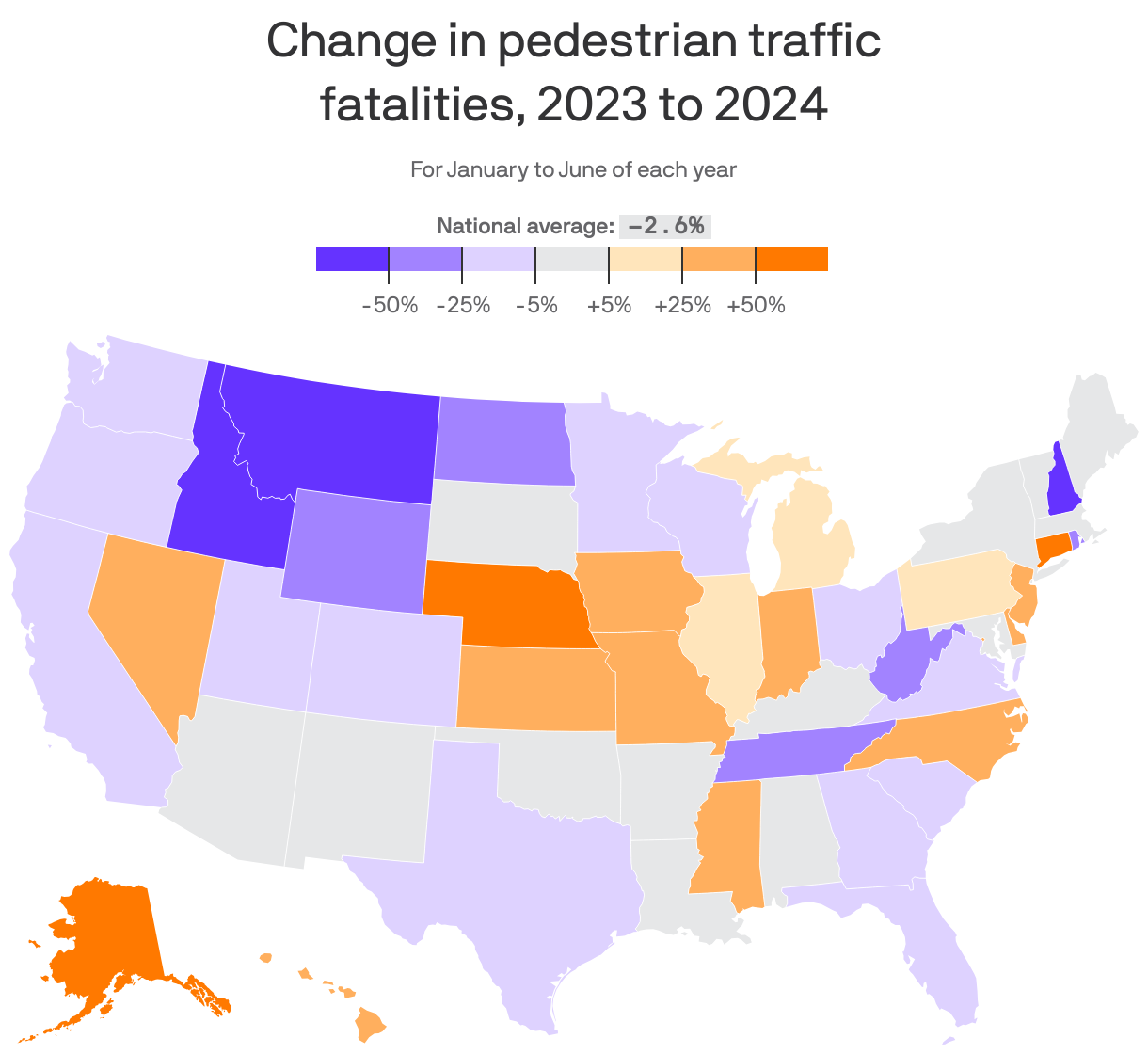
There were fewer pedestrian deaths on U.S. roads in the first half of 2024 compared to a year prior, but nearly 50% more than a decade ago, a new projection finds.
Why it matters: Cities worldwide are trying to reduce pedestrian deaths — so many of which are utterly avoidable — though "Vision Zero" programs, lower speed limits, "traffic calming" road design and more.
Driving the news: 3,304 pedestrians were killed on roads nationwide between January and June 2024, per a new Governors Highway Safety Association (GHSA) preliminary report.
- That's 88 fewer deaths than during the same period in 2023, but 1,072 more than during the same period in 2014.
Stunning stat: "Between the first half of 2014 and 2024, pedestrian deaths have risen at a rate almost seven times faster than population growth," the report finds.
Zoom in: Nebraska (+150%, 6 more deaths), Alaska (+66.7%, 2 more deaths) and Connecticut (+56.5%, 13 more deaths) had the biggest percentage increases in pedestrian deaths in the first half of 2024 compared to the same period in 2023.
Yes, but: States with more people tend to have more overall pedestrian deaths.
- When adjusting for population, New Mexico (2.07), Mississippi (1.94) and Nevada (1.9) had the highest rates of pedestrian deaths per 100,000 residents in the first half of 2024.
- The per-100,000 rate increased the most in Washington, D.C. (+0.54) in the first half of 2024 compared to the same period in 2023, while it decreased the most in Wyoming (-0.52).
What they're saying: It's "encouraging to see states with historically higher fatality counts report large percentage decreases in 2024," the report notes, highlighting Tennessee (-30%), Colorado (-21%), and Washington (-19.7%).
What's next: "There are proven strategies to improve pedestrian safety," per GHSA, including "building a system that minimizes pedestrians' exposure to vehicles ... encourages safe road use through education and enforcement, and prioritizes visibility between drivers and pedestrians."
