Half of 2023's fossil-fuel carbon emissions tied to 36 companies

Add Axios as your preferred source to
see more of our stories on Google.
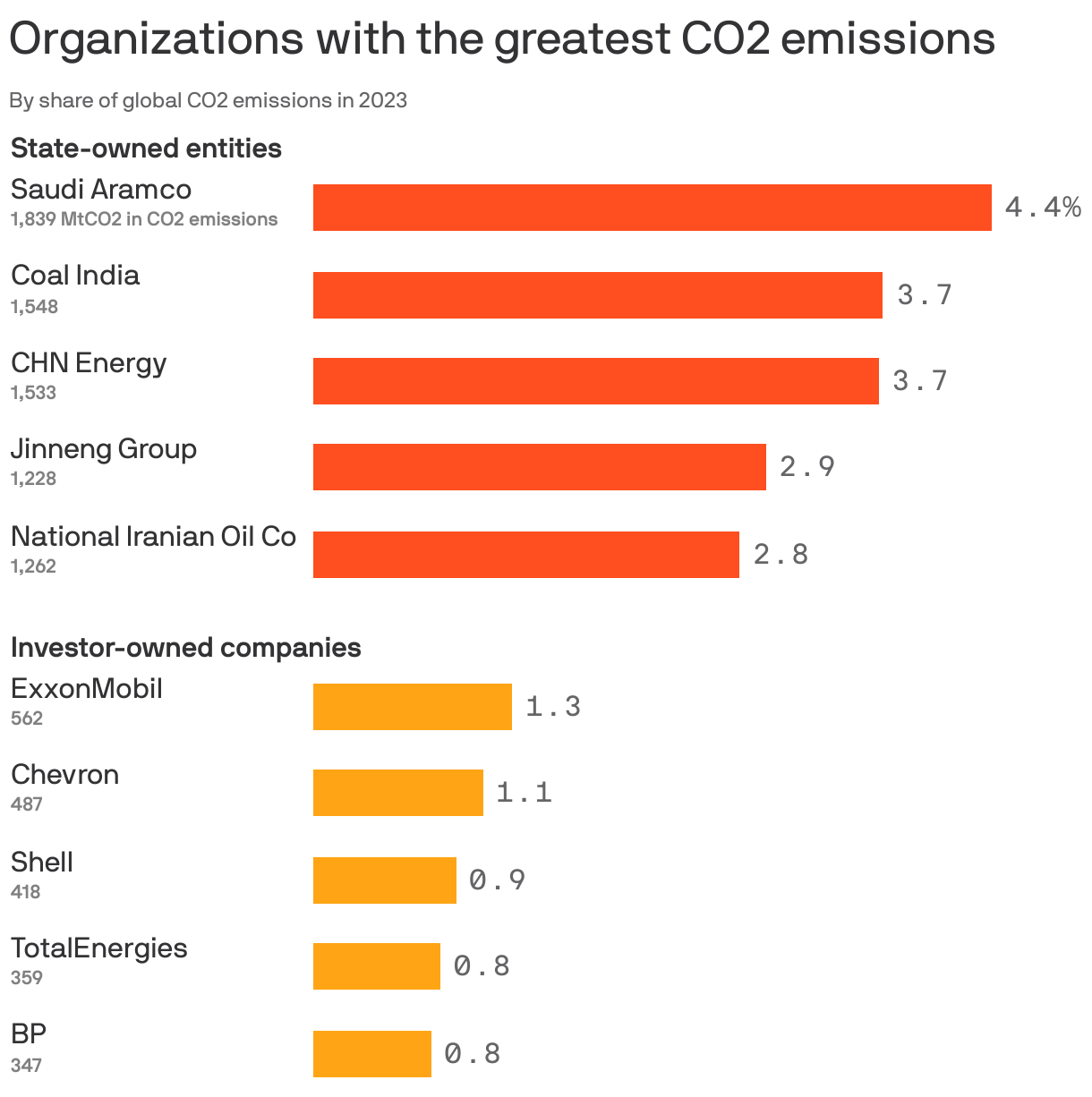
A new analysis finds that a few companies are responsible for much of the world's greenhouse gas emissions, and that state-owned firms dominate the list of top emitters compared to investor-owned oil and gas companies.
Why it matters: Tying historical fossil-fuel emissions to specific companies can establish accountability for climate change-related harms.
- Such accountability is taking the form of new laws as well as legal and regulatory action.
Zoom in: The "Carbon Majors Database" from the London-based climate think tank InfluenceMap shows that state-owned companies were tied to a majority — 52% — of global emissions in 2023.
- Just 36 oil, gas, coal and cement producers contributed more than 50% of the world's fossil fuel-linked CO2 emissions.
- In all, 16 out of the top 20 global emitters in the database, which traces emissions from 1854 through 2023, are state-owned entities.
- The new report released Wednesday shows that many of the world's biggest emitters increased their emissions in 2023 compared to the previous year.
- This was particularly true with the energy-intensive cement industry.
The intrigue: As was the case in 2022, Chinese companies contributed more fossil fuel-related CO2 emissions than companies from any other country, befitting the world's top emitter.
- Chinese companies were responsible for 23% of global fossil fuel and cement CO2 emissions in 2023, the report found.
- The top state-owned companies were led by Saudi Aramco, which was responsible for 4.38% of global CO2 emissions.
- The top investor-owned companies were on the hook for a lower percentage of global emissions, led by ExxonMobil at 1.28% and Shell and Chevron with about 1% each.
Between the lines: This is the first year the database includes detailed information on coal emissions from China, Russia and several other nations, rather than only national-level details.
- This shows that CHN Energy, a Chinese coal company, was the third-biggest emitter of fossil fuel-related CO2 in 2023, and the 14th largest historically.
Yes, but: The Carbon Majors database largely assigns responsibility for global emissions, and hence human-caused climate change, to companies that extract fossil fuels.
- Other ways of accounting for climate change responsibility could look further down the chain to power companies that burn the fuels, automakers and others.
Zoom out: The database was first produced in 2013 and is now an annual report produced by InfluenceMap.
- It has been cited in efforts to pass climate superfund laws in Vermont and New York.
- In addition, researchers have used its findings to tie extreme weather events to specific companies, rather than just carbon emissions in general.
- Advocacy groups are also using it for legal actions against fossil fuel companies and leaders.
What they're saying: "While a few profit-driven corporations continue to expand fossil fuel infrastructure, climate disasters are hitting hardest in regions where people have contributed the least," said Johan Rockström, director of the Potsdam Institute for Climate Impact Research, in a statement.
- "A global turnaround is not just urgent — it's essential, and it must start with these key players."
