Tulsa reparations plan unveiled to help race massacre victims and descendants

Add Axios as your preferred source to
see more of our stories on Google.
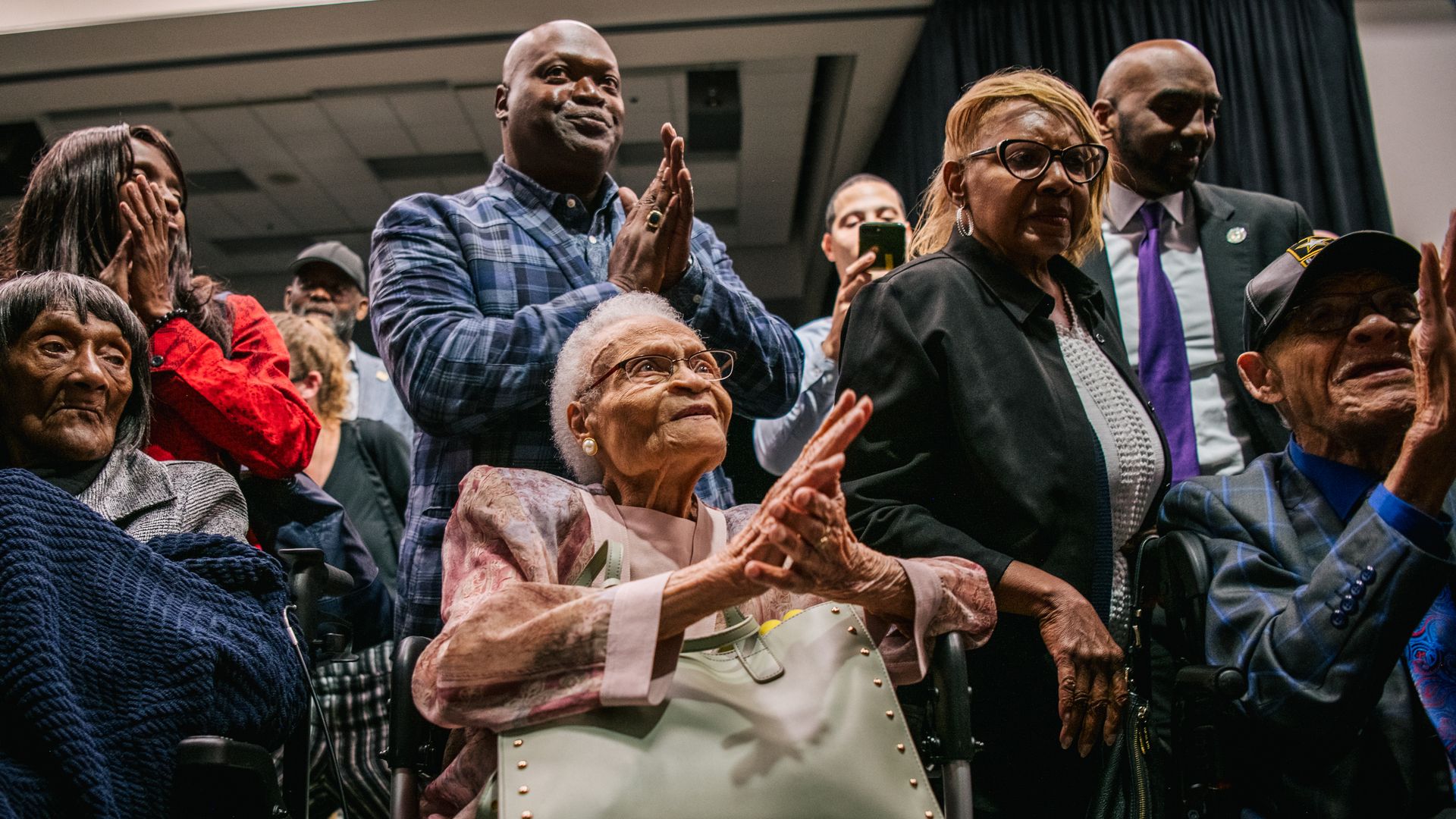
Tulsa Race Massacre survivors Lessie Benningfield Randle, Viola Fletcher, and Hughes Van Ellis sing together at the conclusion of a rally during commemorations of the 100th anniversary of the Tulsa Race Massacre on June 01, 2021, in Tulsa, Oklahoma. Photo: Brandon Bell/Getty Images
Advocates in Oklahoma have announced a new plan seeking reparations, preservation and economic development for Tulsa Race Massacre survivors and their descendants.
Why it matters: Details for Project Greenwood, which was named for Tulsa's once thriving Black economic hub, were unveiled a month after the outgoing Biden administration's Justice Department concluded "no avenue for prosecution exists" for the crimes carried out during the 1921 massacre.
- It was one of the deadliest series of killings in U.S. history.
The big picture: The project follows years of lobbying by the group Justice For Greenwood, which has sought more acknowledgment and compensation for massacre victims and descendants.
Zoom in: The plan seeks to create a victim compensation fund and cash payments for the families of known victims.
- It also calls for business grants, scholarships, employment and city contract preferences for documented descendants.
- It asked that victims and descendants be immune from Tulsa taxes, fees and utility bills.
Zoom out: The project also demands that the city do a "land audit" of the historic Greenwood neighborhood and determine if the land was unlawfully seized after the massacre. If land is determined to be illegally taken, the plan calls for it to be returned to families.
- The plan seeks to create a level 1 trauma hospital in the area and name it after Dr. A.C. Jackson, a Black surgeon killed during the massacre.
- The project did not have a dollar amount, but it is likely to cost millions.
What they're saying: "Project Greenwood is good for the survivors and descendants because it provides them a tangible benefit to move forward," Damario Solomon-Simmons, an attorney who represents the last two surviving victims, said at a press conference Tuesday.
- Solomon-Simmons, who helped create the plan, said it was not race-based but "harm-based."
- "You cannot move forward as a city with those claims being unpaid."
Jacqueline Weary, a descendant of massacre survivor John Emerson, Sr., said she often wonders about the economic cost for victims' families had they'd been compensated years ago for lost homes and property.
- "It was an atrocity. Imagine what would happen if the money was still here for the descendants to have their own business right now."
The intrigue: Tulsa Mayor Monroe Nichols said in a statement he'll be addressing the plan in the coming weeks.
- "Project Greenwood reflects the unshakable resolve of the last living massacre survivors and descendants to address the generational impact of Greenwood's destruction and move Tulsa forward.
- Nichols said he looks forward to implement significant elements of the plan in partnership with Justice for Greenwood.
- Former Tulsa Mayor G.T. Bynum had said reparations would "divide" the city, and instead supported developing property where Black Wall Street once stood.
Context: On May 31, 1921, a white mob descended on Greenwood after unsubstantiated rumors that a Black teen assaulted a white woman.
- City officials deputized members of a white mob who randomly shot and killed innocent Black residents.
- In 24 hours, the mob torched 35 blocks of Black-owned businesses, churches, homes, a library, a school, and a hospital.
- The vigilantes wiped out Greenwood's vibrant Black economic hub, known as "Black Wall Street."
No one was charged in the mass killing of some 300 Black residents.
- The city later prevented many Black residents from rebuilding by refusing to sell them construction materials. Many moved into makeshift tents.
- Researchers recently found a mass grave at Oaklawn Cemetery that some believe are victims of the race riot.
