D.C. plane crash: What we know about the collision and recovery efforts


Add Axios as your preferred source to
see more of our stories on Google.
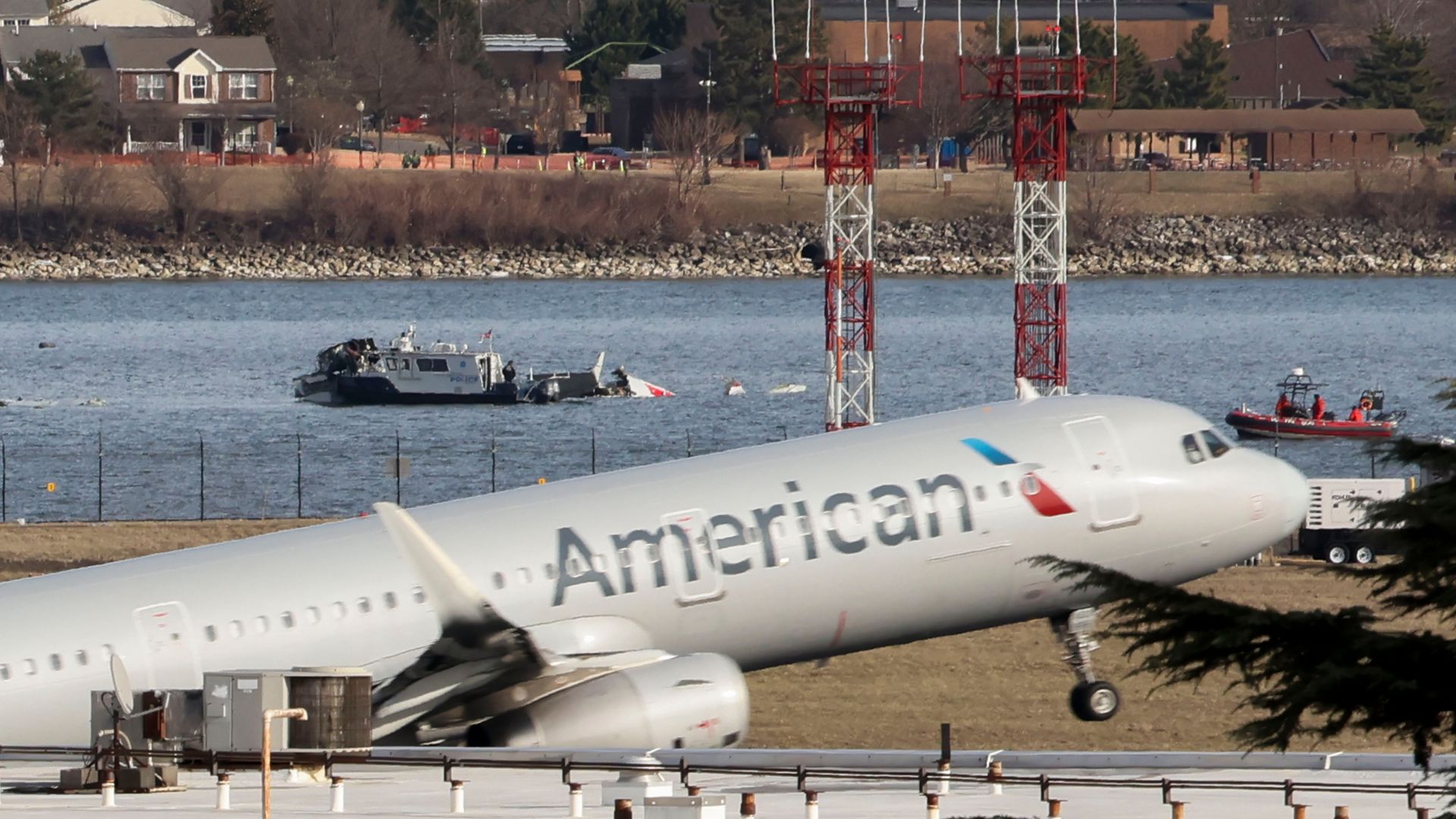
An American Airlines airplane takes off from Ronald Reagan Washington National Airport (DCA) as emergency crews work at the crash site on the Potomac River after a passenger jet collided with a helicopter while landing in Arlington, Virginia. Photographer: Tierney L. Cross/Bloomberg via Getty Images
Investigators have recovered the black boxes of the passenger jet involved in a collision with an Army helicopter near Reagan National Airport outside D.C. — the deadliest aviation disaster in the U.S. in more than 20 years.
The big picture: The American Airlines passenger jet with 64 people on board and U.S. Army Black Hawk helicopter carrying three soldiers collided on Wednesday night, sending both aircraft plunging into the Potomac River. There are no known survivors.
- The rescue mission shifted to a recovery operation early Thursday, but at least a dozen people were still missing by day's end. Investigators are working to determine the exact cause of the crash.
- The airport resumed flight operations Thursday morning, but dozens of flights have been delayed or cancelled since. Passengers were advised to check with their airlines for specific flight information.
- Reagan National Airport has the country's busiest runway — which has long caused concerns about overcrowding at the airport and understaffing among air traffic controllers, Axios D.C.'s Mimi Montgomery reports.
Go deeper: Here's what we know about the victims ... How D.C.'s first and last responders are recovering the dead
Situation report: The National Transportation Safety Board intends to have a preliminary report on the crash within 30 days, board member Todd Inman said during a briefing Thursday afternoon.
- "We do not know enough facts to be able to rule in or out human factor, mechanical factors," Inman said.
- President Trump delivered remarks from the White House earlier Thursday afternoon, briefly calling for national unity before attacking his Democratic predecessors and blaming DEI policies for the crash.
Reality check: Statistics from the U.S. Census Bureau and IPUMS show air traffic controllers and airfield operations specialists are predominately male and white. Go deeper.
Zoom in: The president later signed a memorandum in keeping with an earlier one ordering the Transportation secretary and FAA administrator "to review all hiring decisions and changes to safety protocols" made during the previous four years.
- It also directs them "to take such corrective action as necessary to achieve uncompromised aviation safety, including the replacement of any individuals who do not meet qualification standards," Trump added in the memo.
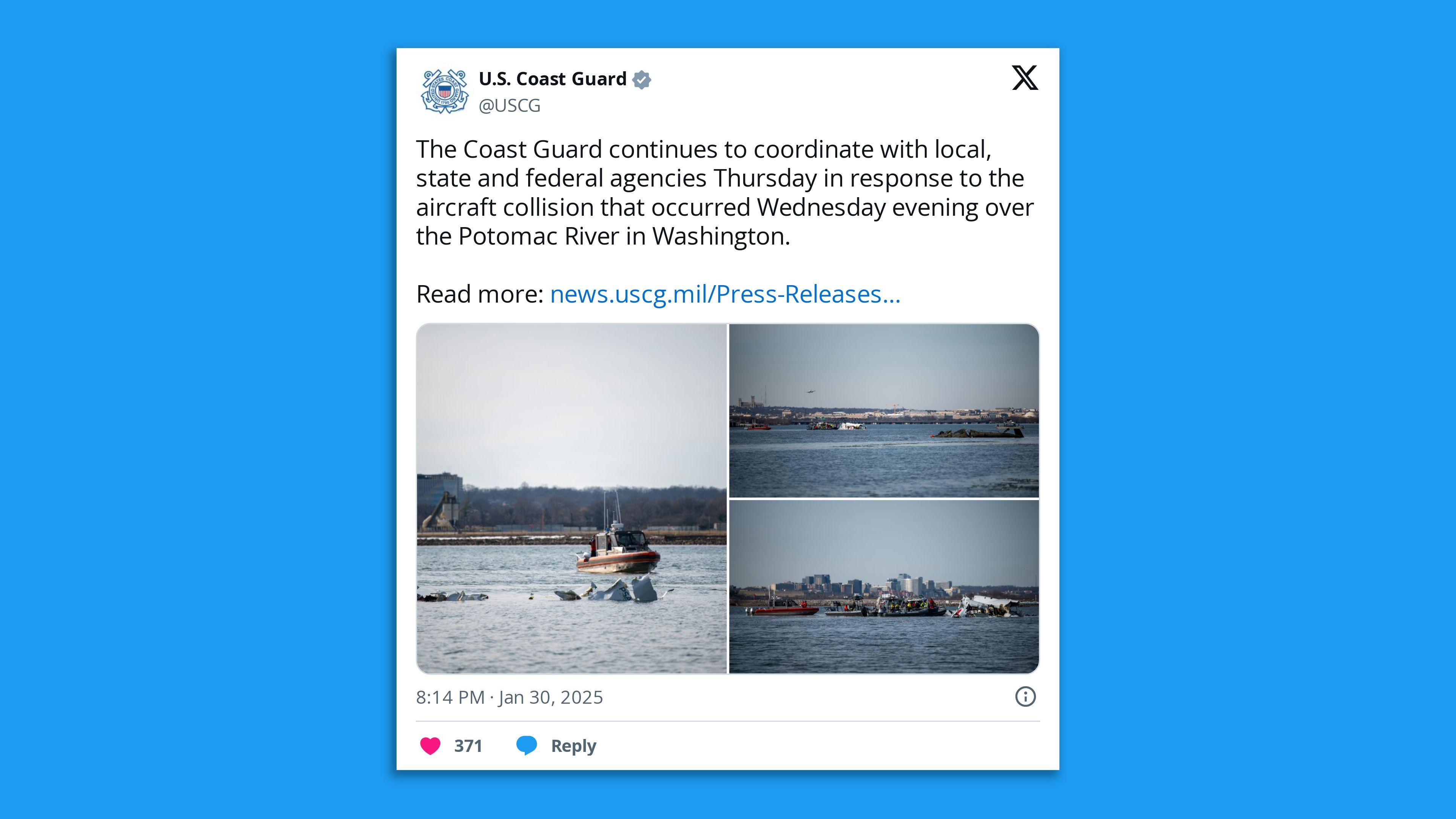
Catch up quick: Remnants of the two aircraft discovered included the fuselage of the American Airlines commercial plane, which was found in three sections in "waist-deep" water, Transportation Secretary Sean Duffy said at a briefing Thursday morning.
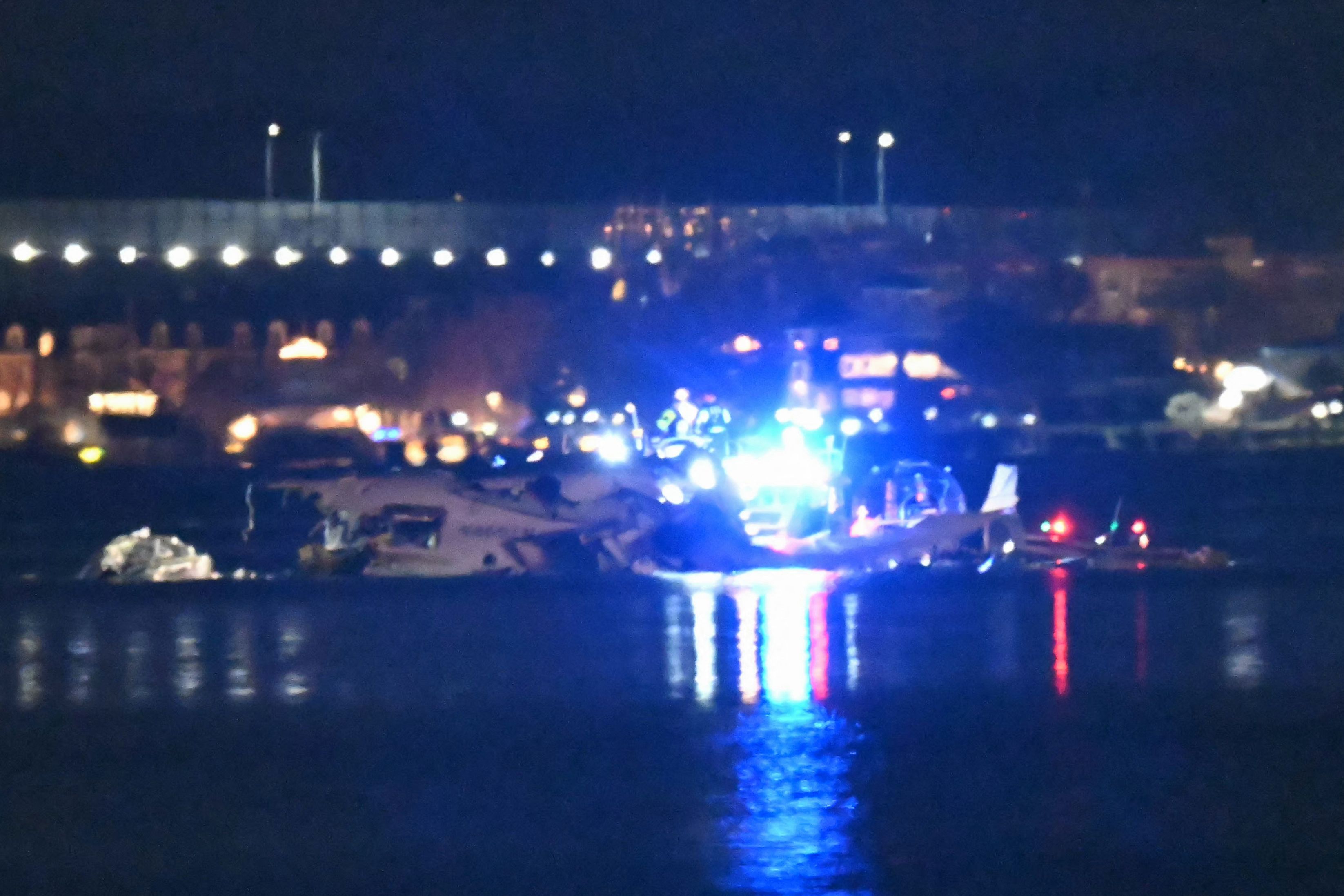
- Rescue operations along the frigid river began soon after the crash, around 9pm ET. Some 300 people were involved in those efforts, per John Donnelly, chief of D.C. Fire and EMS.
Speculation mounts on "absolute tragedy"
"Everything was standard in the leadup to the crash," Duffy said, while declining to speculate about where things went so tragically wrong.
- Defense Secretary Pete Hegseth said in a video statement Thursday the Army unit involved in the collision, the 12th Aviation Battalion, was placed on a 48-hour operational pause while the incident is reviewed.
- Army Secretary nominee Dan Driscoll called the incident an "absolute tragedy" during a hearing before the U.S. Senate Committee on Armed Services. "We might need to look at where is an appropriate time to take training risk and it may not be near an airport like Reagan," he added.
- The New York Times reported Thursday that the helicopter flew outside its approved flight path and that the air traffic controller was juggling two jobs.
How the crash happened
American Eagle Flight 5342, traveling from Wichita, was approaching DCA, sometimes described as having America's busiest runway.
- Visibility was good at the time of the crash, with winds blowing out of the northwest. An advisory for high winds had expired earlier in the evening.
- Both the jet and the helicopter were following "standard flight patterns," Duffy told reporters.
- Hegseth noted the helicopter was manned by a "fairly experienced crew" that was appropriately equipped with night vision goggles.
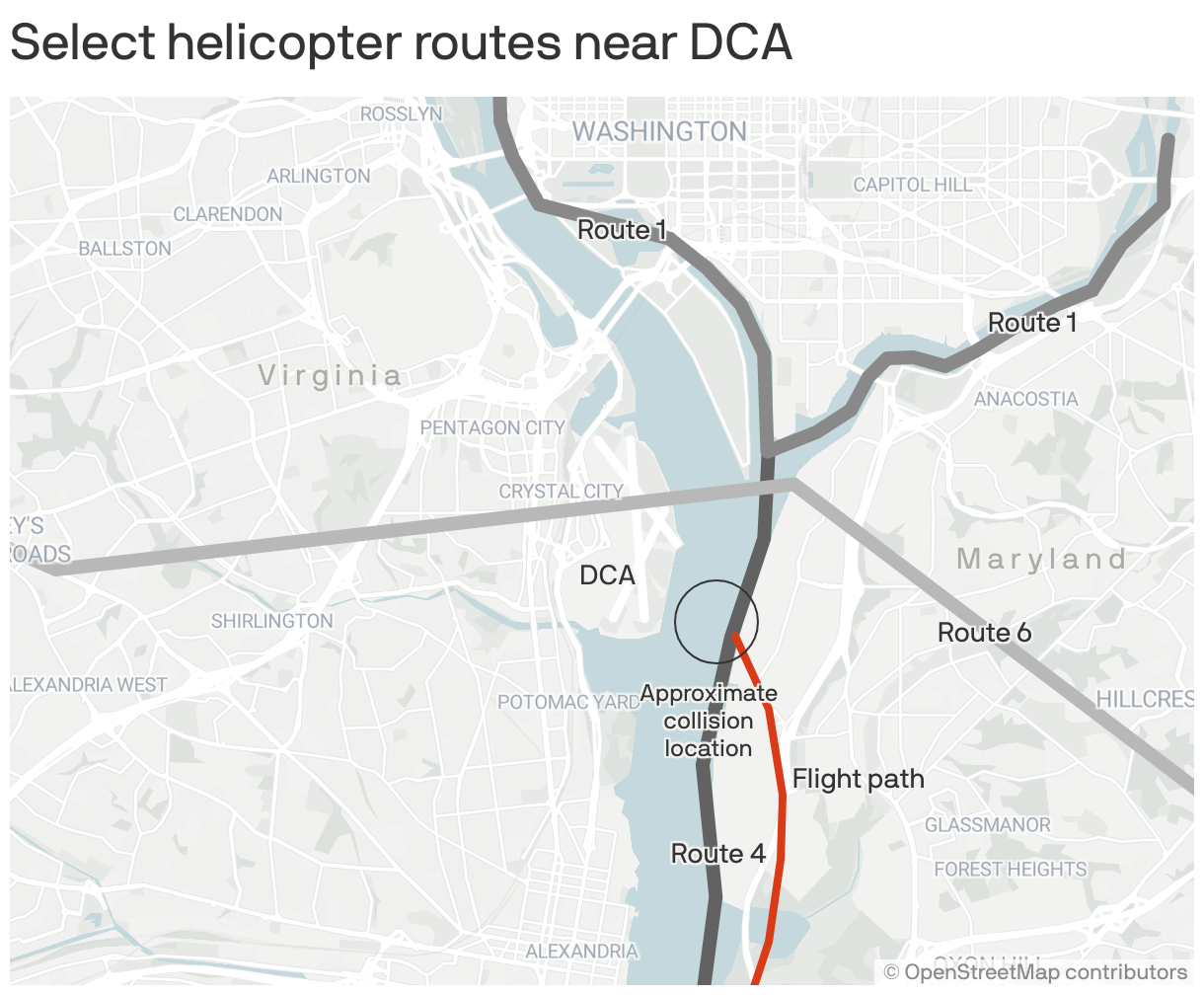
The U.S. Army UH-60 helicopter was on a training exercise out of Fort Belvoir, Virginia, a Pentagon spokesperson said.
- The helicopter was told to maintain visual separation with the plane — essentially, "see and avoid," Axios aviation expert Alex Fitzpatrick notes. That's not an unusual procedure, despite a Truth Social post from Trump questioning why the control tower hadn't given more direct instructions.
- It's also not unusual to see Black Hawks flying low along the Potomac. This is some of America's busiest airspaces due to the presence of both military and commercial aircraft.
What remains unclear is why the helicopter did not divert from its path and collided with the jet as it made its final descent.
- "Do I think this was preventable? Absolutely," Duffy said, without offering specifics.
Who was on board
U.S. Figure Skating confirmed "several" of its members were on board, as well as family members of some athletes returning from a development camp in Wichita.
- The Kremlin confirmed Russian figure skaters and other citizens were on board and China's state media reported two Chinese citizens were on the plane, which was carrying 60 passengers and four crew.
- Officials and family confirmed Ryan O'Hara, the crew chief of the helicopter, and Chief Warrant Officer 2 Andrew Eaves were two of the three service members aboard the helicopter.
Recovery operations continue
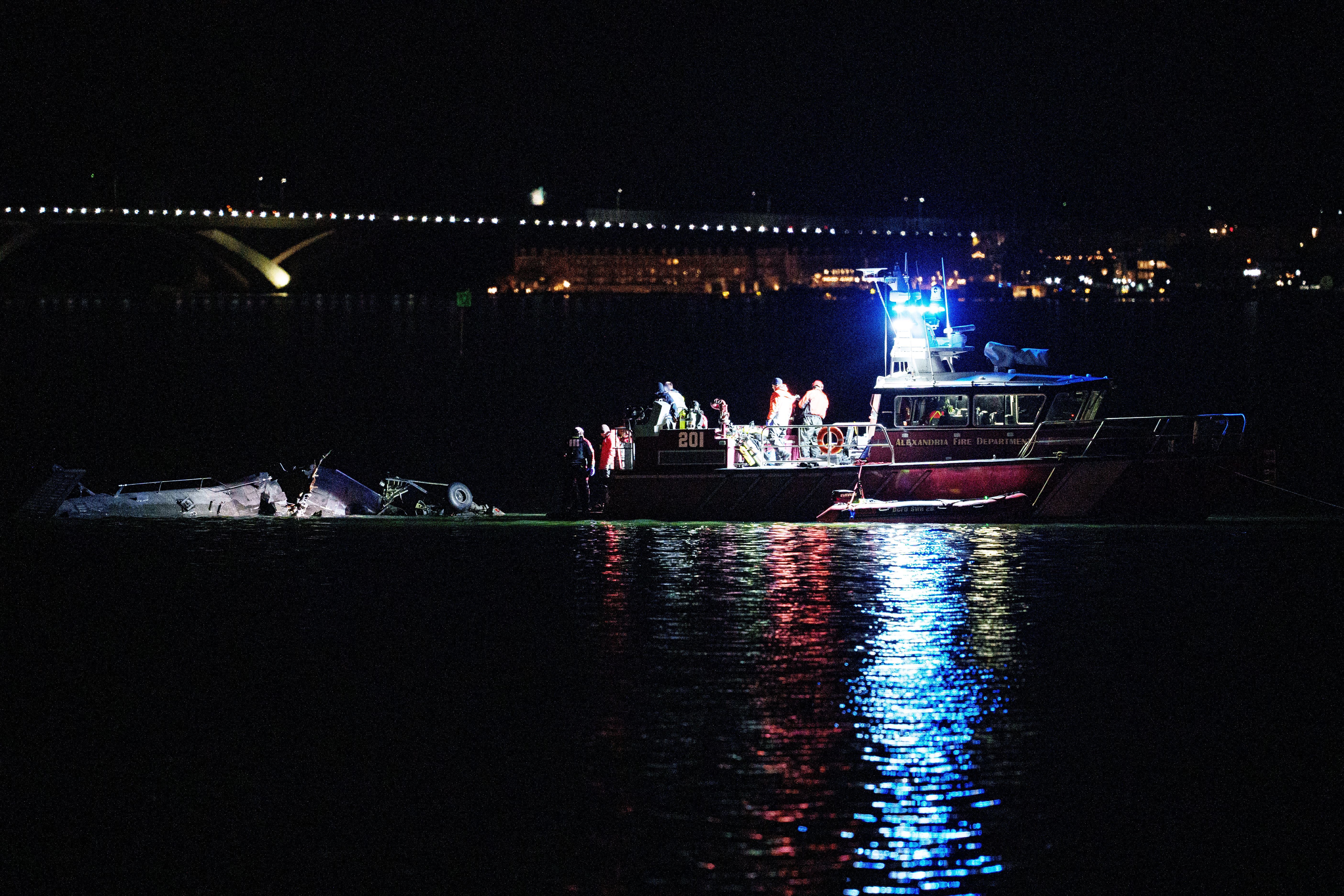
Recovery efforts are ongoing in and around the Potomac. Based on an initial count, around 30 people had yet to be recovered as of Thursday morning.
- Dive teams scoured the site as helicopters from law enforcement agencies across the region flew over the scene in a methodical search for bodies, per AP.
Deadly plane crashes in the U.S.
Fatal crashes of commercial aircraft in the U.S. have become a rarity.
- The last was in 2009 near Buffalo, N.Y. All 49 passengers and crew above Colgan Air Flight 3407 were killed when the Bombardier DHC-8 propeller plane crashed into a house. A person on the ground also was killed.
- Other than the Pentagon attack on 9/11, last night's collision is the worst air tragedy in the D.C. area since the Air Florida Flight 90 crash on Jan. 13, 1982, which killed 78 when it hit the 14th Street Bridge and crashed into the Potomac.
This story has been updated throughout and will continue to be updated as new information comes in.
