Passenger jet prototype breaks speed of sound, decades after Concorde

Add Axios as your preferred source to
see more of our stories on Google.
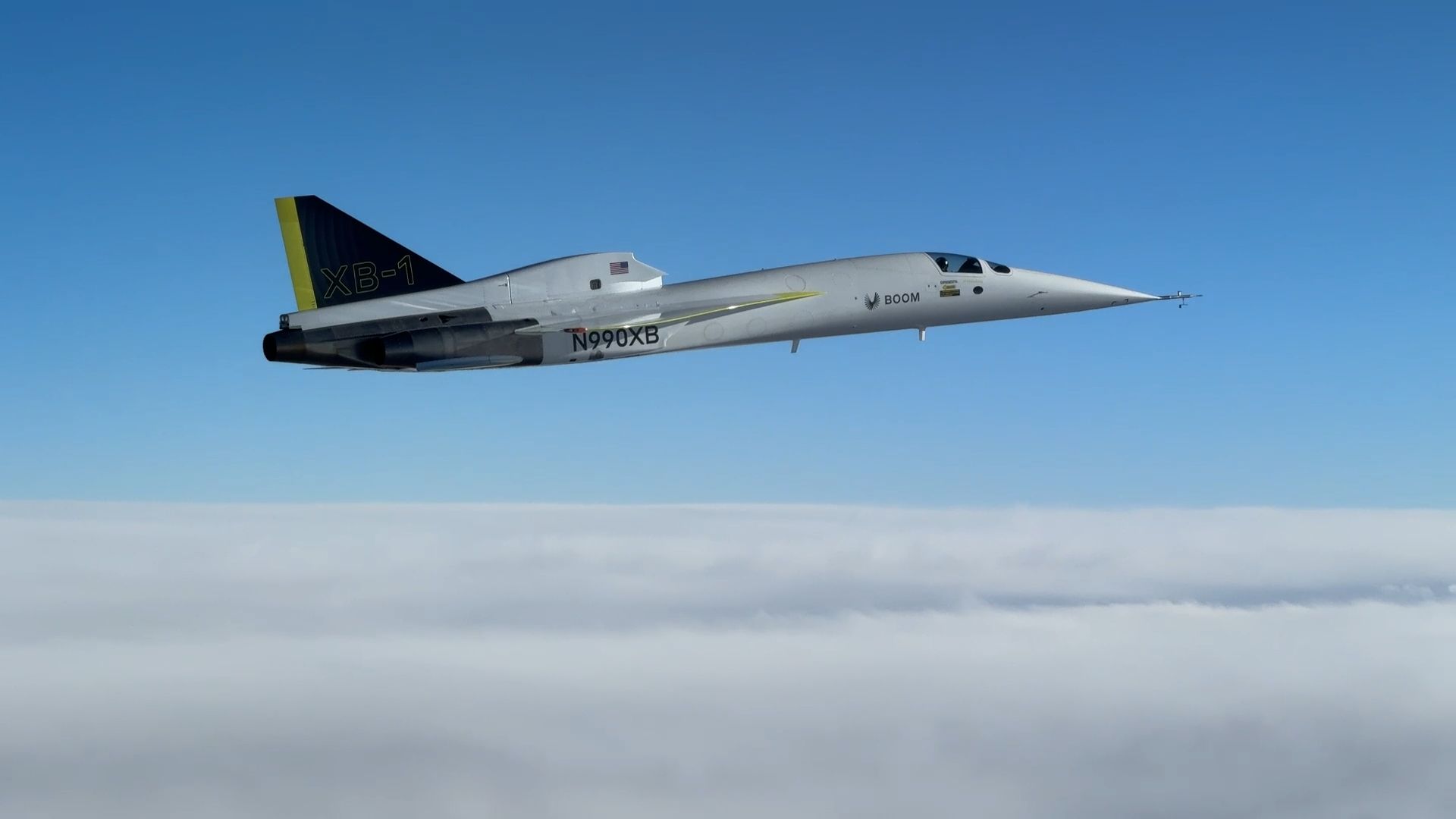
Boom Supersonic's XB-1 prototype breaks the sound barrier on Jan. 28. Photo: Courtesy of Boom
A prototype of a passenger jet designed to succeed the supersonic Concorde broke the sound barrier for the first time on Tuesday above the Mojave Desert in California.
Why it matters: Exceeding Mach 1 speed — 770 miles per hour — is an important milestone in the quest by Boom Supersonic, a Denver-based startup, to resurrect high-speed air travel 22 years after the Concorde retired.
- It's also a bid to reestablish American leadership in aviation amid a broader race for supremacy in AI, space exploration and other technologies, Boom CEO Blake Scholl tells Axios.
- It's the first independent company to design, build and fly a supersonic aircraft. (The Concorde was a joint development effort between the governments of France and the United Kingdom.)
Driving the news: Boom's supersonic flight took place in the same airspace near Edwards Air Force Base where legendary Air Force test pilot Chuck Yeager first exceeded the speed of sound in 1947.
- With Boom Chief Test Pilot Tristan "Geppetto" Brandenburg at the controls, the XB-1 demonstrator plane entered the supersonic corridor and reached an altitude of 35,290 feet before accelerating to Mach 1.1 (652 knots or 750 miles per hour).
- Mike Bannister, former chief Concorde pilot for British Airways, narrated the livestream of the flight, along with two Boom engineers.
- "This is aviation's Falcon 1 moment," Boom's Scholl said, referring to Space X's first rocket, which was the world's first privately developed launch vehicle to reach orbit in 2008.
Between the lines: The XB-1 prototype (named after Yeager's iconic aircraft, the Bell X-1) is one-third the size of the Overture passenger jet that Boom plans to use for passenger flights.
- Like Overture, it's made from lightweight carbon fiber materials and features an augmented reality vision system to help pilots see over the plane's long nose during high-angle takeoffs and landings.
- The plane could carry up to 80 passengers at Mach 1.7, about twice the speed of today's airliners, the company says. That could mean flying from Washington, D.C., to Paris in four hours, or from San Francisco to Tokyo in six hours.
- It's designed to fly on 100% sustainable aviation fuel (SAF) made from feedstocks like household solid waste, algae or used cooking oil. That means dramatically lower carbon emissions than traditional jet fuel.
- SAFs are in short supply, however, meaning until production increases, much of the plane's environmental benefits won't be immediately realized.
Where it stands: Last summer, Boom finished construction on a factory at the Piedmont Triad International Airport in Greensboro, N.C., that could employ up to 2,400 people by early next decade.
- When operating at full capacity, it could produce as many as 66 planes per year.
- The plane's engines will be produced in San Antonio, Texas.
- The company has 130 orders and "pre-orders" from American Airlines, United Airlines, and Japan Airlines — a five-year pipeline of production, Scholl says.
- Boom expects to begin commercial service by 2029.
The big picture: Supersonic flight has the potential to revolutionize commercial air travel, but there are multiple technical and business challenges.
- British Airways and Air France flew the Concorde from 1976 to 2003 on international routes like New York to London in under three hours, but couldn't do it profitably.
- Boeing-backed Aerion shut down in 2021, citing a lack of capital.
- Another startup, Hermeus, is developing even faster "hypersonic" aircraft for defense purposes.
What's next: In December, Boom said it had raised $100 million (albeit at a lower valuation) from tech investors including OpenAI's Sam Altman, LinkedIn's Reid Hoffman and others, primarily to fund development of the plane's proprietary engine.
- It has raised nearly $600 million from investors to date, and received an additional $250 million from the U.S. Air Force, airline customer deposits and local incentives in North Carolina.
- Still, Boom will need a lot more money to fulfill its plans.
- "This is a multibillion dollar program that we've planned for since our inception, and our milestone-based approach to fundraising continues to be the best approach for the company and our supporters," a spokeswoman said.
- Or as Scholl puts it: "What we really we need to show is that Boom as a team is able to execute this successfully, and [today's flight] is the proof point."
