Bank of Japan raises rates, shrugging off Trump risks

Add Axios as your preferred source to
see more of our stories on Google.
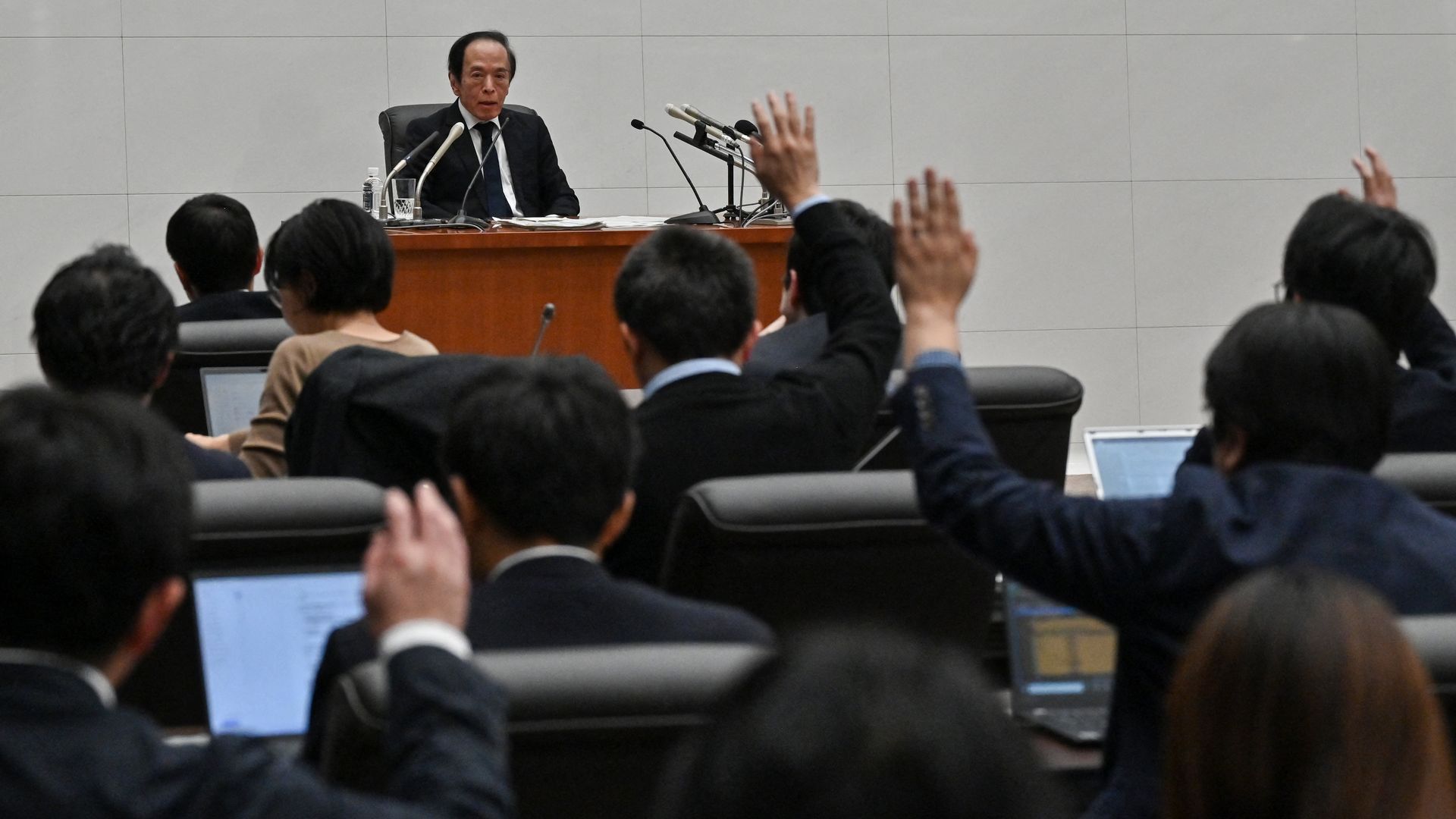
Bank of Japan governor Kazuo Ueda on Friday. Photo: Richard A. Brooks/AFP via Getty.
In the eyes of Japanese economic policymakers, there have been few surprises from the nearly week-old Trump administration.
- That, in part, gave them confidence to raise interest rates again Friday.
Why it matters: The Bank of Japan had held off hiking rates late last year, preferring instead to wait out any economic surprises from the White House that might jolt global financial markets.
- So far the opposite has been the case: Trump's tariff plans were intense on the campaign trail but have chilled since he took office.
What they're saying: "The actions taken by the new U.S. administration so far have been within expectations," Bank of Japan governor Kazuo Ueda said at a news conference in Tokyo after hiking rates to the highest in over 15 years.
- "There has been no major confusion in the markets," he added.
Driving the news: After a strong run-up since Trump's election win, the U.S. dollar has weakened against a basket of currencies, including the Japanese yen. The reason: the hardcore trade regime Trump promised no longer seems like a sure thing.
- The flip side of a weaker dollar is a stronger yen, minimizing the risks of importing more inflation pressures than desired by Japan's policymakers.
- Recall when the run-up in dollar strength in August blew up a yen trade that wreaked havoc on financial markets.
What to watch: Japan's decades-long deflationary trap looks firmly in the past, the key reason the nation's central bank moved ahead with a rate hike.
- Japan is the only major economy with rising rates; elsewhere, rates are falling.
- Still, Japan is raising rates from a deeply negative territory. Its roughly 0.5% rate, as of today, is still quite low.
The bottom line: Trump did not derail Japan's expected rate hike, though it's no sure bet that Trump trade policies will be benign.
- Elsewhere in Asia, central banks in Singapore and Korea are attempting to Trump-proof their economies with pre-emptive rate cuts as they brace for trade turmoil.
