Musk & Milei: How an international bromance could shape Trump-era spending cuts

Add Axios as your preferred source to
see more of our stories on Google.
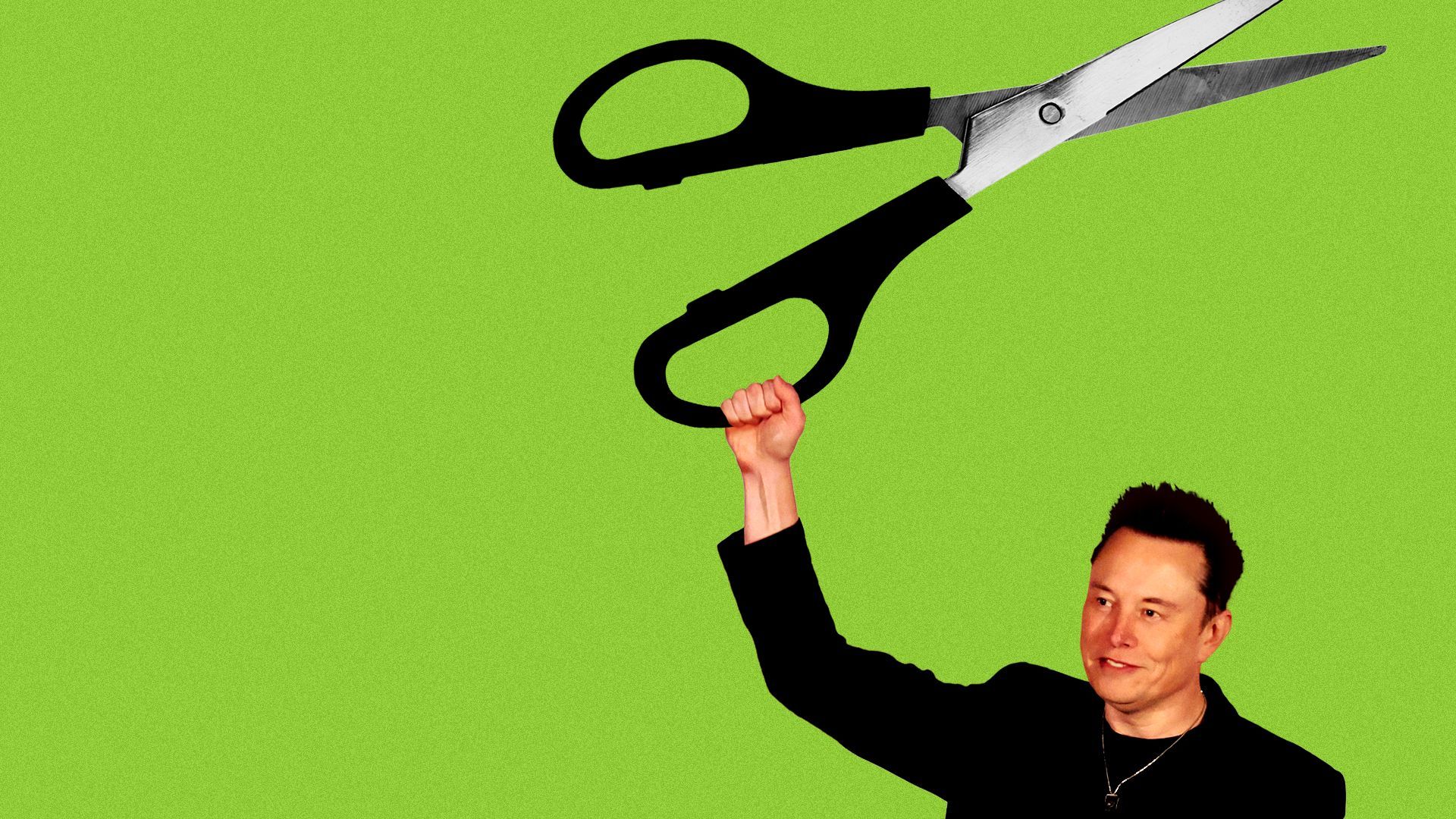
Elon Musk. Photo illustration: Sarah Grillo/Axios. Photo: Alex Wong/Getty Images
Elon Musk wants his crusade to radically slash federal spending to resemble what is underway in Argentina, where the leader's name is now synonymous with drastic budget cuts.
Why it matters: Musk previewed last month how influential he might be on Trump-era fiscal matters.
- His admiration of the "chainsaw-like" approach in Argentina shows how hard he could push to axe the size of America's government — maybe with some success.
What they're saying: "The example you are setting with Argentina will be a helpful model for the rest of the world," Musk told Argentine President Javier Milei in an exchange on social media platform X.
- Vivek Ramaswamy, tapped by President-elect Trump to lead the Department of Government Efficiency (DOGE) alongside Musk, said late last year: "A reasonable formula to fix the U.S. government: Milei-style cuts, on steroids."
The big picture: The U.S. fiscal situation is starkly different from that of Argentina, a nation prone to financial and economic crises stemming from government overspending and sovereign debt defaults.
- Milei, a self-described "anarcho-capitalist," has been cheered by U.S. right-wing politicians who see his rise as an example of Trump-like populism spreading beyond America's shores.
- Most appealing to Musk and others might be how the eccentric economist — known to pose with a chainsaw to signal his affinity for spending cuts — has defied global naysayers with unconventional policies that look successful.
"Milei has changed the conversation about economic policy — not only in Argentina, but I think maybe a little bit more generally, too," Steve Hanke, a Johns Hopkins University professor who advised Argentina's economic officials in the 1990s, tells Axios.
- "But there is a tremendous amount of low-hanging fruit to pick in Argentina — it's just a different system," Hanke adds.
Between the lines: Milei cut government spending by about 30%, roughly in line with the share of spending DOGE wants to eliminate in the U.S.
- But spending cuts in Argentina happened in a very different context. Milei's austerity measures aimed to arrest double-digit inflation after years of failed economic reforms.
"There's a real sense of urgency in Argentina, that something dramatic has to be done to save them from the abyss," Cato Institute's Johan Norberg, who interviewed Musk and Milei in Buenos Aires last year, tells Axios.
- "Musk almost single-handedly has shifted the debate in the U.S. — suddenly there is a discussion about spending and whether things can be reformed," Norberg says.
- "That doesn't mean there is a popular mandate to do it, because I'm not sure that sense of urgency is there."
Milei laid off thousands of federal workers, scrapped many of the subsidies supporting Argentinians, eliminated government agencies and halted public works projects.
- Inflation has plunged as a result of Milei's shock therapy: In November, it was 2.4%, well below the 25% when he took office.
Yes, but: Milei's shock therapy comes at a steep cost to the real economy. Poverty rates last year soared to the highest in 20 years, according to the government's statistics agency.
Much of Milei's economic shock therapy was done via executive orders, though legislation ultimately passed to support his efforts.
The other side: DOGE is not a government agency. It's akin to an advisory council with no official power — and no guarantee Congress will take up the group's spending cut plans.
- Cutting $2 trillion in spending would likely require cuts to politically popular programs. The downside impact might be a hit to economic activity.
The intrigue: Trump, who campaigned on policies that would increase spending, might be the biggest roadblock to DOGE's efforts.
- Over the weekend, Trump urged Congress to pass a bill that would — among other things — renew his first-term tax cuts, secure the border and remove taxes on tips.
Flashback: Previous efforts to crack down on government spending accomplished little. The Reagan administration created the Grace Commission, which similarly aimed to eliminate waste and inefficiency.
- Congress ignored most of the recommendations by the group, which was led by and named after industrialist Peter Grace.
- "Businessmen think they can go into the public sector and use business techniques to right the ship and make it efficient," says Hanke, who worked with the group as part of his role as an economist with Reagan's Council of Economic Advisors.
- Of the Grace Commission, Hanke says: "We didn't really accomplish very much."
