New Orleans attack mirrors global pattern of using vehicles as terror weapons

Add Axios as your preferred source to
see more of our stories on Google.
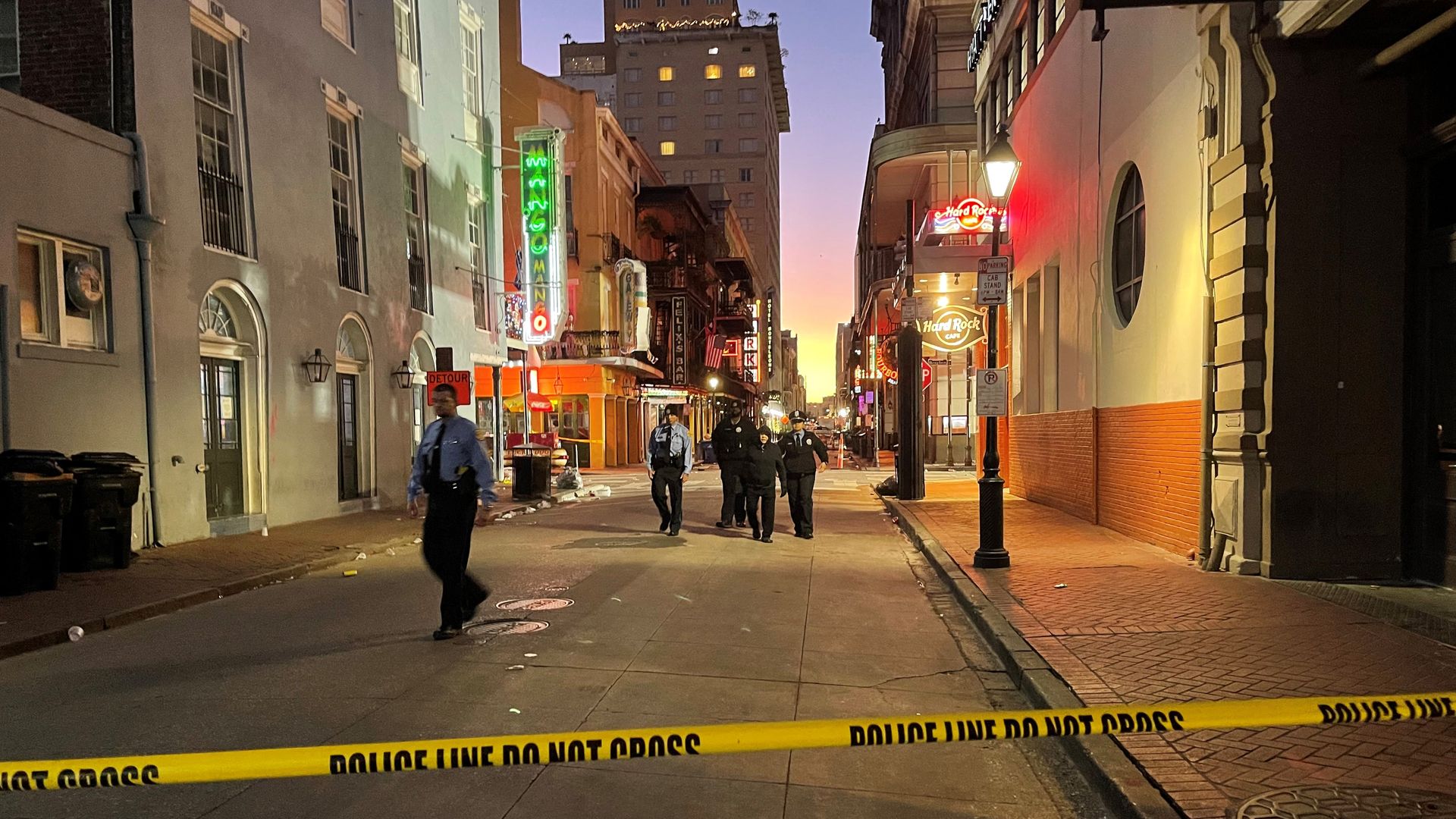
Police cordon off the area around the site of the overnight attack in the French Quarter of New Orleans on Jan. 1. Photo: Matthew Hinton/AFP via Getty Images
The pickup truck attack that killed 14 bystanders in New Orleans' French Quarter on New Year's is part of a persistent global trend of using vehicles as weapons.
The big picture: Vehicle attacks are becoming more common because they're incredibly simple and extremely difficult to prevent, experts warn.
- Experts told Axios that terror group ISIS, in particular, helped popularize using vehicles as weapons.
State of play: The New Orleans tragedy came less than two weeks after a car attack at a German Christmas market killed five and injured more than 200.
- According to the Mineta Transportation Institute's study of 184 vehicle attacks between 1963 and September 2019, 70% occurred after Jan. 1, 2014.
- While there is no one cause for the increase in attacks, one big factor stands out: Cars are abundant, readily available and can easily be used as a deadly weapon.
Catch up quick: While the exact motivations of the driver, 42-year-old U.S. Army veteran Shamsud-Din Jabbar, are unknown, an ISIS flag was found in the truck he rented.
- It's not clear if Jabbar, who died at the scene, had any formal affiliation with terrorist organizations, but he posted videos to social media indicating he was inspired by ISIS.
The rise of cars as weapons
Ramming attacks emerged as a terrorism tactic in the 1990s with Palestinian groups.
- At that time, groups like al-Qaeda favored spectacular, sophisticated mass casualty attacks, Javed Ali, a former counterterrorism official who teaches at the University of Michigan, said.
- ISIS' emergence presented a "very significant philosophical shift for jihadist operations" where attackers used "whatever means they could."
- In 2016, ISIS outlined how adherents outside the Middle East could attack using "vehicles that unexpectedly mount their busy sidewalks" in its online magazine, Rumiyah.
Recent attacks
The deadliest vehicle attack was in July 2016 when a driver killed 86 people on Bastille Day in Nice, France, using a rented 19-ton truck. ISIS called the driver its "soldier."
- After several similar attacks across Europe, Ali worried about that threat coming to America.
Then on Halloween 2017, an Islamic extremist from Uzbekistan drove a truck onto a New York bike path, killing eight.
Yes, but: These attacks are not just carried out by jihadist groups or sympathizers.
- One of the most prominent vehicle attacks in America occurred in 2017 when a white supremacist drove into a crowd of counter-protesters at a rally in Charlottesville, Virginia, killing one.
Between the lines: Violent tactics can skip across ideologies, said Timothy Clancy, a researcher at the University of Maryland's National Consortium for the Study of Terrorism and Responses to Terrorism.
- Just days after a high-profile terror attack on London Bridge killed eight in 2017, a man influenced by far-right ideas drove a van into worshippers outside a London mosque.
What we're watching: Researchers speculated that the ISIS-inspired vehicular ramming "contagion" had "burned itself out" before the New Orleans tragedy, Clancy said.
- "But sometimes these scripts can last for years or decades, and you have another one pop up and sort of refill the reservoir," he said.
- These attacks followed a similar template, Clancy said: rent a vehicle, weigh it down, ram into a group of people, and then get out with weapons to inflict more damage.
- Jabbar drove a rented F-150 Lightning, which weighs over 1,000 pounds more than a conventional Ford pickup truck and provides instant acceleration.
Preventing the threat
There are significant challenges to preventing these threats because urban areas host millions of pedestrians — and vehicles.
- Experts recommend erecting temporary or permanent barriers where people or gatherings are the most exposed to reduce fatalities.
- Additionally, there have been calls for increased scrutiny of truck or large van rentals.
Despite precautions, the threat remains.
- About 400 police officers were in the French Quarter over Tuesday night, New Orleans Police Department Superintendent Anne Kirkpatrick said Wednesday.
- A parked NOPD SUV had replaced malfunctioning bollards, but Jabbar swerved around it and onto the sidewalk to illegally enter the pedestrian-filled roadway.
- "We did indeed have a plan, but the terrorist defeated it," Kirkpatrick told reporters.
The bottom line: Attackers adapt to new protections, "and then that adaptation becomes part of the new contagion," Clancy said.
- Preventing attacks often means finding those who are at high risk of being radicalized first — and checking in with those who seem to be going down a dangerous path.
- "Because these are so statistically rare, it's very hard to put in place a policy designed to specifically stop them that doesn't have an unintended consequence higher than the cost of the act itself," he said. "And that's a hard balancing act."
Go deeper: What to know about Turo, the app used by the New Orleans and
