Elon Musk, volatility junkie, disrupts the regular order

Add Axios as your preferred source to
see more of our stories on Google.
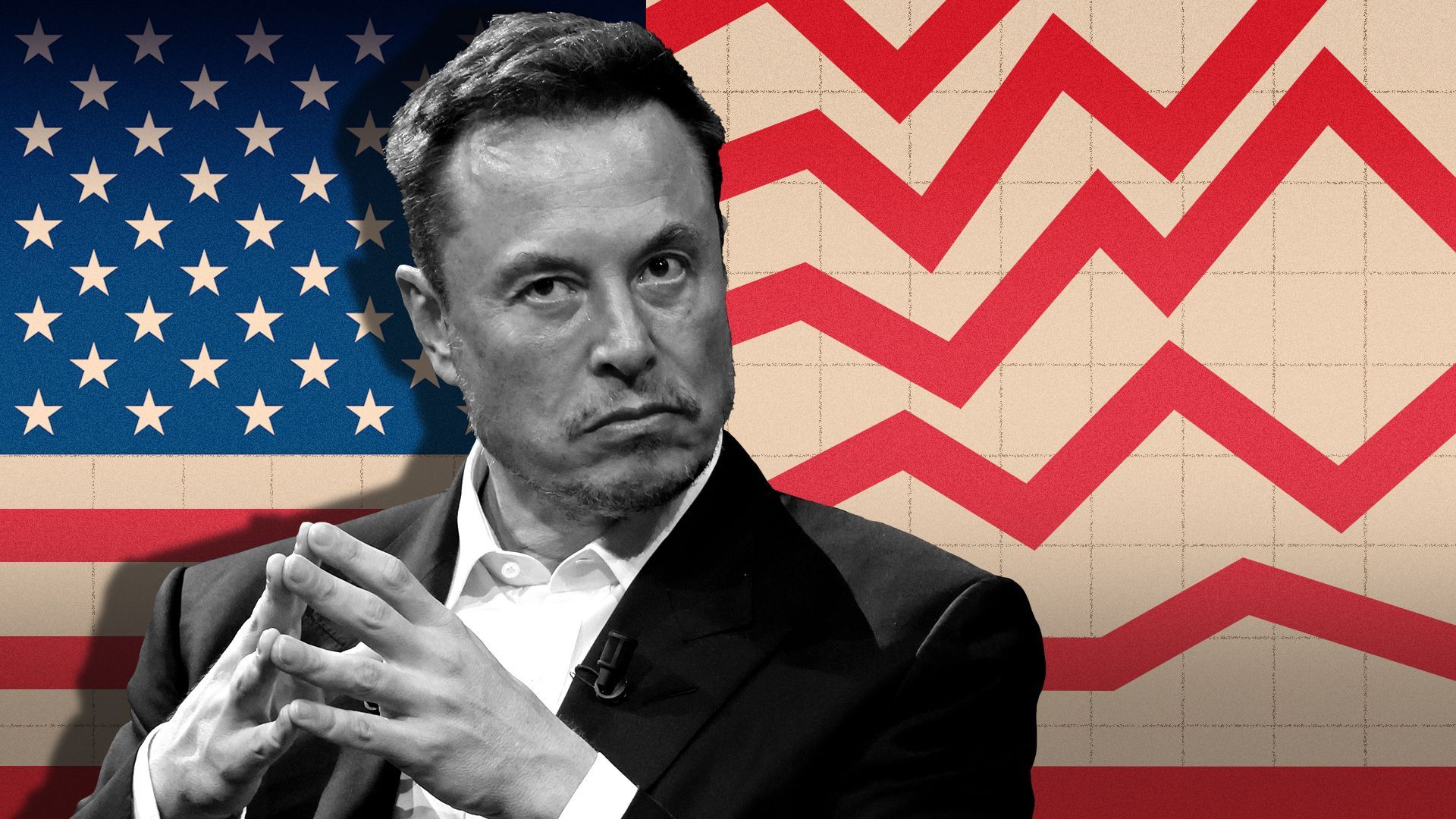
Illustration: Sarah Grillo/Axios. Photo: Chesnot/Getty Images
When things are going fine, blow everything up and risk it all. That principle has made Elon Musk the richest human alive — and he's now applying it to the government of the United States.
Why it matters: High risk can mean high return — or it can mean ruin.
- For people of great wealth and ambition, that's often a tradeoff worth making. At the sovereign level, however, Musk's antics risk upending the lives of millions.
Driving the news: A month before Donald Trump even gets sworn in, his First Buddy Elon has managed to orchestrate an all-but-certain government shutdown, not to mention a significant spike in stock-market volatility.
The big picture: Musk generally tries to operate his life on its maximum difficulty setting — juggling multiple companies, children and ex-wives while simultaneously seeking to steer the future of the U.S. government (and also logging full-time hours simply posting on X).
- Specifically, Musk wants to get the deficit under control by cutting spending, which is infinitely harder than the already extraordinarily difficult task of doing so by raising taxes.
- "What the U.S. really needs is another 2% of GDP in revenue, which is really not hard," says economist Paul Krugman. "We're the lowest taxed of the G7 economies by a long shot."
- Thanks to our demographics, Krugman says, "stabilizing U.S. finances is a much easier task at a fundamental level than any other rich country."
- Trying to stabilize them by cutting the size of government, however, is sure to be "hugely, hugely unpopular."
Between the lines: Musk has told Axios that his own habits can be "very painful" and that "people should not do this." All the same, he seems to be intent on imposing his pain-maximization impulses on 335 million Americans.
How it works: On a planet where millions of people take repeated huge risks, it's statistically inevitable that some of them will become enormously wealthy.
- In his book "On The Edge," statistician Nate Silver models what would happen to a group of hypothetical sports bettors who all start with $100,000 and then makes a series of 272 bets, each of which is likely (but not certain) to pay out.
- Normal bettors, using the Kelly criterion for optimal bet sizing, would end up making money more than 75% of the time, and would end up with $372,000 on average.
- Ultra-risky bettors, on the other hand, wagering five times the Kelly-recommended amount on each bet, would end up losing money 90% of the time. But the maximum winnings would go up from $10 million to $225 billion — and the average winnings would be $57 million.
The bottom line: Musk is the ultimate example of the upside that comes with volatility and risk. But that doesn't make his lead a good one to follow.
