Why Latino storytelling is the core of this reporter's work

Add Axios as your preferred source to
see more of our stories on Google.
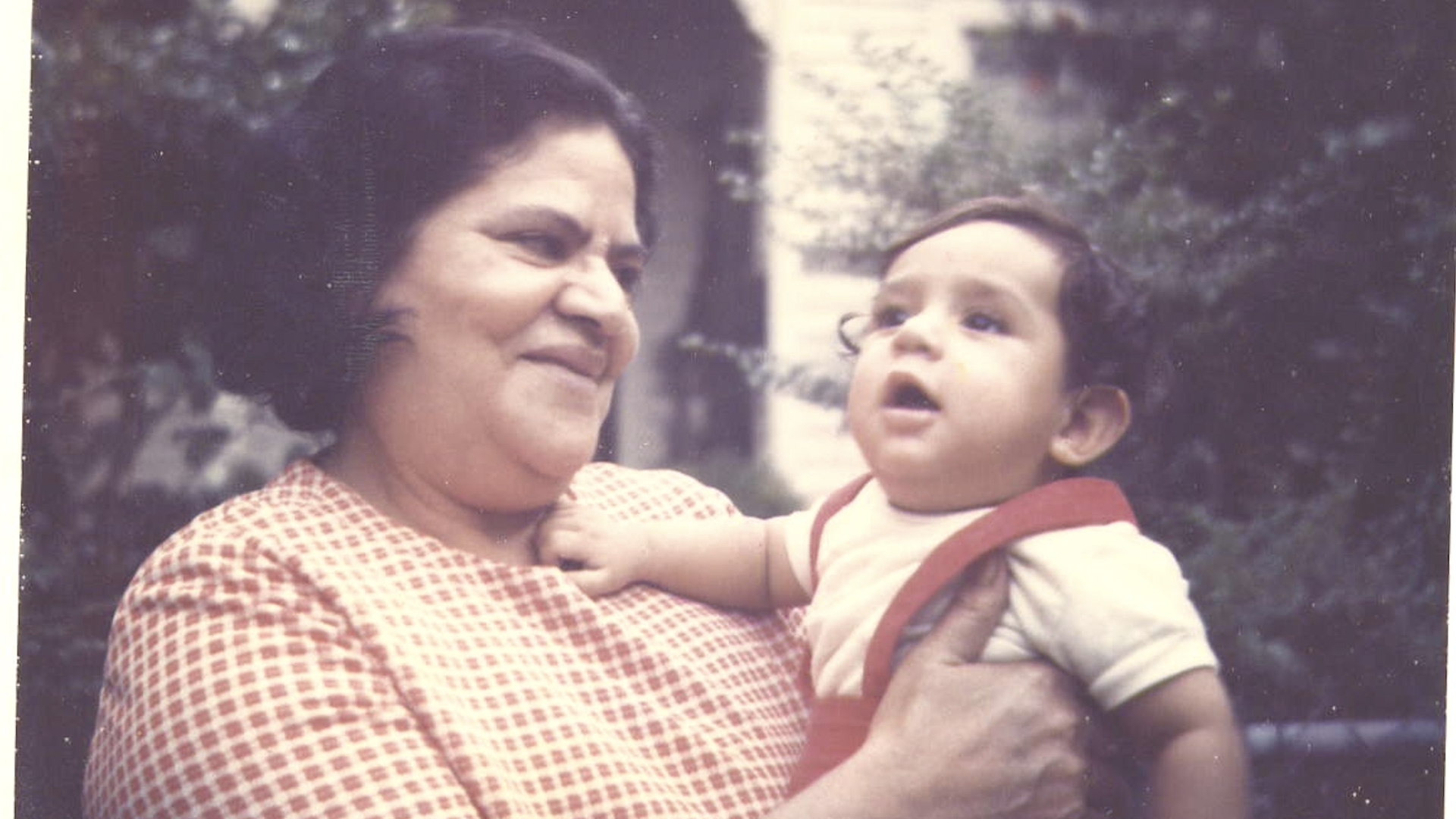
Russell as a child meeting his Mexican-born grandmother, Guadalupe Ramos, for the first time in 1975 after a family estrangement. Photo: Courtesy of Russell Contreras.
As the Axios Latino newsletter ends, senior reporter Russell Contreras reflects on covering Latino communities.
The now-defunct Houston Post's Hispanic insert, Viva Magazine, published my first professional piece of journalism in 1994. It was about Latino immigrants passing U.S. citizenship tests and the celebrations that followed.
Why it matters: My Mexican-born grandmother, Guadalupe "Lita" Ramos, was among the first to see the piece. She cut it out and saved the clipping.
Yes, but: She couldn't read it. Lita was semi-literate and could barely decipher words in English.
- During my later visits to her home, she would tell me about events in her Houston North Side neighborhood that I should investigate.
- She was convinced that I had the skills to figure out who ruined the sidewalk in front, why gunshots always went off at 12:15 am on Tuesday. Why there's a ghost camping in her backyard who sang when the moon was half full.
Zoom in: I never got down to the bottom of any of that, but 30 years later, I now understand what she was trying to say: We matter, and our stories matter.
- Will someone please pay attention?
Flashback: For the first few months of my existence, I didn't meet Lita. She had adopted my mother and kept that fact from her until her wedding day. They fought and became estranged, an occurrence that would repeat regularly.
- When she met me for the first time, I may have been one year old. In a photo, she's looking at me with happiness, and I'm glancing toward the neighborhood.
Between the lines: Every time I visited, curiosity struck me about Lita's street.
- Why was there so much poverty?
- Why do we always do what's right and still get it wrong?
- Why are we always praying to Saint Jude, the Saint of Lost Causes?
- Why does it all go away when we dance at the Knights of Columbus Hall?
The big picture: For most of my professional career, I've been seeking those answers in my journalism.
- The Axios Latino newsletter allowed me, for a brief few years, to explore these questions and show you, the reader, what I'm finding for people who share a similar background.
- You see, for decades we've been estranged from our stories, from our past.
- History books often exclude us, movies forget we exist, and when we do appear in news stories, most of the time, someone else is telling us who we are and what we're thinking.
- I tried to do all I could to fix that with stories.
No reporter ever interviewed Guadalupe Ramos.
- If they had, they would have found out she was a naturalized U.S. citizen, voted in every election, was a victim of horrific violence in Mexico (that prevented her from having kids) and smoked in secret because she always wanted to be Bette Davis.
- Guadalupe was in the U.S. because her brother killed someone in Mexico.
- She knew she was difficult, and she needed help.
- She came from, as the poet Lorna Dee Cervantes writes, "a long line of eloquent illiterates whose history reveals what words don't say."
- And she became a grandmother to three grandchildren with graduate degrees and another grandkid thinking about it.
The bottom line: I've been chasing that story of estrangement my whole professional life. I'm still looking at the neighborhood while Lita's spirit looks at me.
- Somewhere, in some other time, someone will figure out a business model that allows these stories to be born and shared beyond small but intense surges of happiness.
- We will hold those stories and smile, even as those stories look out and see a future we can't even imagine. Yet.
