Don't blame inflation for the price of new cars

Add Axios as your preferred source to
see more of our stories on Google.
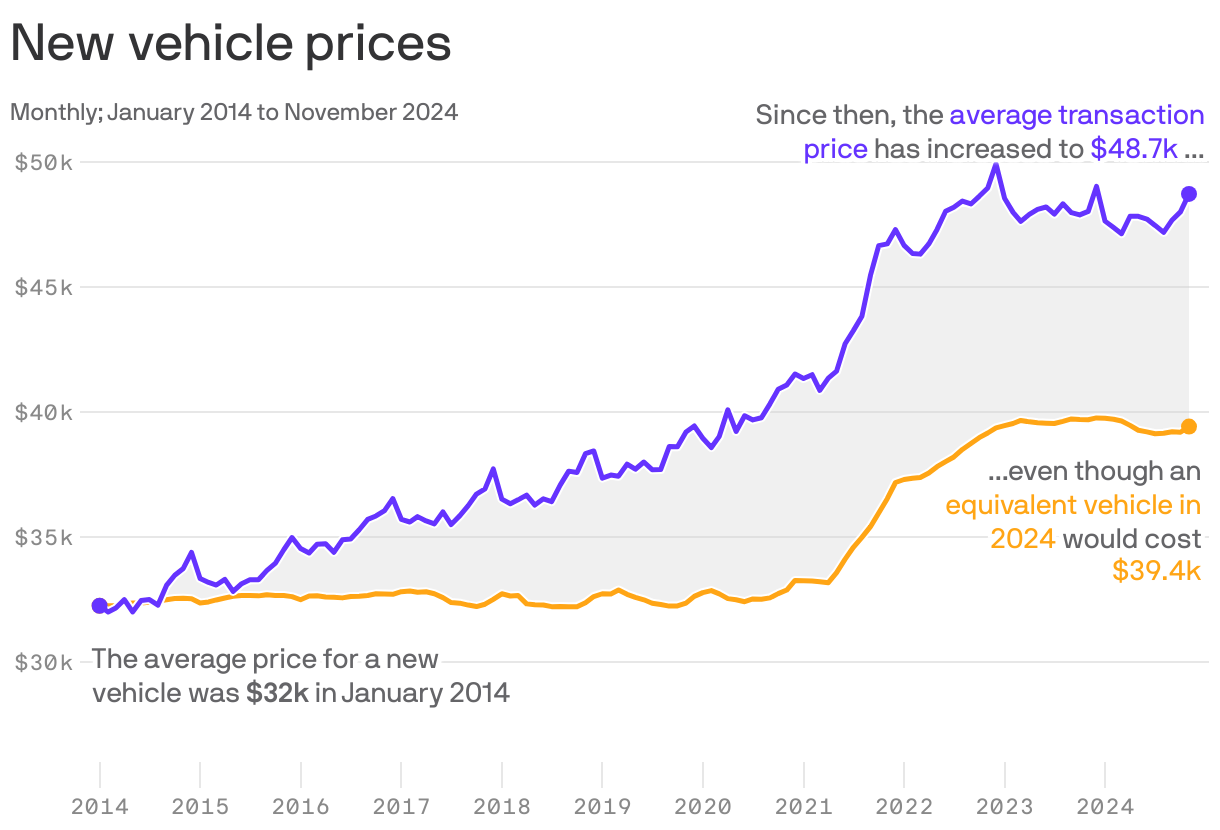
New cars are very expensive — the average transaction price last month was $48,724, per Axios corporate cousin Cox Automotive. But, weirdly, that's not because of inflation in the price of new cars.
Why it matters: Americans are paying more for new cars mainly because they're trading up in size.
By the numbers: The average price paid for a new car at the beginning of 2014 was $32,250. By November 2024, that had risen by $16,500 — or 51% — to $48,750.
- Only $7,000 of that gain, however, can be attributed to inflation in the cost of new cars. That's measured by the Bureau of Labor Statistics, which looks to see how much any given car has risen in price from month to month.
- The other $9,500 of cost increase is a function of the way in which automakers have concentrated on selling expensive trucks and SUVs, while steering consumers away from cheaper cars.
How it works: When consumers buy more big vehicles and fewer cheaper ones, the average transaction price can rise even when any given vehicle isn't going up in price at all.
- Imagine a world where the price of a bottle of prosecco never goes up, and neither does the price of a bottle of Champagne. But if consumers start buying a lot more Champagne and a lot less prosecco, the average price paid for a bottle of sparkling wine will rise substantially.
The big picture: New car prices have actually been coming down in real terms, if you look at the broad consumer price index.
- On an inflation-adjusted basis, a car that sold for $32,250 in 2014 should be selling for about $43,400 today were it to have kept pace with inflation. Instead, that car today sells for $39,400.
- That's a 9% decline in real terms.
Between the lines: There's a popular (and false) narrative that car prices have outpaced incomes over the past roughly 40 years.
- According to the Bureau of Economic Analysis, which uses a different methodology to Cox Automotive, the average transaction price for a new car in December 2023 was $32,559, up from $11,399 in 1984. That's a rise of 194%.
- Median household income, however, has risen from $22,420 to $80,610 over the same period — a rise of 259%.
- In other words, Americans spent about 147 days' worth of their income when they bought a new car last year, down from 186 days in 1984.
The intrigue: In the first nine months of 2024, the U.S. imported 3 million cars from Mexico and Canada, worth $81 billion.
- If Donald Trump makes good on his promise to impose a 25% tariff on those imports, the effect on prices would be huge.
The bottom line: Americans have demonstrated a revealed preference for ever bigger, more expensive cars. One reason is that those cars are becoming both cheaper and more affordable, in real terms.
