Why America's drug stores are vanishing

Add Axios as your preferred source to
see more of our stories on Google.
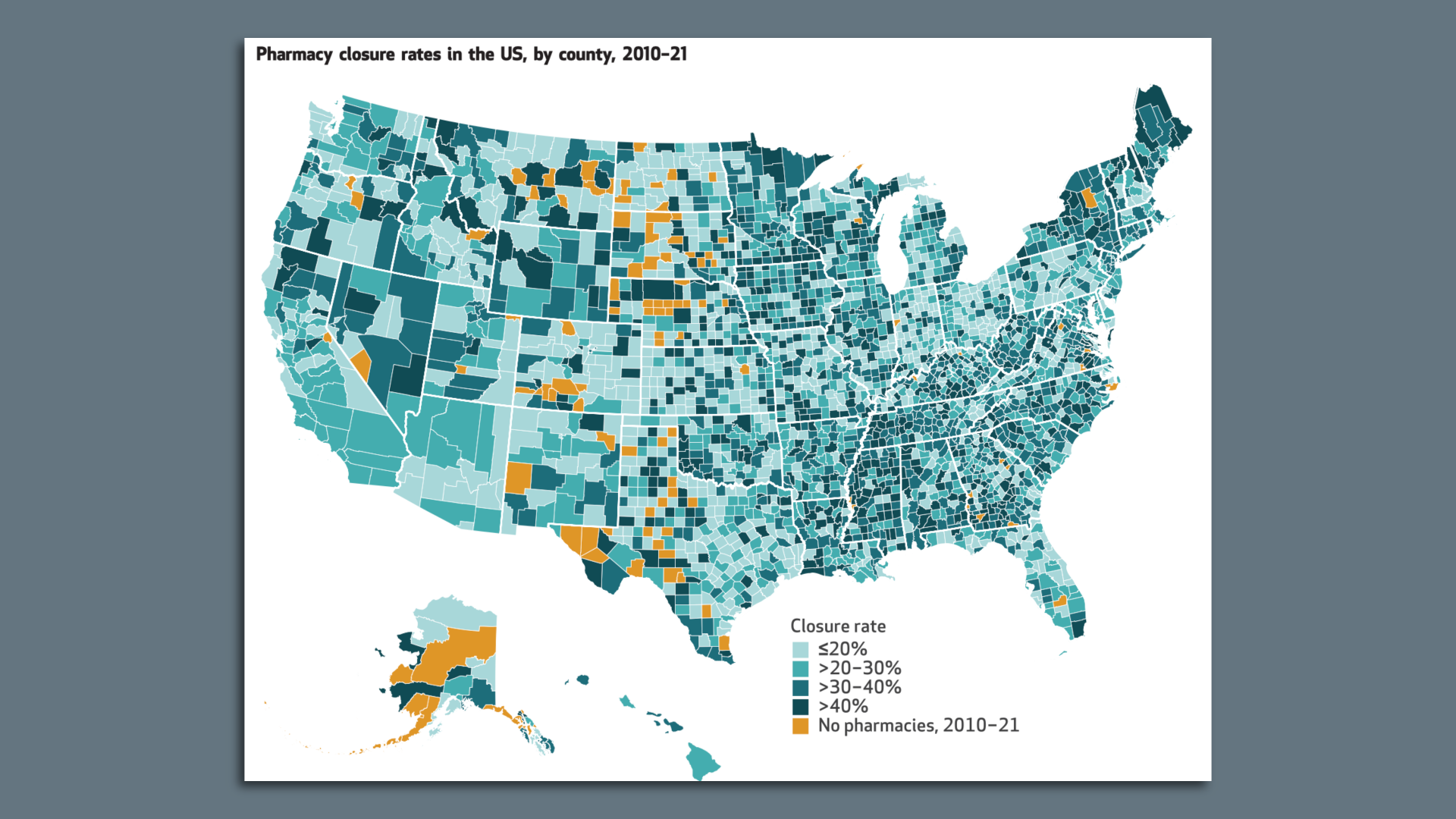
Chart: Courtesy of Health Affairs
Nearly 1 in 3 U.S. retail pharmacies closed over a decade in a series of cutbacks that weighed heaviest on communities of color already grappling with health disparities and barriers to care.
Why it matters: The closures illustrate how prescription drug market forces and a changing retail landscape are constricting the delivery of care and worsening inequities.
The big picture: Independent pharmacies were likelier to close from 2010 to 2021, possibly because pharmacy benefit managers steered patients to their own in-network pharmacies, University of California, Berkeley and University of Southern California researchers found.
- Inadequate reimbursements from Medicare and Medicaid also factored in neighborhoods with fewer commercially insured people, which tended to have more Black and Hispanic patients.
- The shutdowns picked up in the second half of the decade, hastened by industry consolidation that led to the closure of a growing number of chain pharmacies between 2018 and 2021.
- States such as North Dakota and Arizona were less affected, with closure rates under 20%, while New York, West Virginia, Vermont, Rhode Island and Mississippi all saw closures above 35%.
Threat level: Pharmacy closures aren't just an inconvenience; in some disadvantaged areas, a pharmacy can be the difference between having care or not.
- A continuation of the drop-off could also undercut COVID-era trends that saw pharmacists play a bigger role administering care, distributing vaccines, antivirals and tests and helping patients navigate the health system.
- It's not enough to offer digital or mail-order options, Rob Andrews, CEO of the Health Transformation Alliance, told Axios.
- "People who don't have access to a lot of digital resources and/or income are going to have a harder time getting access to stuff they need, because the drugstore that used to be two blocks away isn't there anymore," Andrews said.
Between the lines: The study comes as major pharmacy chains including Walgreens and CVS continue to go through painful shakeouts.
- Each has cited declining front-of-store sales — where products like greeting cards or shampoo are found — as contributing factors as consumers mail-order drugs and online shopping.
- "It just isn't profitable to operate a drugstore if you're not also profiting from other aspects of the supply chain," Andrews said.
But bigger forces could be hastening some pharmacies' decline. Regulators are focusing more attention on PBMs' role in the drug supply chain, including driving up prices and squeezing out independent pharmacies.
- The Federal Trade Commission has charged the nation's biggest PBMs with forcing pharmacies to swallow unfair contracts — a charge they've disputed.
- The study calls, in particular, for policymakers to increase Medicare Part D and Medicare reimbursement rates for pharmacies that are at the highest risk of closure.
- They also call for mandates on PBMs to expand preferred pharmacy networks to independent pharmacies.
Between the lines: There's a widening gulf between what patients want and what the system is willing to pay for, Peter Bonis, chief medical officer at Wolters Kluwer Health, told Axios.
- A recent survey the firm did found most patients still prefer to get their drugs from brick-and-mortar pharmacies. The majority are also concerned about being able to get essential medications close to home due to closures.
- "People already don't adhere to their drugs for a variety of reasons. They don't get the care that they need," Bonis said. "Making it harder for them to get their drugs isn't helping."
The bottom line: The problem could intensify as vertically integrated health companies with retail pharmacies tighten their belts.
- CVS, Rite Aid and Walgreens plan a combined 2,600 store closures, as filling prescriptions becomes less profitable and costs rise.
- "The vision was: You get your health care there, but then you're going to fill your prescriptions there, and you're going to get your suntan lotion there and they sort of have this internal cross-selling from this little center of health care," Bonis said. "It just hasn't worked that way."
