USDA mandates federal bird flu testing in milk

Add Axios as your preferred source to
see more of our stories on Google.
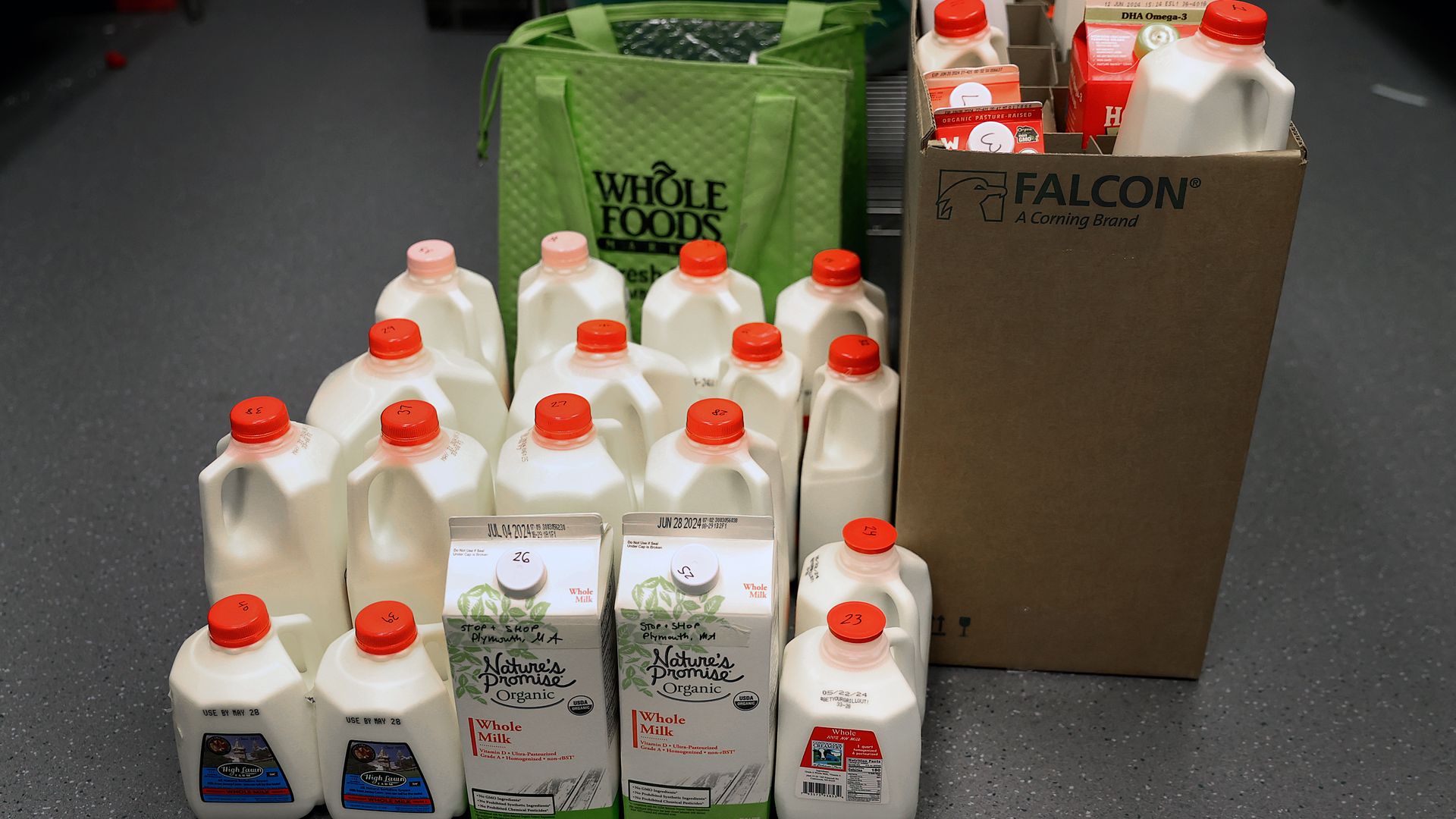
The Broad institute, Sabeti Lab is testing purchased milk at area grocery stores for the presence of bird flu. Photo: David L. Ryan/The Boston Globe via Getty Images
The U.S. Department of Agriculture on Friday announced a federal order that the country's milk supply be tested for bird flu.
Why it matters: The sluggish federal response to the H5N1 bird flu outbreak has alarmed researchers, especially with new findings that the virus is one mutation away from being able to more efficiently affect humans.
- "This new guidance from USDA, which was developed with significant input from state, veterinary and public health stakeholders, will facilitate comprehensive H5N1 surveillance of the nation's milk supply and dairy herds," the department said.
How it works: Any entity responsible for a dairy farm, bulk milk transporter, bulk milk transfer station or dairy processing facility that sends or holds milk intended for pasteurization will be required to share samples upon request.
- Herd owners with positive cattle will also be required to provide epidemiological information for contact tracing and disease surveillance.
- Private labs and state veterinarians must report positive results to USDA from the tests done on the raw milk samples.
What's next: The first round of testing is scheduled to begin the week of Dec. 16 in six states: California, Colorado, Michigan, Mississippi, Pennsylvania and Oregon.
- Not all of the states have reported H5N1 infections in cattle, but federal investigators are trying to get a sense of which herds are affected.
- Some states are already conducting testing compatible with the new order.
The latest: On Friday Arizona announced its first human bird flu infections.
- Two people were exposed to infected poultry while working at a commercial facility in Pinal County. Both recovered after experiencing mild symptoms.
- Other human cases have been reported in California, Colorado, Michigan, Missouri, Oregon, Texas and Washington, according to the Centers for Disease Control and Prevention.
Context: Some public health officials warned that the federal response to the bird flu, already lacking in the Biden administration, could be abandoned during President-elect Trump's presidency.
- The CDC last month recommended expanded testing of farm workers after new evidence showed previously undetected cases of bird flu in humans.
Threat level: With one mutation, the virus would more efficiently latch onto human cells, per a study published Thursday in the academic journal Science.
- "Acquisition of human-type receptor specificity is believed to be required for human-to-human transmission of influenza virus and is one of the major factors considered by the CDC for pandemic risk of a novel animal strain," the research said.
- The researchers said they did not analyze all factors associated with human transmission of zoonotic influenza viruses, or diseases transmitted between animals and humans. They also said other factors are required for human-to-human transmission.
Catch up quick: The California Department of Food and Agriculture this month suspended raw milk products from company Raw Farm because of the virus being detected.
Go deeper: Alarms raised over bird flu response under Trump
Editor's note: This story was updated with information about the first confirmed human cases in Arizona.
