Billionaires underperform the S&P 500

Add Axios as your preferred source to
see more of our stories on Google.
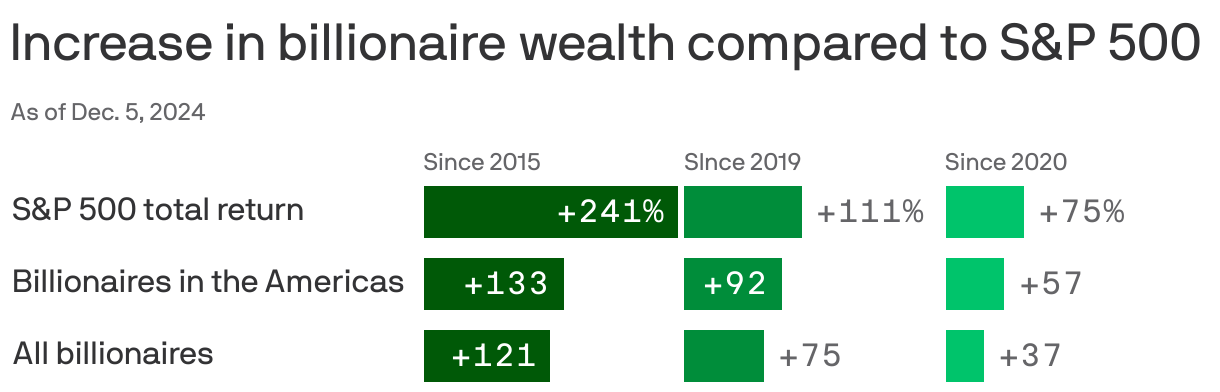
If you want to outperform the average billionaire, you might try just sticking all your money into an S&P 500 index fund.
Why it matters: While it's true that the ultra-rich have been been getting richer in recent years, even they haven't been able to keep up with the torrid pace set by the U.S. stock market.
- There are exceptions, of course, particularly of late for those with warm ties to Donald Trump. Elon Musk and Peter Thiel, for example, have had a very good year, and Trump's Cabinet will feature plenty of their ultra-rich compatriots.
Between the lines: Though billionaires have effectively unlimited access to the world's top investors and financial strategies, almost nothing can keep up with the sheer power of U.S. stocks when they're on a bull run.
- That's worth keeping in mind when financial services companies try to sell you access to investments that have historically been available only to the ultra-rich.
The big picture: Billionaires face two disadvantages compared to the S&P 500.
- One is that they're global, so they tend to be exposed to global markets, which have generally underperformed U.S. stocks.
- The second is that they tend to be concentrated in their own family companies. Even in America, two out of three S&P 500 companies are underperforming the index as a whole. (Thanks, Nvidia.)
The other side: Billionaires do, however, have the advantage that there are more of them than ever.
- This year's total billionaire wealth of $14 trillion can be attributed to 2,682 billionaires, up more than 50% from 2015, according to a new report from UBS.
- Meanwhile, the number of companies in the S&P 500 is always very close to 500.
By the numbers: The wealth of the average billionaire rose 45% over the nine years between 2015 and 2024, from $3.6 billion to $5.2 billion, per UBS.
- That's a rise of just 8% in real terms, or less than 1% per year.
The bottom line: When you're already dynastically wealthy, you often focus more on preserving your wealth than you do on growing it.
- Those of us saving for retirement, by contrast, generally have a much greater need for our savings to grow.
