Trump's latest health care curveball

Add Axios as your preferred source to
see more of our stories on Google.
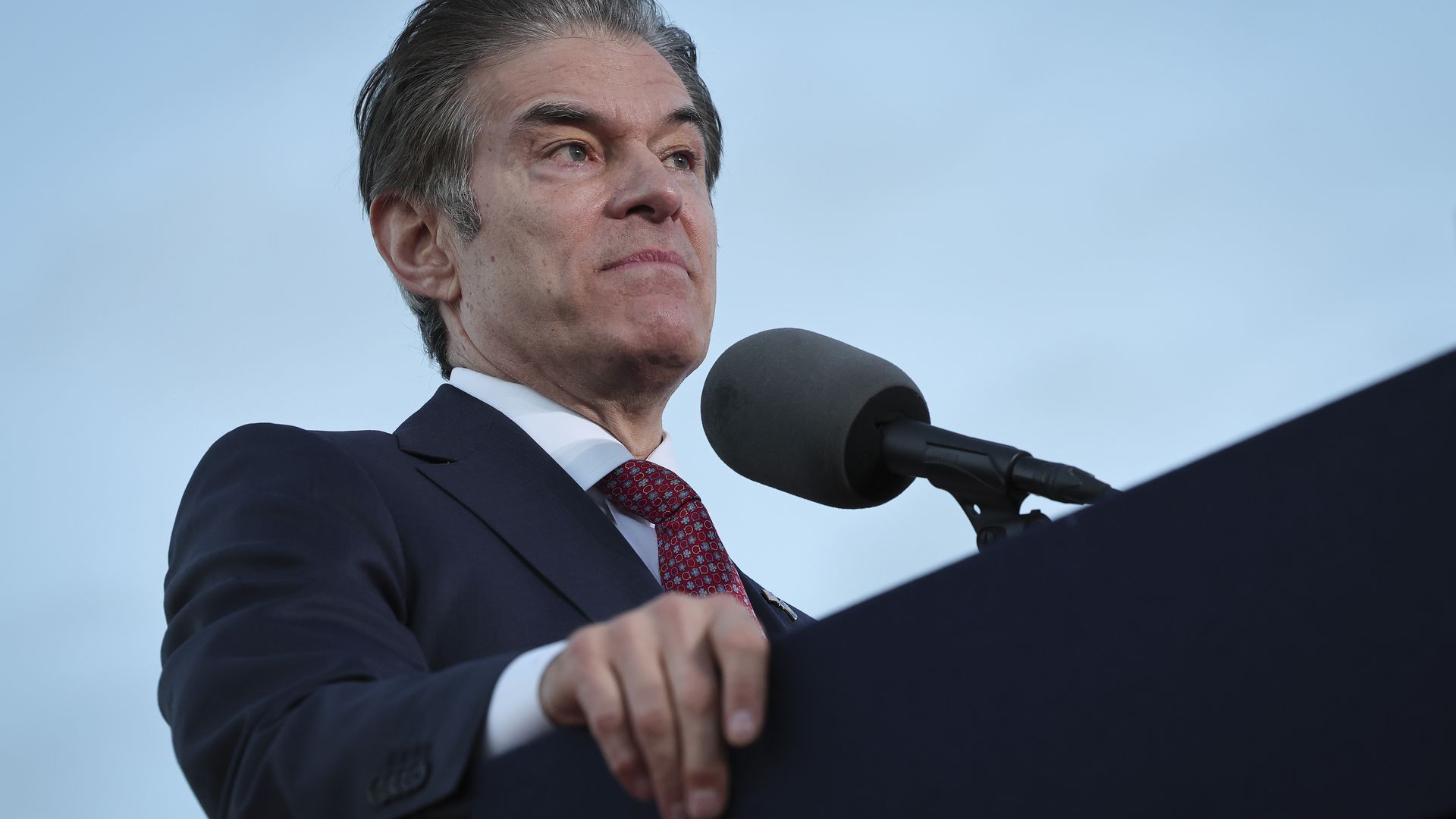
Oz during the 2022 Pennsylvania Senate race. Photo: Win McNamee/Getty Images
President-elect Trump's selection of Mehmet Oz, or Dr. Oz., to run the Centers for Medicare and Medicaid Services puts a celebrity physician with no prior experience in government in line to run the nation's biggest health insurance programs.
Why it matters: Oz is a household name with a medical degree, a Wharton MBA and Trump's seal of approval. But he has a history of blending mainstream ideas for improving American health with misinformation.
- If confirmed by the Senate, he'd wield enormous influence over Medicare, Medicaid, the Affordable Care Act and other programs that cover more than 160 million people.
The big picture: CMS administers Medicare and Medicaid and conducts other services like inspecting nursing homes.
- It's the largest health insurance payer in the country and covered nearly 36% of the U.S. population in 2023, according to KFF.
- Medicare and Medicaid together cost the federal government $1.7 trillion last year.
Oz came to prominence as Oprah Winfrey's go-to health guru, and later hosted his own long-running talk show.
- He played up his connections to Trump during his failed 2022 Pennsylvania Senate campaign, but lost to Democrat John Fetterman, who leveraged an unconventional style and support of abortion rights to drive Democratic turnout and tap into the working-class vote.
Where it stands: Trump in a statement on Tuesday charged Oz with cutting waste and fraud at CMS, incentivizing disease prevention and taking on the "illness industrial complex."
- As administrator of CMS, he'd work under Robert F. Kennedy Jr., Trump's pick for Health and Human Services secretary. Both men have at times drawn criticism from health experts for spreading misinformation.
- A 2014 study of 40 random episodes of "The Dr. Oz Show" found that less than half (46%) of the recommendations made on the show had at least a case study to back them up. Evidence contradicted 15% of the recommendations he made and couldn't be found for 39% of them.
Zoom in: Oz's Senate campaign and his long career as a public personality offer some clues into his health policy positions. He's a big proponent of privatized Medicare and pushed for "Medicare Advantage for All" during his campaign.
- Oz panned the Inflation Reduction Act, though details on his position about its Medicare prescription drug provisions are scant.
- He also suggested he likes short-term health plans. An archived version of his Senate campaign website said he wanted to increase access to "private sector plans expanded by President Trump and beloved by seniors for their low costs and high quality that could be available to all Americans who want them."
- He's shown significant enthusiasm for GLP-1 drugs. That could put him in conflict with RFK Jr., who's criticized the immensely popular weight-loss drugs.
Yes, but: Oz has flip-flopped on his policy stances before. Prior to entering politics, Oz supported requiring every American to have health insurance. He even praised the universal health care systems of Germany and Switzerland, CNN reported in 2022.
What they're saying: Many medical and scientific leaders opposed Oz during his 2022 run for Senate.
- "[I]t's all but guaranteed he would bring pseudoscience to the table when crafting and voting on legislation that affects the health and welfare of Americans," public health expert Timothy Caulfield wrote in an opinion piece for Scientific American that year.
- But GOP senators, who will have the final say over Oz's appointment, indicated Tuesday they're happy with the pick.
- Sen. John Barrasso (R-Wyo.) told Axios that Oz is "a world-class physician, surely he understands how Medicare and Medicaid works. … It's a scenario where he has significant knowledge and would be able to make improvements in the system."
- And Fetterman wrote on X: "If Dr. Oz is about protecting and preserving Medicare and Medicaid, I'm voting for the dude."
