Why Election Day is on a Tuesday in November

Add Axios as your preferred source to
see more of our stories on Google.
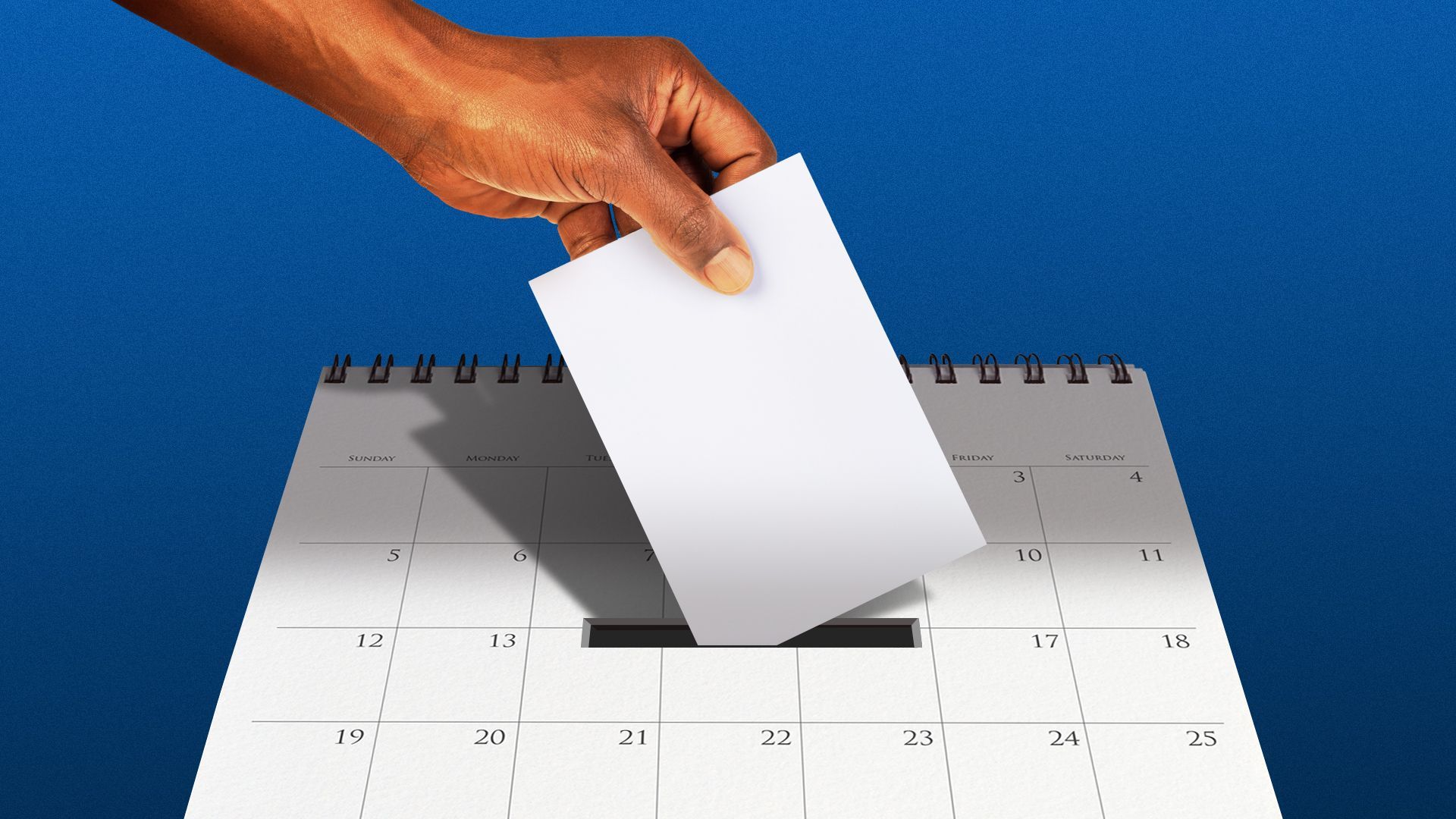
Illustration: Sarah Grillo/Axios
The U.S. norm of voting on a Tuesday in November dates back to 1845 and is thanks to farmers.
The big picture: U.S. voting these days isn't confined to just Election Day, but results aren't shared on a rolling basis as was the case before the mid-19th century.
- More than 75 million Americans had already cast mail-in or early ballots by Sunday — totaling nearly half the total electorate that voted in 2020.
Flashback: The 28th Congress passed a federal law in 1845 designating Election Day as "the first Tuesday following the first Monday in November," according to the U.S. Vote Foundation.
- Before this, states could previously hold elections over 34 days before the first Wednesday in December.
- States that held their elections early in that timeframe would publish results — influencing the outcome of election results other states with elections later in the allotted period.
Behind the scenes: Tuesday and November were each chosen out of convenience to farmers, per History.com's Evan Andrews.
- "Since people often traveled at least a day to vote, lawmakers needed to allow a two-day window for Election Day," Andrews wrote. "Weekends were impractical, since most people spent Sundays in church, and Wednesday was market day for farmers."
By November, the harvest was complete and winter weather hadn't started.
- Spring and early summer elections would have interfered with farmers' planting season, while late summer and early fall overlapped with the harvest, Andrews wrote.
Zoom out: Elections are usually on a Sunday across Latin America, Saturday in the Middle East and can span weeks in India, per Al Jazeera.
- Following Tuesday, the next U.S. general elections fall on Nov. 7, 2028 and Nov. 2, 2032.
Go deeper: `What poll watchers can and can't do
