Uruguay to vote for new president and lowering retirement age

Add Axios as your preferred source to
see more of our stories on Google.
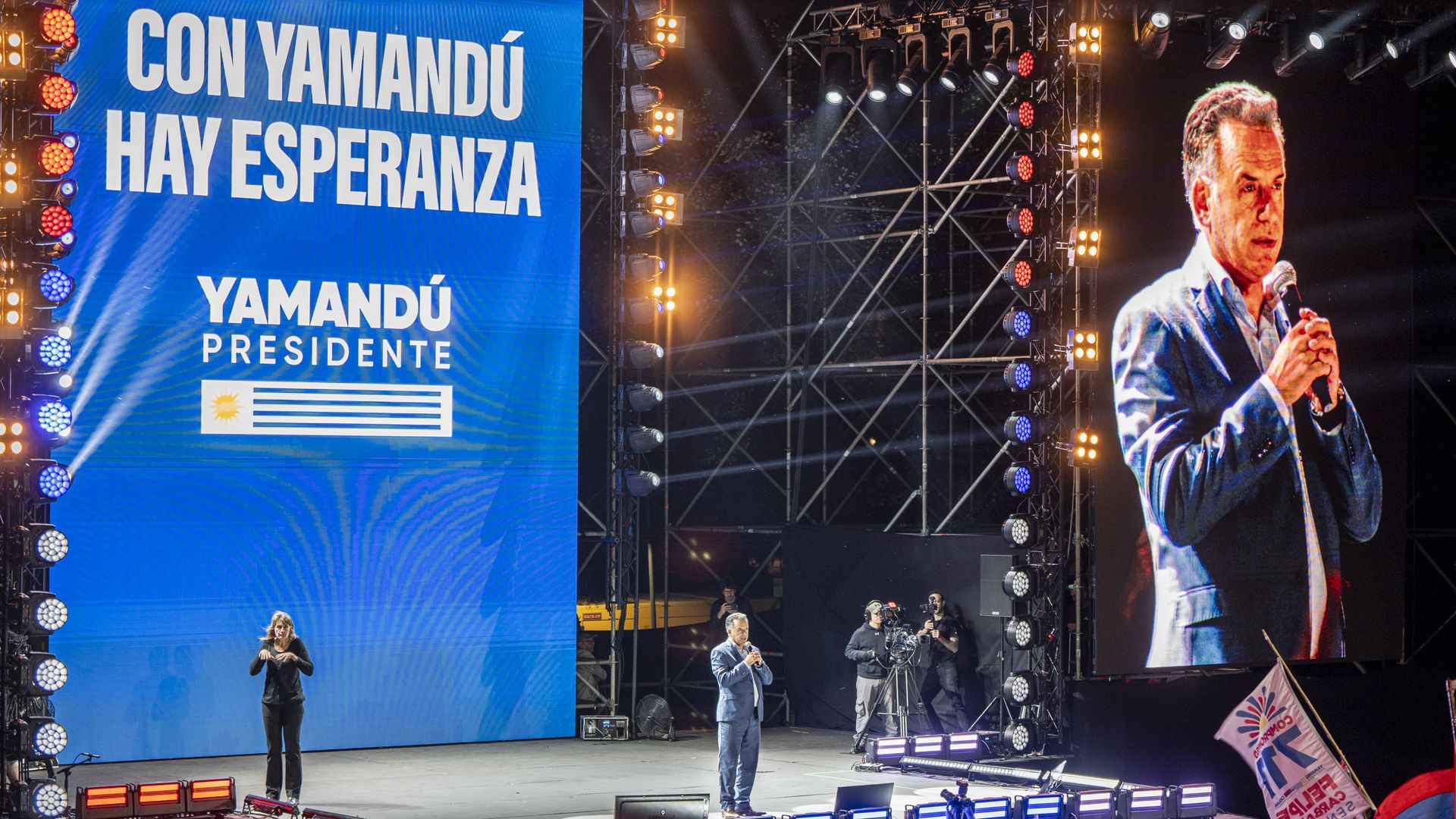
Uruguayan presidential candidate Yamandú Orsi speaks to supporters during his closing campaign rally in Montevideo on Tuesday. Photo: Mauricio Zina/Bloomberg via Getty Images
Voters in Uruguay, one of the most politically stable countries in Latin America, go to the polls Sunday to decide on a new president and on a major pension reform — with all 129 congressional seats also up for grabs.
State of play: The presidential race, with 11 candidates, is likely to go to a runoff.
- The leading candidate is Yamandú Orsi, from the center-left Frente Amplio party. Orsi is polling between 42 to 45%, just below the threshold to avoid the runoff, scheduled for Nov. 24.
- In the runoff, it's unclear who would face off with Orsi, who is backed by the popular former president José Mujica.
The ruling center-right Partido Nacional candidate, Álvaro Delgado, is polling second at about 19 to 20%, but another candidate, Andrés Ojeda of the also center-right Colorado Party, has been gaining ground, with some polls putting him at 18%.
- Delgado has had support from President Luis Lacalle Pou, who remains popular but can't run as there's no immediate re-election in the country.
Zoom in: The proposed pension reform would lower the retirement age from 65 to 60, and increase payments in some cases — a step unions favor, though several economists and Lacalle Pou say it would create fiscal problems.
- Another referendum asks voters whether police should be allowed to raid homes during the nighttime — which activists say would curtail civil rights but Lacalle Pou's party says is the best option to fight growing crime in port areas due to drug trafficking.
- About 47% of voters favor and 43% oppose the pension reform, per polling. Roughly 50% support the police raids measure. Slightly more than 50% is needed for passage.
What they're saying: "The presidential candidates have mostly remained vague, toeing more on the center line on their platforms," says Carolina Zeballos Lereté, a professor and researcher at Universidad de la República's School of Social Sciences.
- They've largely been waiting to see how the referendums shake out, looking to incorporate that into their second-round campaigns, Zeballos adds.
- The result about whether to lower the retirement age, for example, could indicate a desire for the adoption of other social welfare measures; while the vote on whether to allow police raids at night could point to people wanting more emphasis on tough-on-crime policies.
"There's also a lot of uncertainty as to how the parliamentary majorities could end up looking, with the likelihood of the two main parties not even getting a majority," Zeballos says.
- If that happens, smaller parties may get enough seats to become a thorn in the side of whoever is elected president, which would make the two most voted candidates have to look for how to appeal to them too when campaigning in the runoff, says Zeballos.
The intrigue: Because of this lack of detail for presidential proposals, the election has had little polarization, political scientist Tamara Samudio Cassinelli says.
- She adds that makes Uruguay an interesting contrast with neighboring nations like Argentina, where people fed-up with traditional parties last year elected President Javier Milei, a firebrand candidate from a newly established party.
Subscribe to Axios Latino to get vital news about U.S. Latinos and Latin America.
