What two big global trends tell us about the 2024 election


Add Axios as your preferred source to
see more of our stories on Google.
Illustration: Lindsey Bailey/Axios
Vice President Kamala Harris is trying to retain the White House for the Democrats at a time when voters all over the world are throwing out their incumbents.
Why it matters: Harris could be swept out in the same tide of inflation-fueled economic angst that has doomed incumbents elsewhere. Or she could be saved by the relative buoyancy of the Biden-era U.S. economy — the envy of the world.
The big picture: Job security could hardly be lower for incumbents across the world's wealthy democracies, who have almost universally presided over years of high inflation and precarious post-pandemic economies.
- The Conservatives lost in a historic landslide this July in the U.K. after a decade in power, while French President Emmanuel Macron and South Korea's Yoon Suk Yeol suffered setbacks in legislative elections.
- Japan's long-ruling Liberal Democratic Party is poised to lose seats in a snap general election on Sunday, which was called after Fumio Kishida stepped down as prime minister with an approval rating in the teens.
- The anti-incumbent trend looks like it will continue into next year. Canadian Prime Minister Justin Trudeau's Liberals are down around 20 points to the Conservatives, while German Chancellor Olaf Scholz's Social Democrats are running third with less than 20% in the polls.
By the numbers: Approval ratings for Trudeau (25%), Scholz (20%), Macron (18%) and Yoon (16%), according to Morning Consult's tracker, make President Biden's 38% look stratospheric — let alone Harris' in the mid-40s.
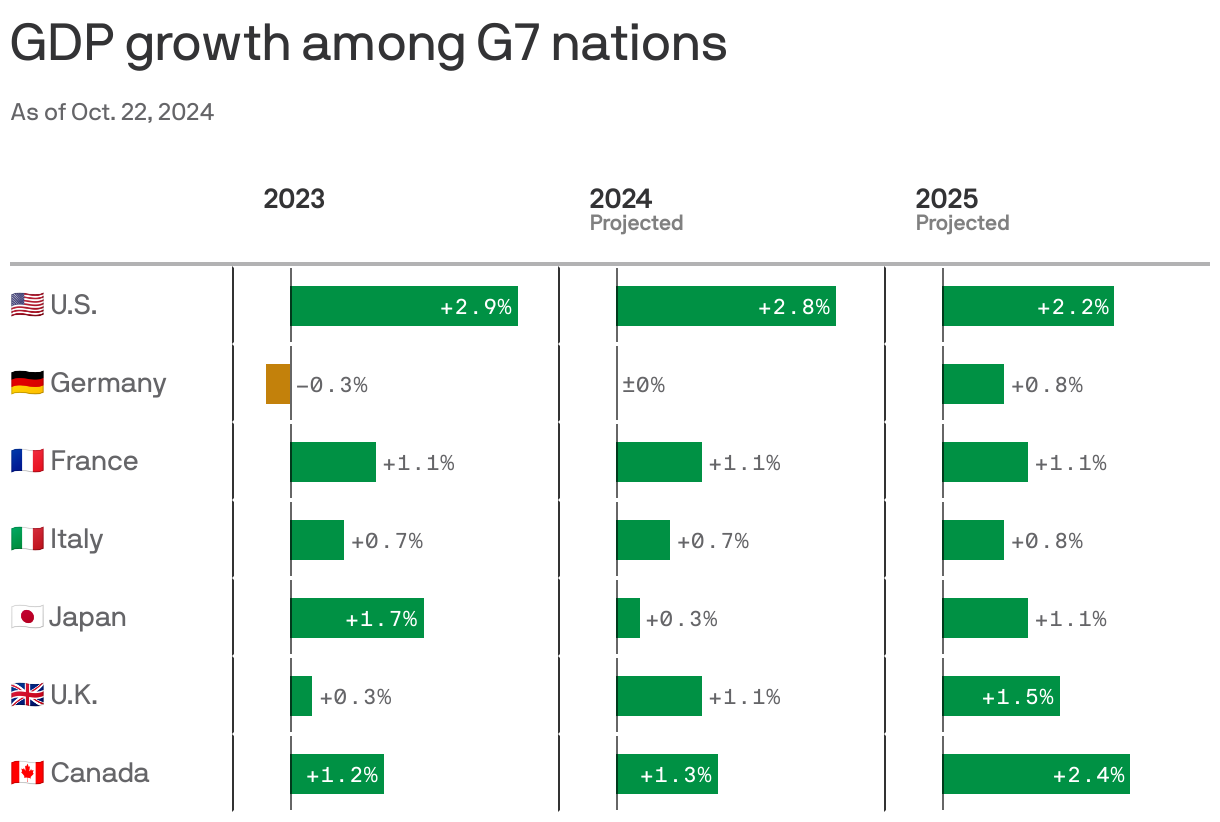
The other side: Those leaders are presiding over considerably weaker economies than the U.S., which is on track to grow faster in 2024 than any other G7 nation for the second consecutive year — by a wide margin.
- International Monetary Fund economists yesterday upgraded their projection for U.S. GDP growth in 2024 to 2.8%. That's more than double the growth rate of Canada, second among G7 economies.
- Inflation, meanwhile, continues its downward glide, with the IMF projecting a 1.9% rise in U.S. consumer prices in 2025.
- Some polling points to improvement in public opinion on the economy, albeit from low levels. The share of registered voters who say the economy is good is up to 38%, according to an AP/NORC poll, from 27% a year ago.
Reality check: While inflation has eased, housing, groceries and other essentials are significantly more expensive than they were four years ago.
- 62% of voters still think the economy is in poor shape, according to the AP poll. They're split over whether Harris or Trump is the right person to fix it.
The bottom line: Gas prices have eased down in recent weeks, the stock market has scraped new highs, the unemployment rate remains low, and economic growth is far outpacing other rich countries.
- The open question is whether that will be enough to create a different political dynamic in the U.S. election from those overseas.
