Global debt could soon equal the world economy, IMF report finds

Add Axios as your preferred source to
see more of our stories on Google.
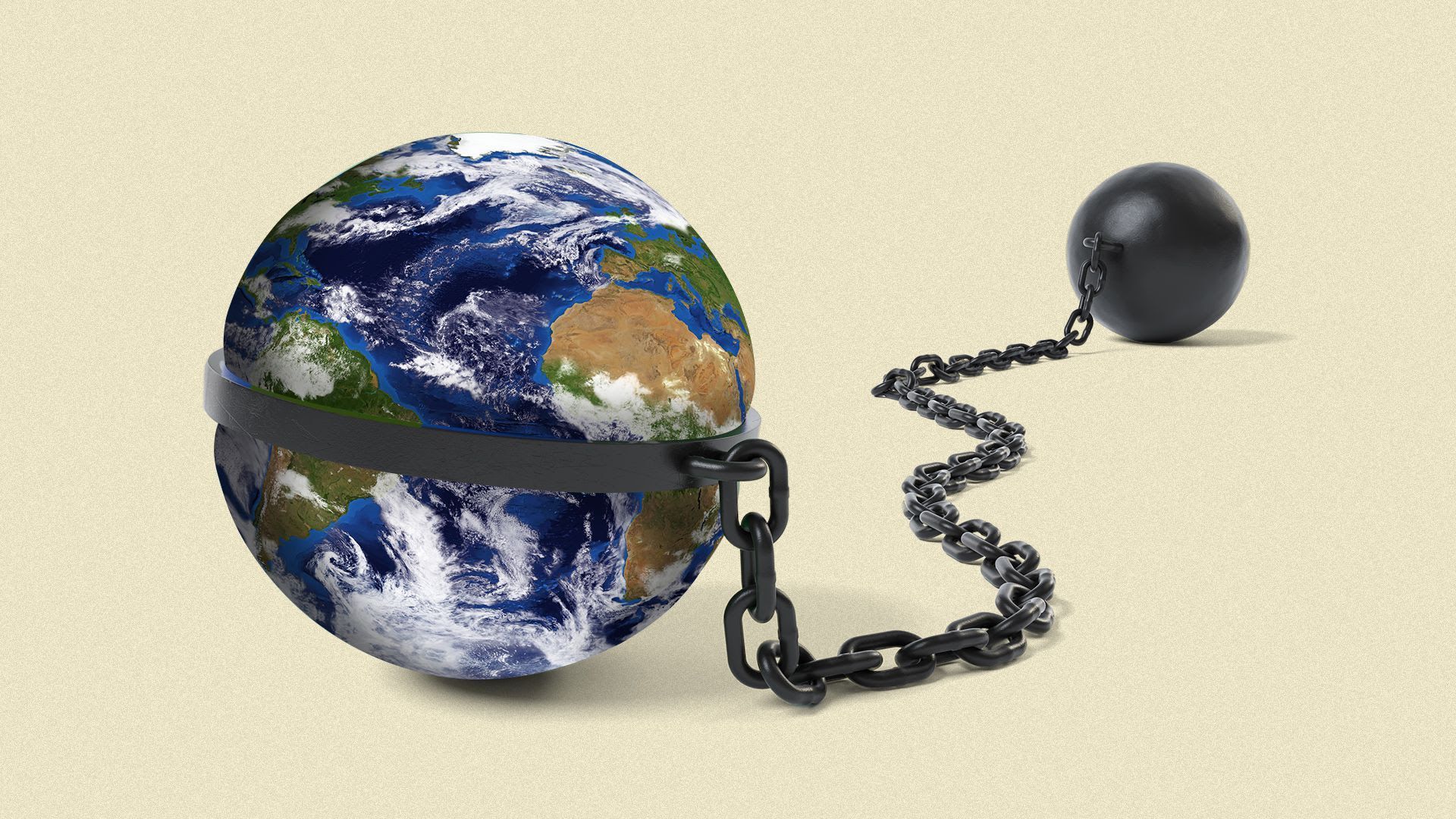
Illustration: Aïda Amer/Axios
Global public debt is on track to match the size of the world economy in the coming years, new projections from the International Monetary Fund show.
Why it matters: That gloomy fiscal outlook in major economies risks triggering market turmoil around the world.
- And global trends — aging societies, geopolitical strife and populist pitches across the political spectrum — suggest the need for more spending, not less.
By the numbers: Global public debt is estimated to top $100 trillion by year-end — or roughly 93% of global GDP, according to new projections from the fund.
- IMF economists expect cumulative global debt will approach 100% of world GDP by 2030, with the two largest economies — the U.S. and China — leading the increase.
- The U.S. is pretty much already there, with a debt-to-GDP ratio of about 100%.
Between the lines: IMF economists suggest that actual outcomes will probably be worse.
- In the group's semiannual Fiscal Monitor Report, researchers say such estimates are often subject to an "optimism bias" and actual global debt levels turn out higher than projected by an average of 6 percentage points of GDP after three years.
The big picture: The estimates don't (and couldn't) fully account for how much governments will have to increase spending to address health care in an increasingly older population, defense, the green transition and more.
- This all assumes a benign economic backdrop and a stable interest rate environment; any potential shock could force higher spending.
Where it stands: The IMF says current economic conditions — cooling inflation, interest rate cuts — provide the environment to rein in spending.
- "With inflation moderating and central banks lowering policy rates, economies are better positioned now to absorb the economic effects of fiscal tightening," the authors write.
Yes, but: That looks politically unfeasible. For instance, both U.S. presidential candidates are campaigning on policies that would add to fiscal deficits to varying degrees.
- The latest projection from the Congressional Budget Office — which doesn't account for campaign promises — shows debt held by the public will be 122% of GDP by 2034.
- "The political discourse on fiscal issues has increasingly tilted toward higher government spending in recent decades," the IMF researchers write.
Threat level: High debt levels in the world's largest economies — paired with the unknown path of fiscal and monetary policy down the line — could rattle financial markets in such a way that spills over into higher borrowing costs for other nations.
- A separate report this week from the World Bank shows the world's poorest countries cumulatively have more debt now than at any point in the past 18 years.
What they're saying: "The debt problems in advanced economies will have consequences — but it's not like the consequences these economies have," Ayhan Kose, the World Bank's deputy chief economist, tells Axios.
