About that 2022 "technical recession" ...

Add Axios as your preferred source to
see more of our stories on Google.
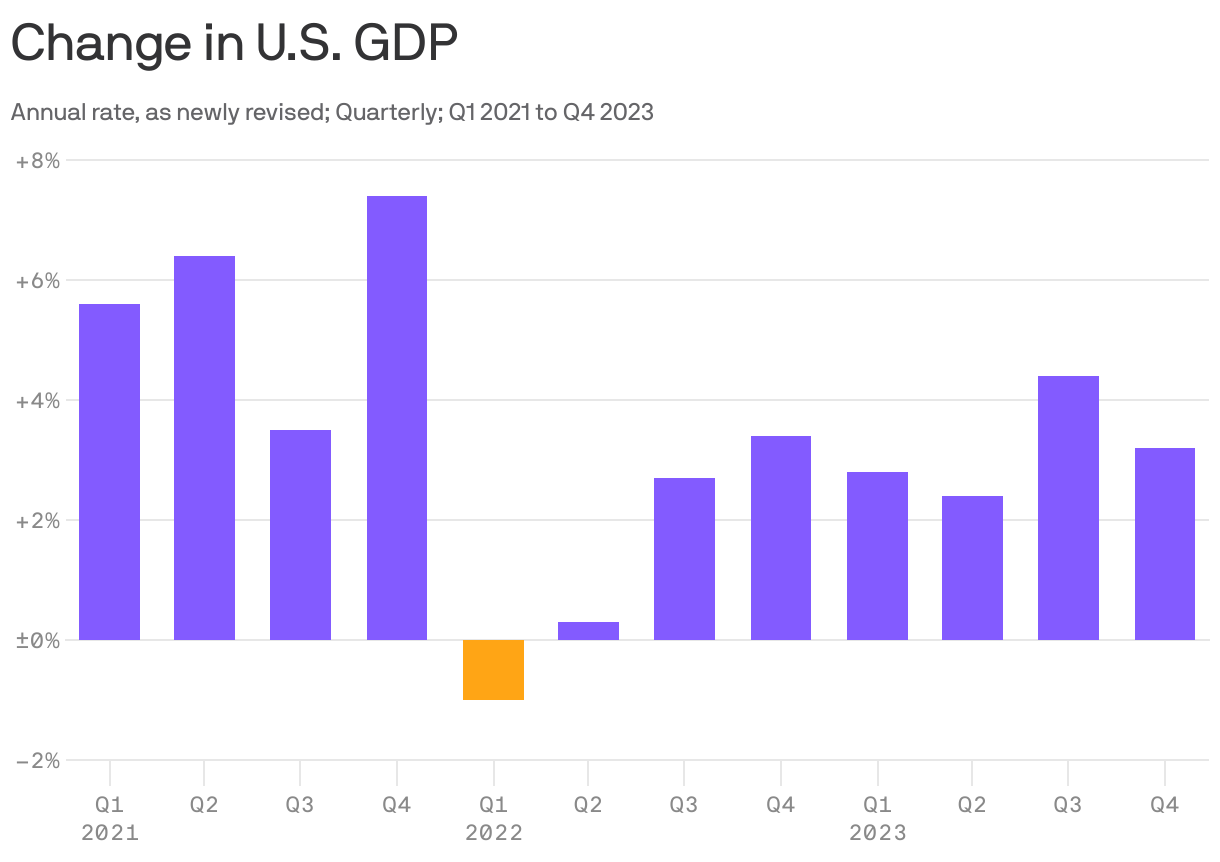
Remember two years ago, when GDP was reported as having shrunk for two consecutive quarters, and there was an entire exhausting discourse about whether it qualified as a recession? Turns out it was a statistical illusion.
Why it matters: It is a reminder, as we get caught up in debates over how to interpret economic data, of how much we don't really know in real time about the inner workings of the economy.
Driving the news: The Commerce Department published on Thursday morning revised GDP data for the past several years based on more complete information. One of the adjustments: GDP is now estimated to have grown in the second quarter of 2022 at a 0.3% annual rate.
- It had previously been estimated to have shrunk at a 0.6% rate, the second of two quarters of contraction.
- Two straight quarters of contraction are a commonly used international rule of thumb indicating a recession. In the U.S., economists have traditionally deferred to a panel of academics to make the recession call, who consult a broader array of data that did not point to a recession in 2022.
Of note: The revisions also point to more robust GDP growth throughout the post-pandemic expansion, with 2021 GDP growth revised up by 0.3 percentage points, 2022 up 0.6 points, and 2023 up 0.4 points.
- The revisions also solved a bit of a technical mystery, as earlier data had shown a wide gap between GDP and gross domestic income, two measurements that should be identical. Now the gap is mostly gone.
Yes, but: GDP growth numbers for the second half of 2023 were revised down, pointing to some deceleration of activity heading into 2024.
