Visa's debit juggernaut

Add Axios as your preferred source to
see more of our stories on Google.
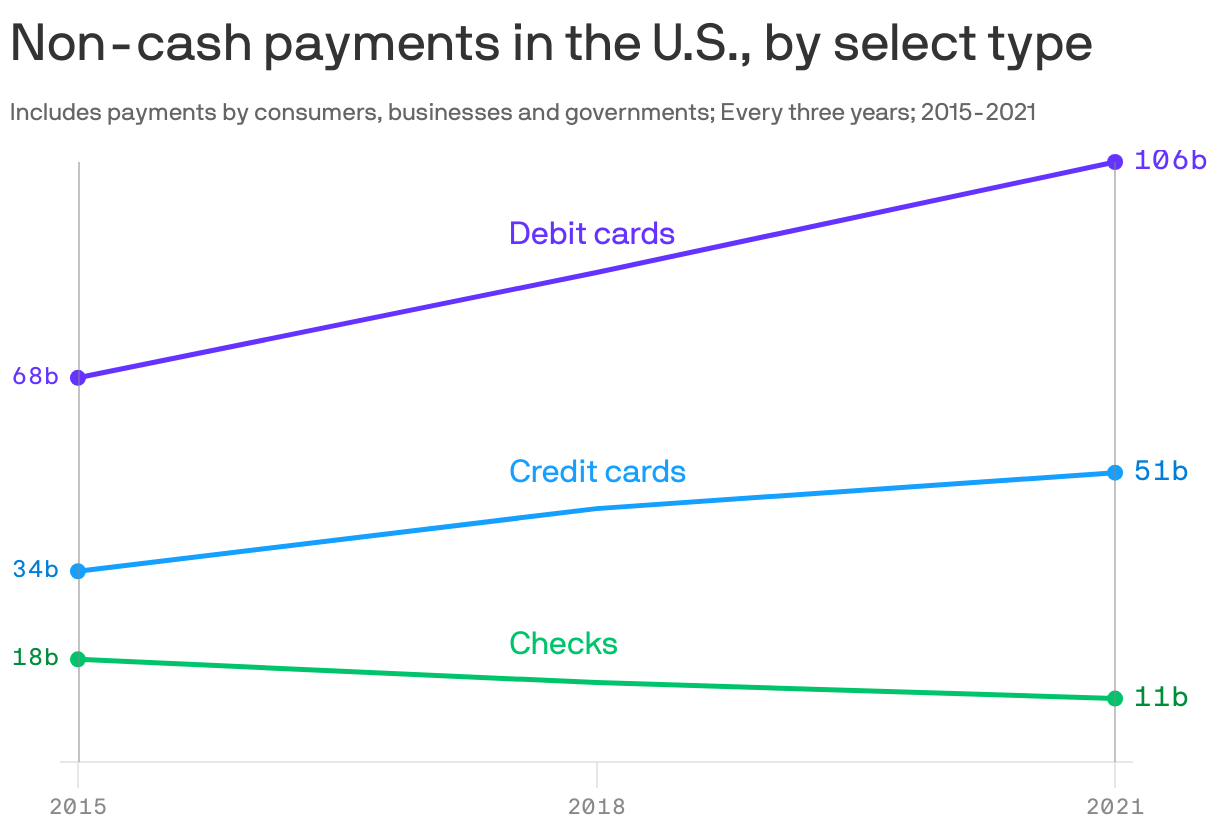
There are roughly 100 billion debit card transactions in the U.S. every year — and one company, Visa, processes more than 60% of them.
Why it matters: Visa charges "supracompetitive prices" for those transactions, per a DOJ complaint filed against the company on Tuesday.
- That means its prices are significantly higher than would be seen in a truly competitive market — and indeed are significantly higher than the prices charged by its existing competitors.
- Nevertheless, for various reasons outlined in the complaint, merchants continue to use Visa to process the majority of their debit-card transactions.
For the record: "This lawsuit is meritless, and we will defend ourselves vigorously," Visa general counsel Julie Rottenberg said in a statement.
By the numbers: The number of debit card transactions in 2021 grew by 20 billion over 2018, per the Fed's triennial payments study. Over the same period, credit card transactions grew by only 6 billion.
How it works: More than 45% of debit card transactions have to use Visa — they're "non-contestable," in the jargon, which means that because either the issuing bank or the merchant's bank doesn't accept the mandated Visa alternative, Visa is the only option.
- Because Visa has a 100% monopoly on those transactions, it can set an exorbitant "rack rate" on them. The only way for merchants to pay a lower price is to agree to route all or nearly all of their debit transactions to Visa.
Follow the money: "Visa charges over $7 billion in network fees on U.S. debit volume annually, earning Visa $5.6 billion in net revenue," says the complaint.
- "In 2022, Visa earned more revenue from its U.S. debit business than from its U.S. credit business, and more from its debit business in the United States than its debit business in any other region in the world."
The bottom line: Debit is a lot bigger than you probably thought it was.
