Why Trump's vow to lower grocery costs will backfire, economists warn

Add Axios as your preferred source to
see more of our stories on Google.
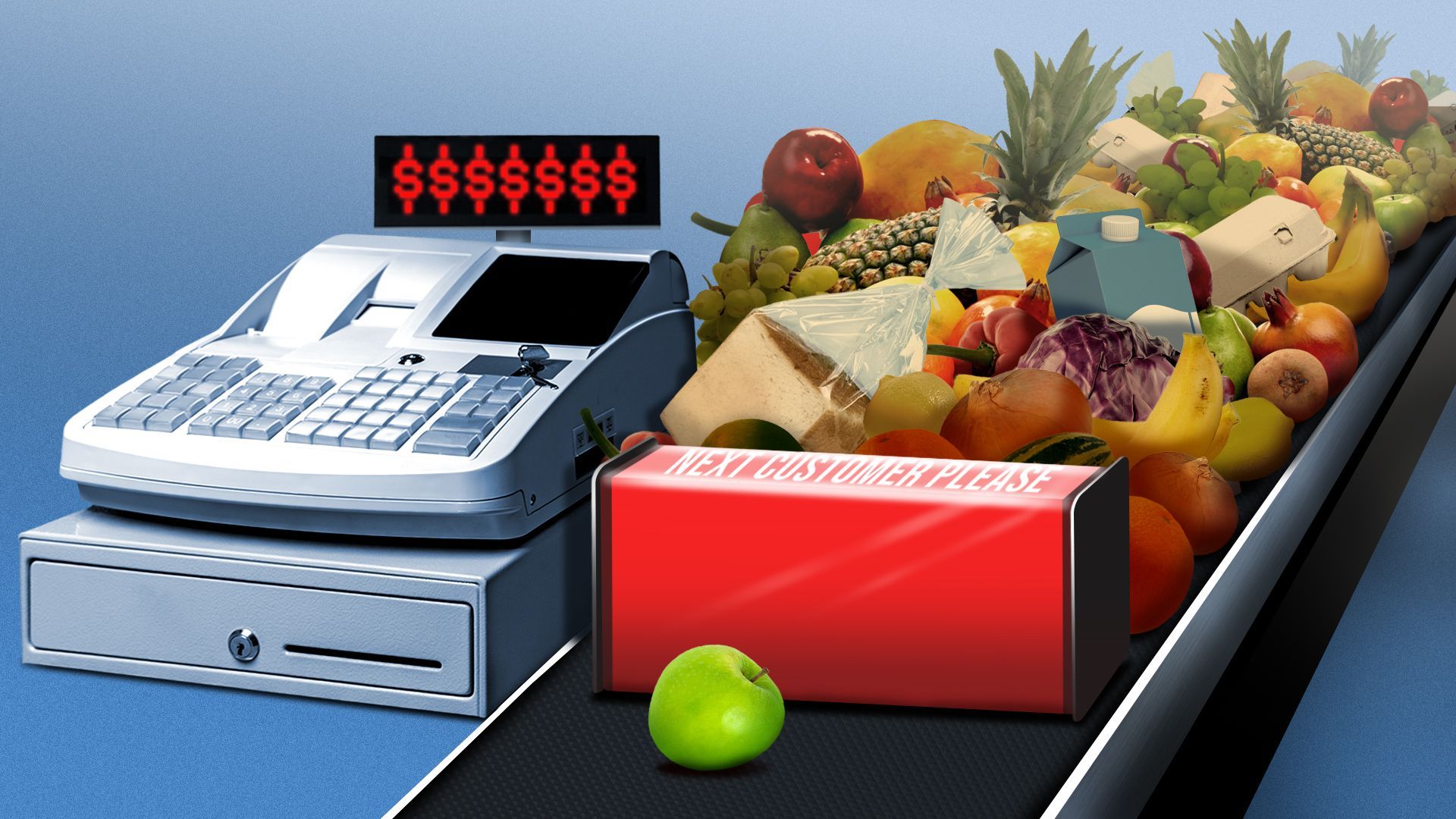
Illustration: Sarah Grillo/Axios
Former President Trump's vow to lower food prices clashes with his love of tariffs and desire to deport migrant workers with economists warning those steps would drive up consumer prices at a time inflation is finally cooling.
Why it matters: Both former President Trump and Vice President Kamala Harris are eager to prove to voters that they have a plan to bring down food prices for voters who are experiencing sticker shock at the supermarket.
Driving the news: At a rally in Michigan Tuesday, an attendee asked Trump what he would do to reduce food costs.
- American farmers, Trump said, are being "absolutely decimated" and that one of the reasons is that the U.S. allows "a lot of farm product into our country." In the future, "we're not going to allow so much," he added.
- The Trump campaign did not respond to Axios' request for comment for details about the plan.
The big picture: The Food and Drug Administration estimates that the U.S. imports roughly 15% of its overall food supply.
- Tariffs were a favorite policy tool of the first Trump administration and play a big part in his plans for a second term — though economists have repeatedly warned that this could reignite inflation.
State of play: Restricting imports via tariffs might decrease some competition but would "almost certainly have the opposite effect" Trump intends and "lead to higher prices," David Ortega, a food economist at Michigan State University, told Axios.
- Food imports work to keep grocery prices low, and using tariffs to decrease food prices "makes no sense," said Joseph Glauber, a senior research fellow at the International Food Policy Research Institute, a think tank devoted to reducing hunger and malnutrition.
- American farmers also export a good deal of what they produce. Introducing import tariffs could cause other countries to retaliate, hurting American farmers, both Ortega and Glauber said.
Context: Any U.S. president "can do very little to affect food prices in the short run," Ortega said.
- The increase in grocery prices over the past few years has been driven by a variety of factors, such as the COVID-19 pandemic disrupting supply chains and labor markets, Ortega said.
- Russia's invasion of Ukraine, climate shocks, and the bird flu have also helped drive commodity prices up, he noted.
Zoom out: The bulk of farm products the U.S. imports are largely "complementary" to the ones it produces, with "very little direct competition," Glauber told Axios.
- This includes "exotic" commodities that aren't produced much in the U.S., like coffee or cocoa, as well as fruits and vegetables that aren't produced year-round domestically, he noted.
- Decades ago, it would have been rare to see fruits like blueberries and bananas available in grocery stores during wintertime. But importing them counter-seasonally keeps them available all year long, Glauber added.
Zoom in: Trump's hope to decrease food prices could also clash with his plans for mass deportations of undocumented immigrants.
- The U.S. food industry relies heavily on migrant labor, including undocumented migrants, for jobs like harvesting and processing crops and meatpacking, Glauber pointed out.
- Replacing migrant workers with Americans or machines could add to the cost of food, he added.
Between the lines: Many consumers are nostalgic for pre-pandemic prices, and while food inflation has dropped to about 1%, that only means that food prices are rising more slowly.
- Slowing inflation is meager comfort for consumers who have watched the average cost of a dozen eggs more than double in the past few years.
- But the spike in grocery prices has been driven less by the cost of the products themselves but rather the costs of processing, packaging and transporting them, Ortega said.
The bottom line: "I don't think we'll get back down to that level that we were seeing" in 2019, Glauber said.
Go deeper:
