The Fed cut rates. What's next for markets?

Add Axios as your preferred source to
see more of our stories on Google.
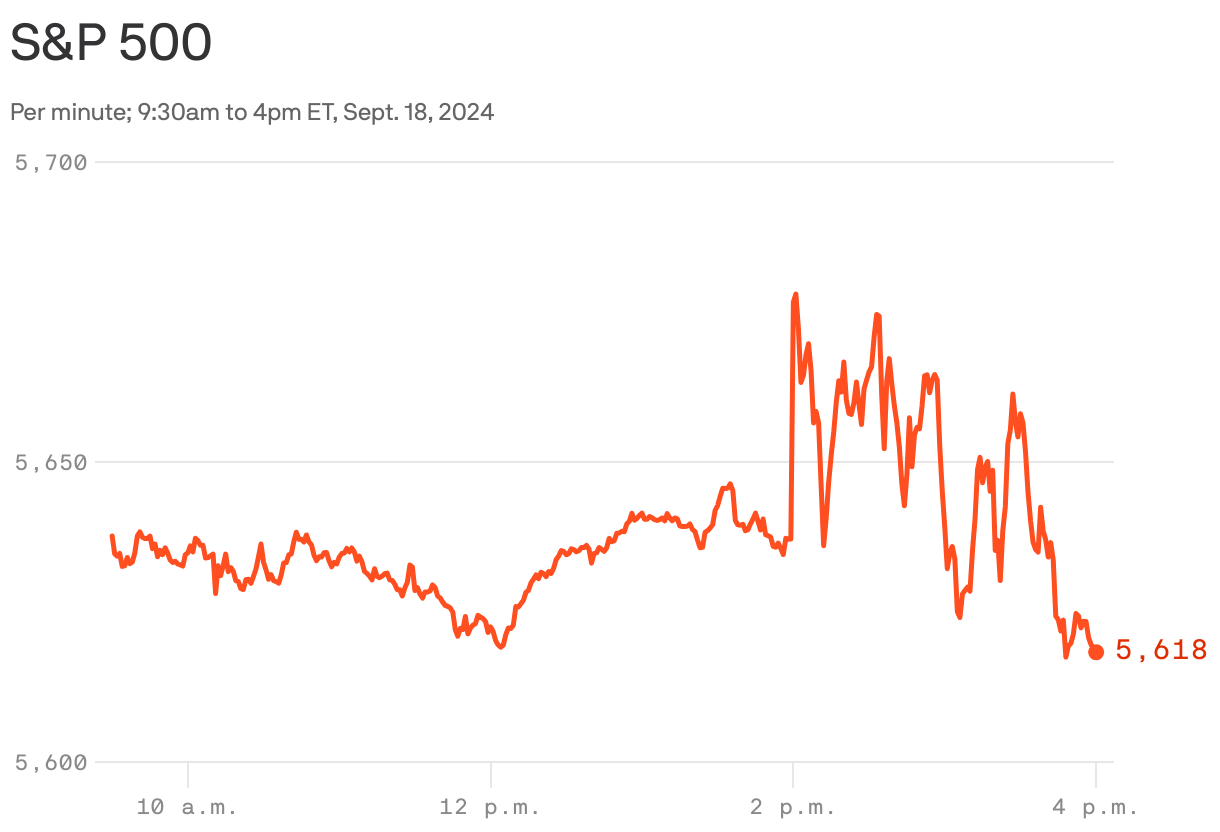
At 2:01 pm Wednesday, right after the announcement that the Fed had cut rates by half a point, the S&P 500 hit an all-time high of 5,678. For the next two hours, it oscillated dramatically, to close modestly lower on the day.
Why it matters: The Fed's decision, complete with a rare official dissent from a board member, turns out to have provided less clarity than some might have hoped.
Between the lines: The size and speed of future rate cuts, and the all-important level at which rates will ultimately settle, remain highly uncertain.
- While the Fed has deliberately and successfully been extremely predictable over much of the past 15 years, chair Jerome Powell is now happy being opaque and unforeseeable.
The big picture: The stock market broadly loves the current stance of monetary policy. Interest rates might still be at high levels but, per the Fed itself, they seem set to come down by another point-and-a-half, to 3.4%, by the end of next year — and even lower than that thereafter.
- Stock prices are an attempt to estimate the present value of future profits — and the lower interest rates go in the future, the lower the discount rate used to value them, and the more those profits are worth today.
- On the other hand, the market doesn't love uncertainty. There's also the risk that if rates come down faster than expected, that'll be because the Fed is reacting to rapidly deteriorating economic conditions, which naturally would hit corporate profits.
Zoom out: There's precious little consensus on where rates should even be today, let alone where they should be headed in the future.
- Politicians like Elizabeth Warren were pushing for a three-quarter-point cut and have said that the central bank has waited far too long to make its first cut.
- Powell said the half-point cut made sense "both from an economic standpoint and also from a risk management standpoint."
- His colleague Michelle Bowman dissented, saying she preferred a quarter-point cut. In a speech last month, she explained that she wants to "avoid undermining continued progress on lowering inflation."
- Former President Trump has said the Fed shouldn't be cutting rates at all before the election.
- And JPMorgan CEO Jamie Dimon said on Tuesday the entire debate is "a minor thing," and it doesn't matter how much the Fed cut this week.
The bottom line: For the time being, markets seem content if not ecstatic with the way the Fed is approaching its mandate. But Powell has ensured they're thoroughly aware of the full range of known unknowns. As a result, volatility is likely here to stay.
