Fed rate cut signals recalibration


Add Axios as your preferred source to
see more of our stories on Google.
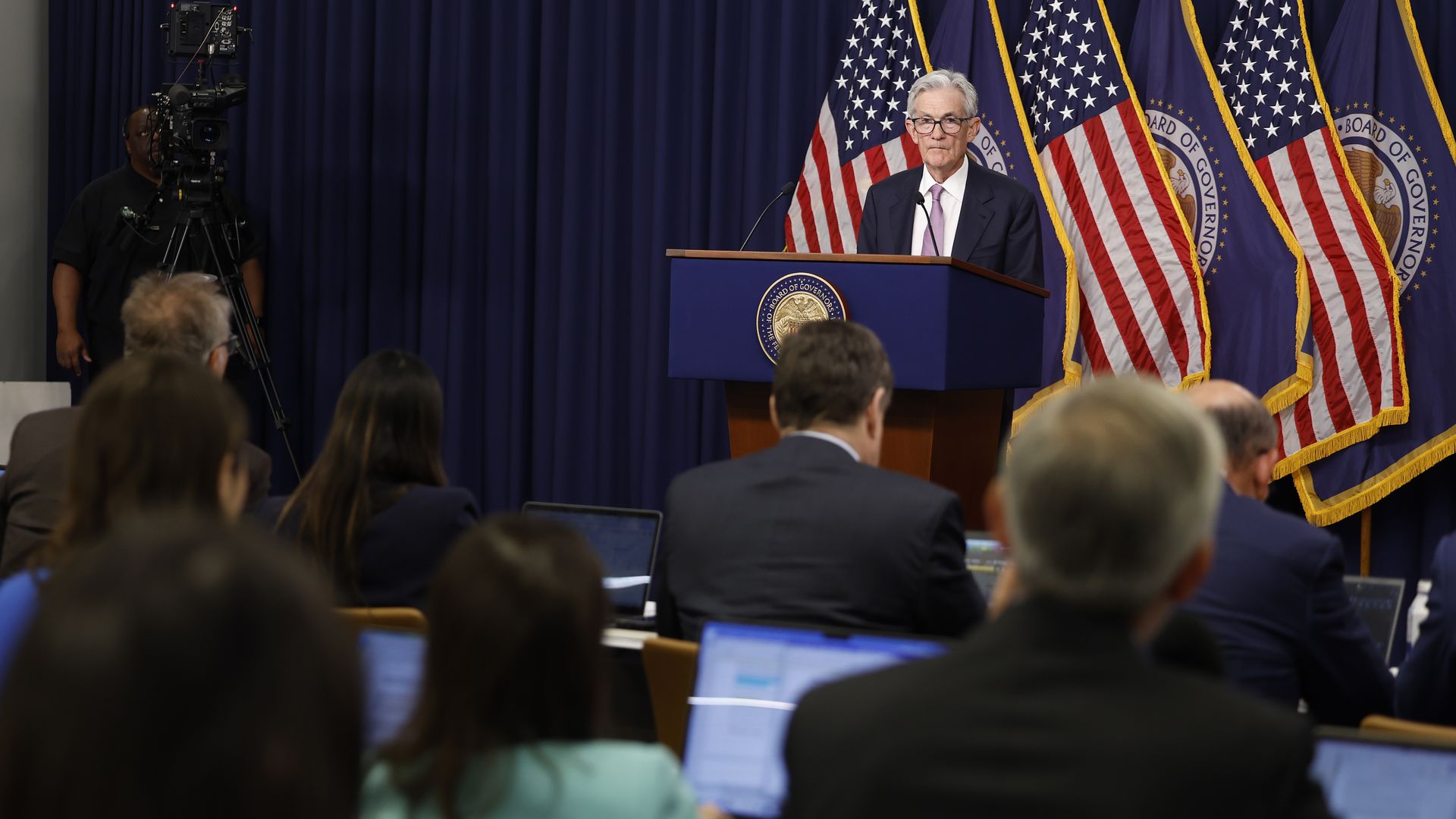
Federal Reserve chair Jerome Powell holds a news conference on Wednesday. Photo: Anna Moneymaker/Getty Images
The Federal Reserve's half-point interest rate cut Wednesday was a monetary policy mulligan, an extra golf swing when the first one didn't go quite the way the swinger intended.
The big picture: Chair Jerome Powell and his colleagues elected not to begin a rate-cutting cycle at their last meeting back in July. Since then, job market data has come in a notch weaker than they expected. Wednesday's move aimed to make up for lost time.
- Both Powell's words and the written projections conveyed that Fed leadership sees the economy as basically sound and very much does not intend to cut rates by half a percent at every meeting.
- Rather, if the economy evolves as the central bank's leadership expects, the unemployment rate will level off only a bit higher than it is now — and we'll see quarter-point rate adjustments at the two remaining policy meetings this year, then four more quarter-point cuts in 2025.
Between the lines: Powell used some form of the word "recalibration" 10 times during his 49-minute news conference Wednesday, one of many signs that Fed leadership is not viewing its extra-large cut as emergency response to incipient recession.
- Rather, the central bank is trying to adjust the dials to set monetary policy appropriately for an economic moment with inflation no longer at crisis levels.
What they're saying: "The U.S. economy is in good shape," Powell said in his news conference. "It's growing at a solid pace. Inflation is coming down. The labor market is in a strong place. We want to keep it there. That's what we're doing."
- He later acknowledged that they "might well have cut" two months ago if Fed officials had received a weak July jobs report before that month's policy meeting (the numbers came out two days later).
State of play: The unemployment rate is still low at 4.2%, but that is up from 3.7% at the start of the year, and the pace at which businesses are adding jobs has slowed substantially.
- The question now is whether Fed rate cuts will do the trick in stopping that deterioration from going much further. In projections released Wednesday, Fed officials saw unemployment moving up slightly to 4.4% in the fourth quarter of this year — and still at that level at the end of 2025.
Reality check: Just because Powell and his colleagues don't expect to find themselves in emergency rate-cut mode doesn't mean it can't happen.
- In January 2001, the Fed started a rate-cutting cycle with a half-point move. In the closed-door meeting, chair Alan Greenspan said that spokespeople "can convey that we're not all of a sudden signaling the prospect of a massive collapse in the federal funds rate."
- In fact, the Fed would cut rates 10 more times that year, bringing its target rate down from 6% to 1.75%.
