Lawsuits threaten infant formula for preemies

Add Axios as your preferred source to
see more of our stories on Google.
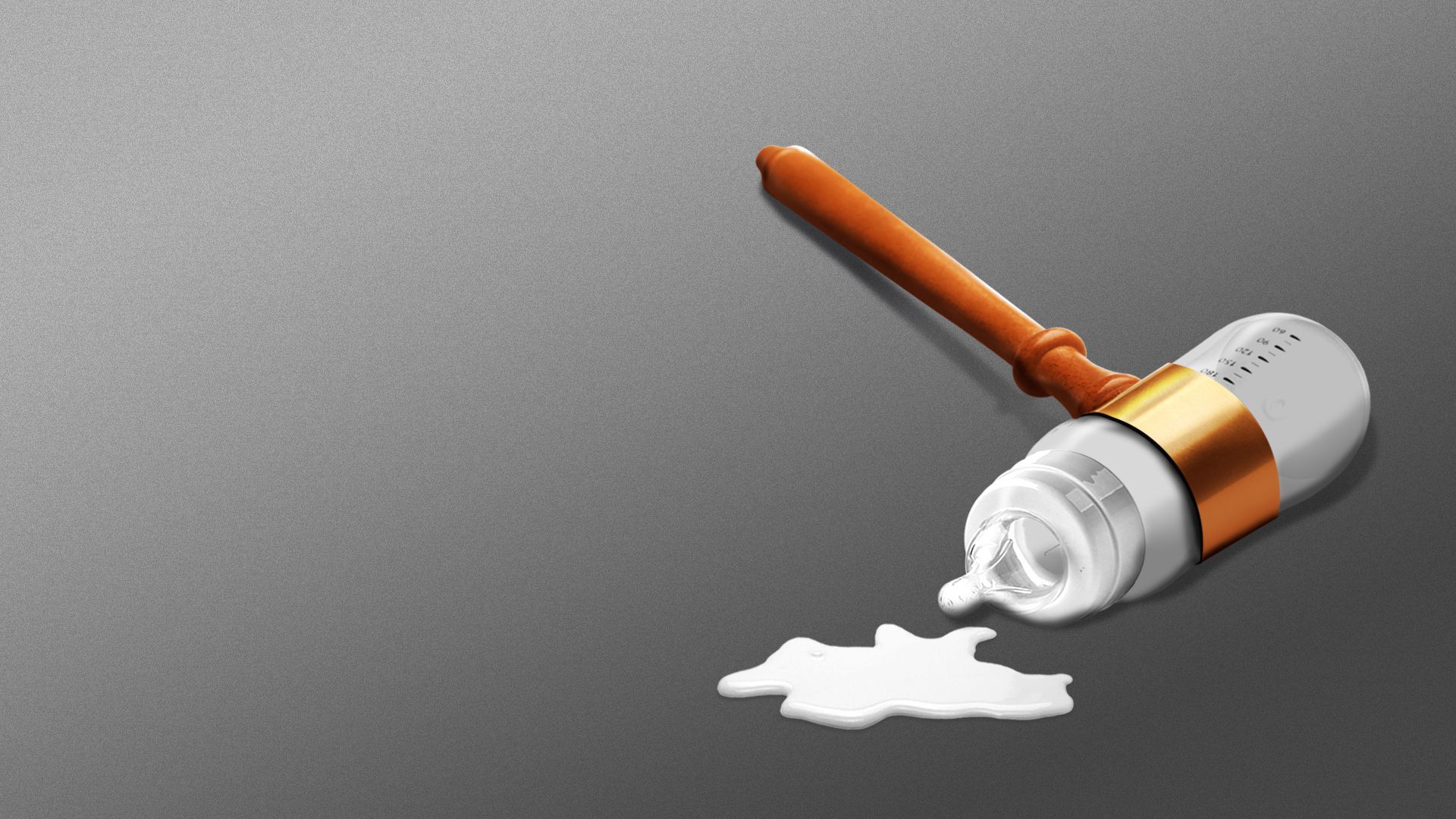
Illustration: Sarah Grillo/Axios
The fragility of the infant formula market is being tested again — this time by legal fights over safety labeling.
The big picture: Two and a half years after supply chain issues and a recall led to a nationwide formula shortage, the only two manufacturers of premature infant formula are threatening to exit amid a flurry of lawsuits from families whose infants got sick or died after taking one of these formulas.
Zoom in: At issue is a bowel disease called necrotizing enterocolitis that mostly affects premature babies. Abbott, which makes Similac, and Reckitt Benckiser, which makes Enfamil, are facing hundreds of lawsuits alleging they failed to warn parents about the risks on product labels.
- A Missouri state court in July ordered Abbott to pay $495 million in damages in the first jury trial over the claims, sending both companies' stocks plummeting. Abbott has denied the allegations and intends to appeal. A second trial is set to begin in St. Louis later this month.
- Reckitt Benckiser — owner of Mead Johnson, which was hit with its own $6o million judgment in the spring — has said it's considering its options. That includes a potential sale of its formula business, Bloomberg reported this week.
- Meanwhile, Abbott CEO Robert Ford told Axios "the industry is at risk."
- "While we do not want to be in a position to have to take these specialized formulas off the market, it's not sustainable to face the threat of unending litigation," Ford wrote in an email.
The American Academy of Pediatrics has warned that the litigation could jeopardize the availability of the formulas, adding necrotizing enterocolitis has multiple causes and that practitioners don't exactly know how to prevent it.
Between the lines: Some expect the companies to turn to Congress for help indemnifying them against the claims.
- "Based on the current legal climate, it is extremely unlikely for this to occur without some sort of government indemnification program," a recent perspective piece in the American Journal of Clinical Nutrition opined, raising alarms about what would happen if cow milk-based preterm infant nutritional products were no longer available.
- The Food and Drug Administration could also "publicly vouch for the veracity of the labeling and safety of the products," Peter J. Pitts, a former FDA associate commissioner, wrote in the Washington Times.
Beyond that, the situation illustrates the precarious nature of the U.S. infant formula market, where four companies — Abbott, Reckitt Benckiser, Nestlé and Perrigo — control the lion's share.
- Studies have shown premature babies should have human breast milk incorporated into their diet to reduce their chance of developing NEC.
- Formula makers acknowledge that mother's milk is optimal but that specialized formula is often the only practical alternative for feeding premature infants.
The specialized formula generates about $9 million in annual revenue for Abbott, Ford said on a recent earnings call.
- It's drop in the bucket for a company that generated $10.4 billion in revenue in the second quarter alone.
- But Abbott still is facing litigation stemming from the closure of a Michigan plant and the recall of contaminated formula that helped trigger the 2022 shortages.
- "It doesn't take much to figure out that no company could do that forever," said Steven Abrams, professor of pediatrics at the University of Texas at Austin and one of the co-authors of the piece in the American Journal of Clinical Nutrition.
- "Given their limited availability, similar products based only on human milk are unlikely to meet the needs of most preterm infants requiring such products," per the paper. "Policy makers cannot assume [these products] will not be critically needed and should identify strategies for their continued marketplace availability."
The other side: "They're saying they're going to take their ball and go home Give me a break," said Jack Garvey, the attorney in that case in which a parent was awarded $495 million.
- "The fight has always been about control of the NICU," Garvey said. "We have emails from their sales people: 'Control the NICU, control the market.'"
- Garvey said Abbott could change its warning label or could reformulate its formula to be safer, if it really wanted to, but won't because it would lose money.
- Abbott disputes those statements, saying the risks of the product are properly disclosed and the products are "safe."
An Abbott spokesperson said the company "has appealed to regulators and government in an attempt to find a policy solution to keep these formulas and fortifiers on market for premature infants and their families."
- An FDA spokesperson declined to comment on possible or ongoing litigation. "The FDA takes its responsibility seriously to ensure the safety and proper labeling of infant formula and recognizes that these products are nutritionally necessary for feeding preterm infants who lack access to or require more than human milk as their sole source of nutrition," they said in an email.
