U.S. health system earns poor grades for efficiency

Add Axios as your preferred source to
see more of our stories on Google.
Screenshot: The Commonwealth Fund
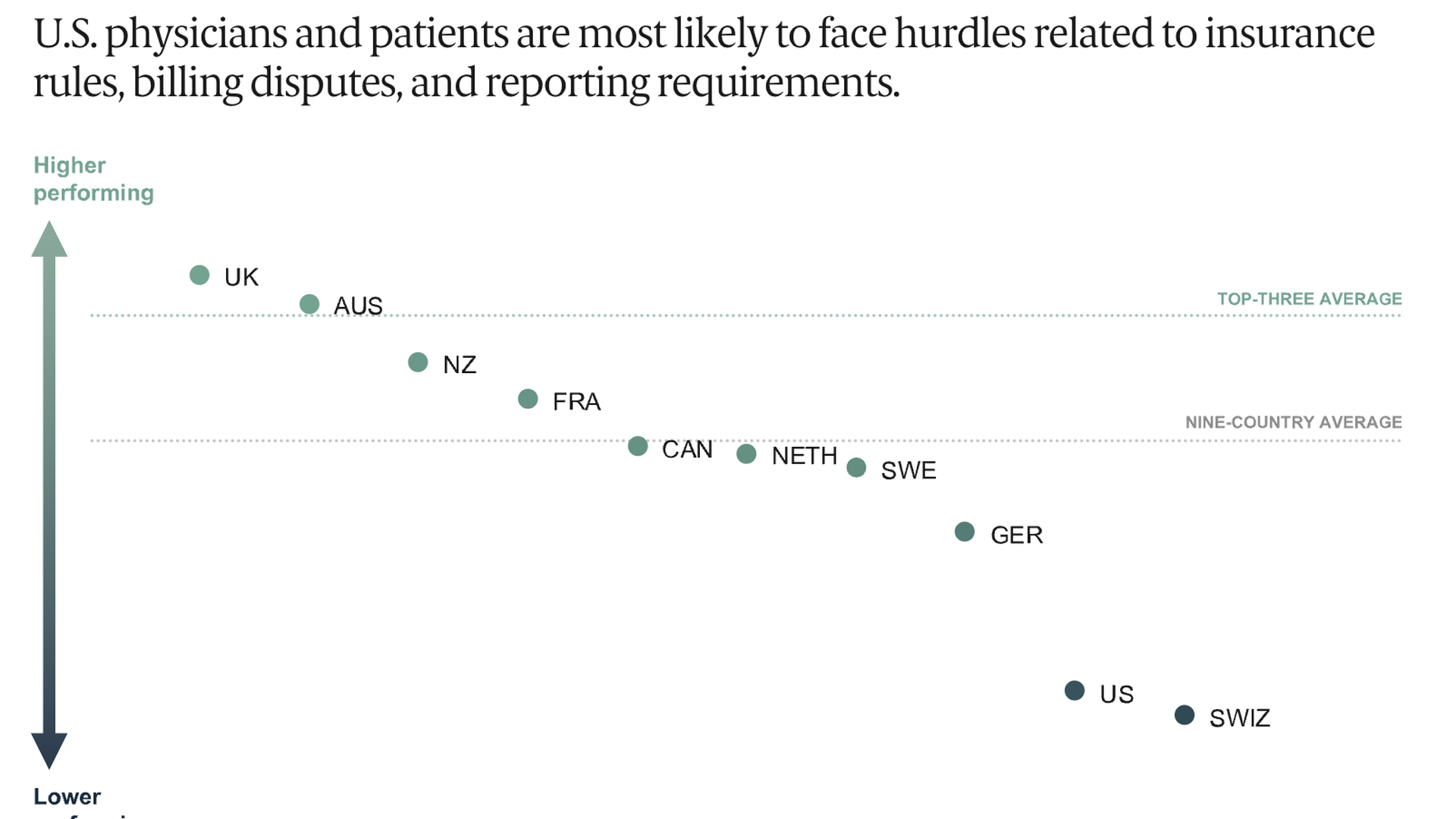
The United States has one of the most inefficient health care systems among high-income countries, according to a new report from the Commonwealth Fund.
Why it matters: Administrative hurdles like requirements that insurers sign off on care before it's delivered cause frustrations and care delays for U.S. patients in a health care system that produces worse health outcomes than its peer countries.
The big picture: The U.S. ranked lowest on health outcomes out of the ten countries surveyed.
- "Our complex health system leaves even those with insurance struggling to navigate it," said Reginald Williams, vice president of international health policy and practice innovations at the Commonwealth Fund.
- "It's bad for both patients and doctors. Administrative requirements can cost time and money," Williams said in a press briefing.
Where it stands: The U.S. ranked ninth out of 10 countries on health care efficiency.
- The United Kingdom, Australia and New Zealand ranked as the top three most efficient health systems in the survey. All three countries have some form of nationalized health care.
- The Commonwealth Fund based the rankings on different international surveys of doctors and patients it conducted across 2021, 2022 and 2023.
Zoom in: The U.K.'s National Health Service eliminates the need for physicians to send a bill for each service rendered. The government-run health program instead pays physicians monthly based on electronic health records data, the Commonwealth report said.
- Australia's efficiency is tied to electronic claims processing systems that facilitate instant reimbursement from both private and public payers.
- In the U.S., every insurer has its own requirements and coverage processes, and providers must report troves of data to the federal government.
Yes, but: The U.S. ranked second in a measure of preventive care, patient engagement, safety in health care, and care coordination.
What we're watching: Recent federal requirements to streamline care have been hailed by health providers as a good first step toward tackling the problems created by prior authorization and other health system inefficiencies.
- Congressional lawmakers have said tackling prior authorization is on their policy agenda for next year.
- But, "it would be so much better if the industries solve it amongst themselves," Rep. Brett Guthrie (R-Ky.) said at a Medicare Advantage policy forum this week.
- Insurers, who have pushed for increased adoption of electronic prior authorization, say their pre-coverage checks prevent inappropriate care.
