Feds testing first respirators for wildland firefighters

Add Axios as your preferred source to
see more of our stories on Google.
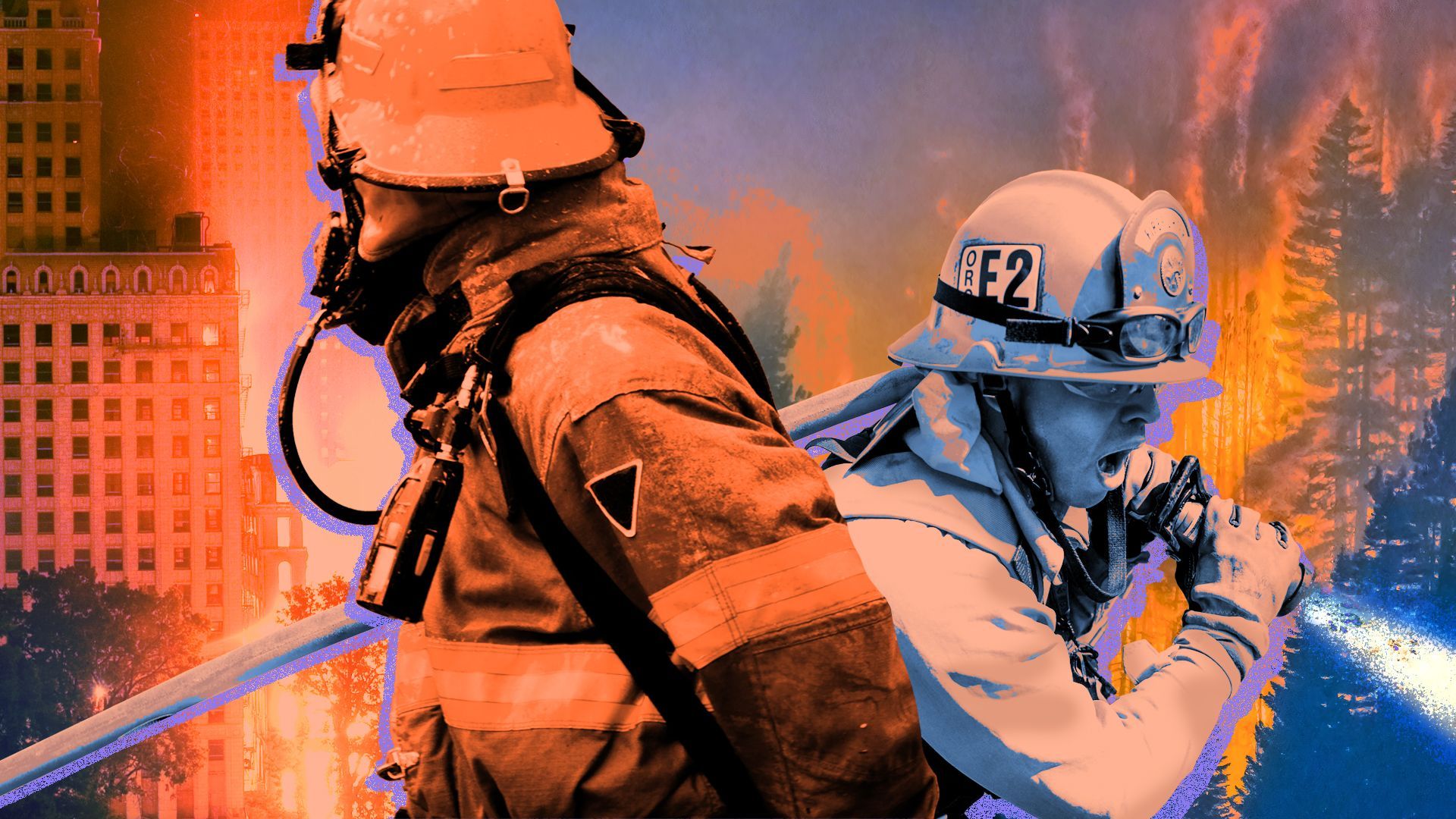
Photo illustration: Sarah Grillo/Axios. Photo: Kevin Sullivan/Digital First Media/Orange County Register via Getty Images
The U.S. Department of Homeland Security is testing what it says is the first respirator developed specifically for battling wildfires.
Why it matters: The device would at last shield wildland firefighters from toxic smoke that most inhale without proper protection, especially as the wildfire season is made even longer by climate change.
The big picture: City or "structure" firefighters commonly exchange a depleted air tank every 15-20 minutes as they rotate through a burning building. Big departments can assign an entire truck to haul racks of 30-pound tanks to a blaze.
Yes, but: The tens of thousands of wildland firefighters who battle U.S. wildfires every summer have no such option.
- "No respirators have been certified and none have been submitted for certification," the U.S. Forest Service, the largest federal wildland fire agency with over 11,000 firefighters, tells Axios.
Driving the news: The Department of Homeland Security's Science and Technology Directorate is midway through a five-year, $1.7 million effort to develop a respirator that's up to the outdoor task.
Context: Wildland crews deploy for days or weeks to remote forests and mountains, where they work to contain fires by digging trenches, felling trees and setting burns.
- The deployments are too far and too long to haul air, and the tasks too strenuous for a basic mask. The common alternative, wildland firefighters and researchers tell Axios, is a damp bandana.
State of play: DHS and contractor TDA Research are working to commercialize a hip-mounted, battery-powered respirator as soon as next year, an agency spokesperson tells Axios. Other efforts are also underway:
- The nonprofit Wildfire Conservancy is testing a similar set of respirators with North Carolina State University, an effort funded by about $2 million in state and federal grants. California regulators are also evaluating devices and drafting rules that would apply to them.
Reality check: Respirators can't deliver the same protection as a structure firefighter's full face mask and air tank, known as a self-contained breathing apparatus or SCBA.
- "If we can get 10%, 20%, 50% protection, that's way better than what we have now, which is zero," says George Broyles, who worked in wildland fire management for the U.S. Forest Service and is now involved in the Wildfire Conservancy respirator project.
Stunning stat: The World Health Organization in 2022 declared that simply working as a firefighter is inherently carcinogenic — not only from exposure to burning toxins but to protective gear treated with chemicals such as PFAS.
- The risks are especially acute for wildland firefighters, who have up to 43% greater risk of dying from lung cancer and 30% of dying from cardiovascular disease, per a 2019 study.
"Anyone who's been in the firefighting business for a while, and especially wildland, you've got impacts to your lungs," says retired structure and wildland firefighter Bobbie Scopa, who midway through her 45-year career was diagnosed with asthma, sinusitis and lung spotting.
- *I can't attribute all that to wildland," said Scopa, who worked at the World Trade Center site after Sept. 11. "But there are lots of us who weren't at The Pile for a month who have the same problems I have."
Between the lines: Droughts and heat fueled by climate change are making wildfire seasons longer and more intense.
- And as towns push further into forests, it's not just trees and leaves igniting, but couches, paint, insulation and other toxins.
